

Business and human rights
National Dialogue’s three key recommendations to foster responsible business practices for decent work in Indonesia’s electronics industry
Government officials, representatives of employers' and workers' organizations and enterprises formulated recommendations for a sustainable and competitive electronics sector in Indonesia.
9 December 2024
JAKARTA, Indonesia (ILO News)- Embedding responsible business conduct (RBC) into the upcoming sectoral skills council and setting up a sectoral tripartite committee and national focal points to promote the ILO’s MNE Declaration and the application of its principles were among the key recommendations made at the National Dialogue on Responsible and Sustainable Electronics Supply Chains organized in Jakarta with the support of the ILO.
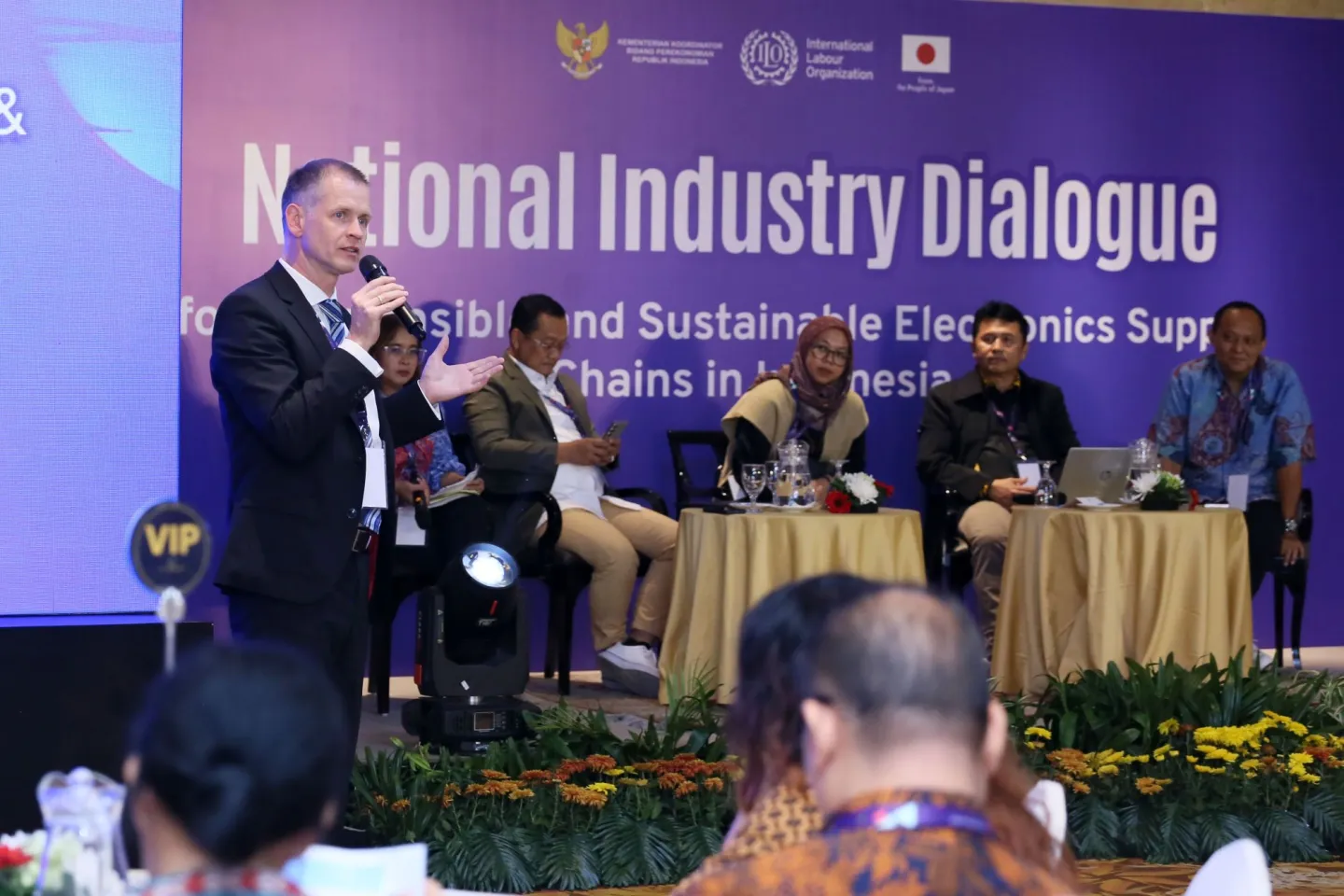
The recommendations emerged after two-days of discussion and consultations among tripartite constituents and industry representatives from across the electronics sector. Against the backdrop of growing sustainability concerns in Indonesia and in exporting countries, stakeholders proposed the creation of a tripartite working group to promote responsible business conduct and ensure that the appropriate enabling legal and policy framework is in place.
Using the ILO MNE Declaration as a reference framework, the new working group will be tasked to review existing legislations, make recommendations, and develop a new industry roadmap to enhance sustainable and responsible business practices for decent work in the sector.
In collaboration with the ILO, we have been actively raising the awareness about human rights principles at the enterprise level. This includes a new webinar series with ILO that looks at issues of workers’ rights, equality, and tackling exploitation in supply chains.
Shinta W. Kamdani, Chair of the Indonesian Employers’ Association (Apindo)
By supporting improvements to business practices, enhancing skills development, advancing the application of labour standards, and promoting human rights due diligence (HRDD) in the strategically important electronics industry, it is hoped the recommendations will support Indonesia in charting a path toward more inclusive growth and sustainable development, in line with the government’s Making Indonesia 4.0. Policy.
Held between 28 to 29 November and co-hosted by the Coordinating Ministry for Economic Affairs, the National Industry Dialogue brought together more than 60 policymakers, leading electronics companies, workers’ and employers’ organizations, and national and international experts to identify priorities and collaborative opportunities to build new forms of competitiveness and sustainability in the sector by promoting RBC for decent work, including by enhancing entreprises’ engagement and partnerships on skills development.
Representing the employers, Shinta W. Kamdani, Chair of the Indonesian Employers’ Association (Apindo), emphasized Apindo’s commitment to support RBC, particularly in the electronics industry. “In collaboration with the ILO, we have been actively raising the awareness about human rights principles at the enterprise level. This includes a new webinar series with ILO that looks at issues of workers’ rights, equality, and tackling exploitation in supply chains,” she stated.
This is not only a challenge for government or the employers, but workers too must play a role in ensuring responsible businesses and decent work.
Elly Rosita Silaban, President of President of the Confederation of All Trade Union (KSBSI)
Similarly, Elly Rosita Silaban, President of President of the Confederation of All Trade Union (KSBSI) added that “the Indonesian trade unions appreciate this joint effort to anticipate future challenges and ensure that this sector continues to protect workers’ rights. This is not only a challenge for government or the employers, but workers too must play a role in ensuring responsible businesses and decent work".
Companies highlighted the shared advantages of contributing to a sustainable and responsible electronics sector. Ridarma Sinaga, General Manager of Rubycon Indonesia, a manufacturer of capacitors from Batam, noted that "RBC is vital in creating conducive and harmonious working conditions that benefit not only investors and employers, but also workers and surrounding communities."
Wanda Abubakar, Senior Director of Human Resources at semi-conductor manufacturer Infineon Technologies, highlighted the importance of social dialogue and underlined the
need for collaborative efforts between employers and all relevant stakeholders, including trade unions and suppliers to put in place the right ecosystem to support responsible business conduct.

The Dialogue comes as Indonesia is preparing to review and update its landmark National Strategy on Business and Human Rights (under Presidential Regulation No. 60/2023), which was launched in 2023. Dewi Yuliana, Policy Analyst at the Ministry of Human Rights, said the recommendations would play a crucial role in supporting the government’s efforts in this area. “The government has established Task Forces nationwide to support the implementation of its National Strategy. We hope to keep collaborating with the ILO and utilize these recommendations to strengthen the implementation of RBC,” she remarked.
The National Dialogue is supported by two ILO projects: the Resilient, Inclusive and Sustainable Supply Chains, or RISSC Project, and the Skills Development and Responsible Business Conduct for Transition project, or METI-Skills, project. Funded by the Japanese Ministry of Health, Labour and Welfare (MHLW), the RISSC Project aims to build more resilient, inclusive, and sustainable supply chains by addressing decent work deficits and advancing responsible business conduct at the enterprise, industry and national policy levels.
The METI Skills project, meanwhile, supports supply chain resilience and sustainability by cultivating workforce skills development, in preparation for the shift in industrial structure towards a sustainable economy.
"Through clear policy commitments and robust tripartite dialogue, Indonesia has a unique opportunity to lead the region in Business and Human Rights," added David Williams, Manager of the ILO RISSC Project. "By working with the ILO in strategic sectors like electronics, we can build the tools and supportive ecosystem for this, proving that social responsibility and industry competitiveness can go hand-in-hand.’’
Related content
Press release
National dialogue develops a pathway to strengthen responsible business in Indonesia’s electronics industry

Event
National Industry Dialogue for responsible and sustainable electronics supply chains in Indonesia
Tripartism and social dialogue
Resilient, Inclusive and Sustainable Supply Chains Asia (RISSC) in Indonesia
Relevant projects

Tripartism and social dialogue
Resilient, Inclusive and Sustainable Supply Chains (RISSC) in the Philippines
ILO-Japan Partnership
Automotive Supply Chain Programme in Thailand

Tripartism and social dialogue
Resilient, Inclusive and Sustainable Supply Chains Asia (RISSC) in Thailand

Tripartism and social dialogue
Resilient, Inclusive and Sustainable Supply Chains Asia (RISSC)