

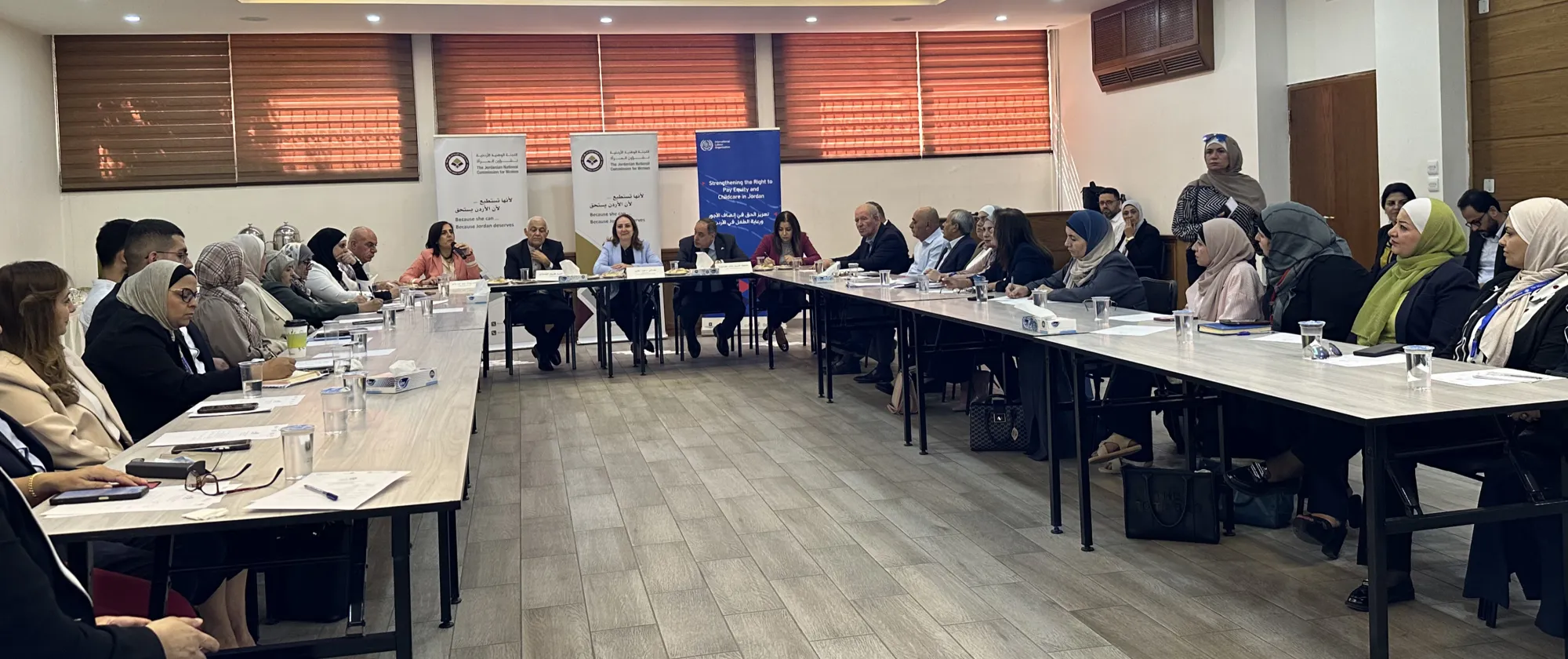
National campaign set to advance pay equality in Jordan’s world of work
On International Equal Pay Day, national and international partners join forces to promote fair pay and equal opportunities in Jordan’s labour market through policies, legislation and digital tools.
17 September 2025
AMMAN (ILO News) –The International Labour Organization (ILO), in cooperation with the Jordanian National Commission for Women (JNCW) and under the umbrella of the National Committee for Pay Equity (NCPE), is launching a national campaign to highlight joint national and international efforts to close the gender pay gap and to advance the principle of justice and fairness in the workplace.
The campaign, launched on International Equal Pay Day, highlights key concepts relating to pay equity, and the main challenges that continue to face women in Jordan’s labour market, including pay gaps and unequal opportunities. It calls upon employers and workers alike to take responsibility in closing this gap by adopting fair policies that guarantee equality and equal opportunities.
Despite progress achieved nationally in recent years through legislative and institutional reforms, gender-based pay gaps persist. This calls for intensified efforts to ensure equal pay for work of equal value, in line with national laws and legislation, international labour standards, and the 2030 Agenda for Sustainable Development.
Amal Mowafy, ILO Country Coordinator in Jordan, emphasized the importance of the day, stating: “On International Equal Pay Day, we highlight the critical importance of evaluating jobs in an objective and gender-neutral manner to achieve equal pay between women and men. Such evaluations are based on clear and sufficient factors, including qualifications, responsibilities, required effort, and working conditions. In this way, wages are determined fairly, helping to close the gender pay gap. ILO reports show that addressing pay inequality is an effective step toward reducing poverty and promoting social justice. The Global Wage Report 2024–2025 indicates that wage gaps remain despite progress, while another ILO study reveals that reducing gender participation gaps by 25% by 2025 could increase global GDP by 3.9% clearly illustrating the positive economic and social impacts of pay equality”.
The establishment of the NCPE in 2011, co-chaired by the Ministry of Labour and the JNCW with the support of the ILO, underscores that fostering a fair and equitable work environment requires genuine partnership among government, employers, workers, and civil society organizations.
In this context, Maha Ali, Secretary-General of the Jordanian National Commission for Women, stated:“Jordan ranked 122nd out of 148 countries in the 2025 Global Gender Gap Index, achieving an improvement of one position compared to the previous year. At the regional level, Jordan came fourth among 14 participating countries, while it ranked 25th in the Equal Pay for Work of Equal Value Index. These results reflect the importance of national efforts in policies and legislation aimed at promoting the rights of workers and ensuring equal opportunities. We look forward to the continued efforts of the National Commission for Pay Equity toward a fairer and more inclusive work environment”.
On the occasion, Reem Aslan, the ILO Decent Work for Women Programme Manager, stressed: “International Equal Pay Day reminds us that the time has come to close the gender pay gap and make pay equity a reality. Despite continuous efforts, pay disparities between men and women persist. Work of equal value deserves equal pay for everyone, everywhere, without exception. This right is preserved in international labour standards and many national legislations, but its implementation still requires greater effort and sustained use of available tools to ensure that both women and men receive fair pay”.
Among these tools is the Unified Electronic Contract Platform, launched in 2024 with ILO support for workers in private schools and kindergartens. This reform was a major step toward wage protection and transparency in the private education sector, where women make up the majority of the workforce.
In a statement, the General Union of Workers in Private Education highlighted: “Driven by our commitment to the rights of education workers and the importance of providing them with a fair working environment in private schools and kindergartens, one that safeguards dignity and ensures job stability, the union has worked to conclude a Collective Bargaining Agreement (CBA). This CBA included the formulation and adoption of the Unified Electronic Contract, launched as a pioneering reform in regulating contractual relations between workers and private school/kindergarten owners. The platform introduced a transformative approach to documenting and processing contracts, ensuring speed, accuracy, and security within a more transparent and organized workplace”.
Abdul Hamid Dugan, Secretary General of the Ministry of Labour, said about the platform: “In line with Royal directives and the Economic Modernization Vision, and reaffirming our commitment to social protection and safeguarding rights, the Ministry together with all partners, initiated the launch of the Unified Contract Platform for private school and kindergarten workers. This milestone reflects a national partnership built on justice and fairness in pay”.
The campaign also coincides with preparations for the 20th meeting of the NCPE, which will be held under the patronage of HRH Princess Basma bint Talal, President of the JNCW since 1992. The meeting marks the 15th anniversary of the Committee’s establishment and will bring together all members from various institutions to review achievements and agree on a work plan for 2026.
This day represents an opportunity to renew Jordan’s national commitment to closing the gender pay gap and enhancing women’s economic participation, contributing positively to Jordan’s economic and social development, while moving closer to achieving full pay equality between women and men.
The campaign is organized within the framework of the Equality@Work Project, implemented by the ILO’s Decent Work for Women Programme in Jordan in partnership with the Government of Norway.
Relevant projects

Project
Equality@Work : Advancing Healthy, Safe and Diverse Labour Force in Jordan