

Labour migration and disability inclusion
Migration and disability rights groups unite to tackle barriers in labour migration
ILO’s TRIANGLE in ASEAN programme organizes groundbreaking gender equality and disability inclusion trainings in five Asian countries, empowering stakeholders to address the challenges faced by persons with disabilities in labour migration.
21 October 2024
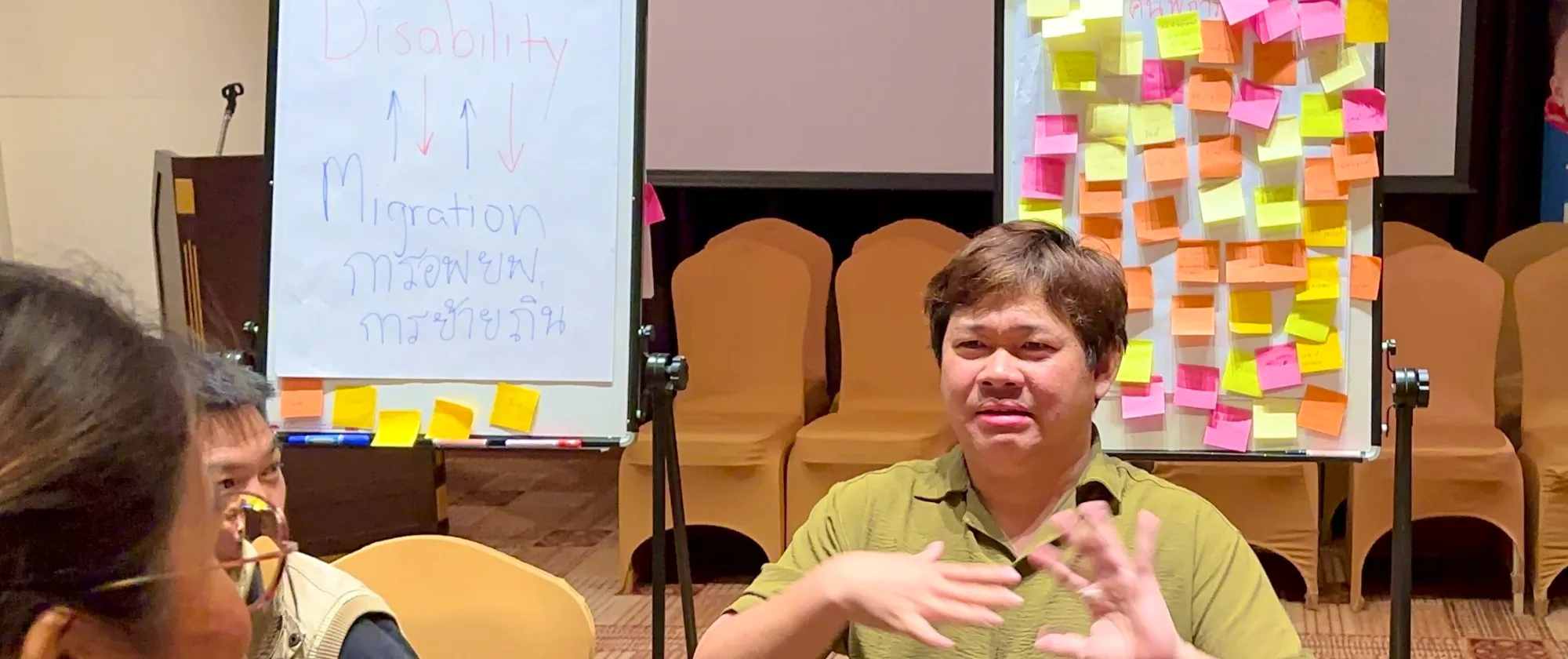
BANGKOK (ILO News) - Migration and disability rights groups in five Asian countries have come together for the first time to address the unique challenges faced by persons with disabilities in labour migration.
A series of successful gender equality and disability inclusion trainings took place from March to September 2024 in Cambodia, Lao People’s Democratic Republic, Myanmar, Thailand, and Viet Nam. They were organized by ILO’s TRIANGLE in ASEAN programme, supported by the governments of Australia and Canada.
Currently, migrant women, migrants with diverse sexual orientation and gender identities, and migrants with disabilities face significant barriers, limiting their access to regular migration pathways. This often forces them into informal sectors with little to no labour protections. Additionally, these groups are less likely to have a voice in decision-making processes regarding labour migration governance.
|
“The sessions brought together migration and disability rights groups for the first time. They learned about each other’s issues and importantly about terminology and ways they can help each other. Persons with disabilities face discrimination by migrant recruitment agencies, employers in destination countries, and sometimes by migration policies in the region. Building coalitions of solidarity will help break down this discrimination,” said Rebecca Napier-Moore, Technical Officer for the ILO TRIANGLE in ASEAN programme.
Participants highlighted the practical nature of the sessions.
“The training is so useful, practical, and relevant to our work. It helps us realise the challenges faced by people with disabilities in searching for jobs abroad. After training, we know better how to provide counselling for people with disabilities on labour migration and support them,” said Nguyen Xuan Thai, Head of the Employment Unit at Ha Tinh Department of Labour, Invalids, and Social Affairs.
Trainees gained insight into the huge diversity amongst the migrant worker population and their various needs.
"The training opened our eyes to the diverse experiences of individuals with different gender identities and disabilities within our society. It enhanced our capacity to include these individuals in our daily work, aligning with the UN's principle of 'leaving no one behind',” said Thet Thet Aung from the Bago Migrant Worker Resource Centre in Myanmar.
The workshops also provided a vital platform for migration and disability rights groups to learn from each other and forge relationships as Khun Vanet from the Children and Women Forum for Persons with Disabilities from Cambodia explains.
“I have now connected with other training participants, facilitator, and staff from Ministry of Labour and Vocational Training, the International Labour Organization and other institutions in which I can seek for support and advice after the training,” she said.
Going forward, participants expressed their commitment to put what they had learned into practice.
"We need to change our mindset to ensure everyone is equal. I'm from the ECOT and I want to help push forward policies for disability inclusion," explained Suree Monta from the Employers’ Confederation of Thailand.
The TRIANGLE in ASEAN programme works at both the ASEAN and national levels to maximize the positive contribution of labour migration to equitable and inclusive growth across the region. This series of trainings aligns with TRIANGLE’s broader commitment to reducing gender inequalities and ensuring people with diverse sexual orientations, gender identities, and disabilities can fully benefit from migration.
“Looking forward, these capacity-building workshops are just the beginning of further efforts to integrate gender equality and disability inclusion into migration policies and practices across the region,” said Rebecca Napier-Moore.
Related content

Migrant workers
TRIANGLE in ASEAN

Migrant workers
Migrant Advocacy for Rights
Relevant projects
Migrant workers
Migrant Advocacy for Rights