

Investments in reskilling needed to support workers and tackle skills shortages
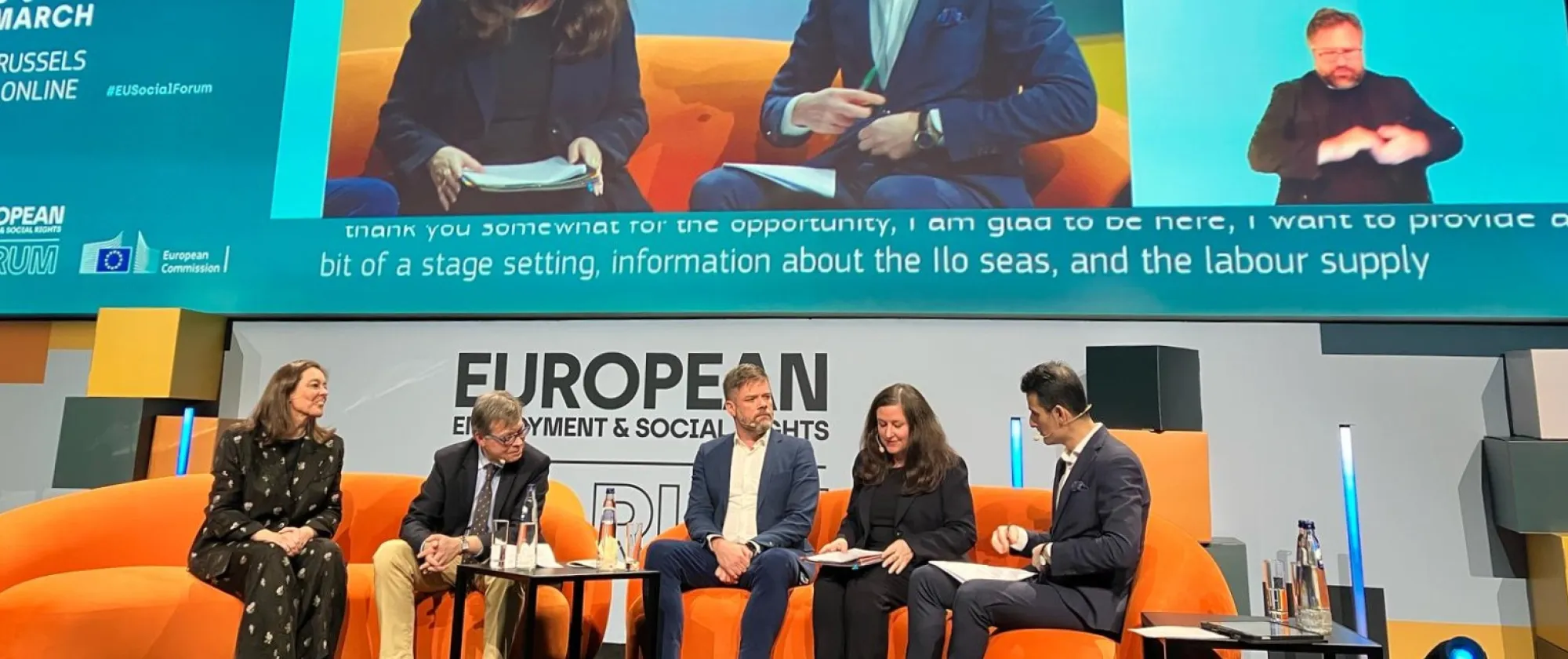
At the European Employment and Social Rights Forum, Celeste Drake, ILO Deputy Director-General, discussed a human-centred skilling agenda to navigate the threats and opportunities brought by rapid digital transformation.
5 March 2025
BRUSSELS (ILO News) – Labour and skills shortages remain a key challenge across the EU, while productivity is stagnating, both at the EU and national level. The third edition of the European Employment and Social Rights Forum, organized by the European Commission, brought together policymakers, businesses, academics and civil society, to discuss how to tackle labour and skills gaps to shape a new vision for a competitive Europe.
The ILO’s report World Employment and Social Outlook: Trends 2025 highlights that labour shortages persist throughout much of Europe even though the number of vacancies has decreased from the post-COVID high in 2022. These shortages are concentrated in specific sectors and occupations, driven in part by a skills mismatch, including in such areas as science, technology, engineering and mathematics, ICT, and healthcare.
Celeste Drake, ILO Deputy Director-General, stated that while ILO estimates suggest some stability in labour market trends, “geopolitical tensions, trade shifts and extreme weather from climate change” will add to pressures that labour markets face from rapid digitalisation and the deployment of artificial intelligence (AI).
AI and the digital transformation are already reshaping jobs. According to ILO estimates, just over 2 per cent of jobs globally and 5.1 per cent of jobs in high-income countries are at risk of displacement. Productivity gains from innovative technologies could potentially reduce hiring in some occupations. The good news is that the potential augmentation effect is much greater. Overall, new job opportunities are emerging, along with a rising demand for specific skills. Ms Drake told the audience in Brussels and online that “there will be jobs available five years from now which we don’t have a description for today”.
Ms Drake underlined the need for a human-centred approach to navigate the threats and opportunities brought on by the digital transformation. It is important also that the “we invest in the reskilling and upskilling of jobseekers and workers to enable them to make the necessary transitions in the labour market and overcome the digital divide.”
Considering the global race for talent, which is acutely felt in the EU, countries need to identify talent requirements and skills in shortage, including with the help of new AI-based tools. Ms Drake insisted on the need to attract and retain talent, including through linking skills policies to the creation of decent jobs.
To support workers during transitions, social protection systems need to be strengthened and public employment services modernized, so that they can provide more effective career guidance and services for jobseekers, especially young people. Deputy Director-General Drake noted on this point that “learning how to learn will remain a primary importance for youth.”
Concluding, the ILO Deputy Director-General underlined that technological progress must be leveraged through meaningful dialogue among governments, employers and workers.
Related content

Region portal
European Union (EU)