

Skills development
Improving practical skills of job seekers through apprenticeship
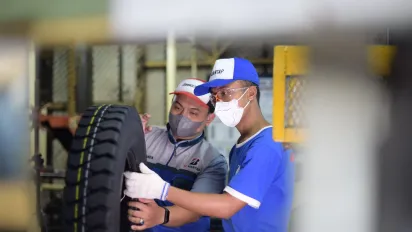
Apprenticeship programme is designed to help job seekers gain hands-on experience within an industry and to learn new practical skills while earning a qualification. The ILO and its partners are now piloting the quality apprenticeship program to support the government’s national apprenticeship programme.
1 August 2018
However, many employers are not yet interested to implement this programme due to lack of incentives provided by the government; on the other hand, trade unions also do not support this programme as they still consider apprenticeship programme as an effort to get cheap labourers and another forms of labor exploitation.
To build a better understanding about the benefits of apprenticeships as a tool to smoothen the transition from school to work and to lessen skills mismatch, the ILO in collaboration with Mitra Kunci conducted a two-day workshop in Cikarang, West Java, from 24-25 July, titled “Workforce Workshop on Quality internship and Apprenticeship Guidelines”. The workshop aimed to socialize the understanding of internship and apprenticeship as these two programmes were jointly implemented and commonly misunderstood by various stakeholders.We have to bear in mind that the apprenticeship programme is not the same as working relation. The apprentices are not workers, but participants. The employers give them assignments as part of the training with improved working skills as the end result."
Sofwan Setiawan, Head of National Apprenticeship Unit of the Ministry of Manpower
In addition to build common understandings and action plans among employers and trade unions, the workshop was aimed to identify roles of relevant stakeholders, particularly the roles of Ministry of Manpower and its offices, trade unions and employers. The workshop also provided a venue for participants to give feedbacks on guidelines of quality apprenticeship for trade unions and apprenticeship participants that has been in the process of development by the ILO and its partners.
Sofwan Setiawan, Head of National Apprenticeship Unit of the Ministry of Manpower, explained key characteristics of the national apprenticeship programme based on Ministrial Decree no. 36/2016. He reminded the participants regarding key characteristics that should be existed in the programme: position-based programme, standards-based curriculum, combination of 25 percent theory and 75 percent practice, undertaken competency test, accompanied by professional mentors and facilities.The apprenticeship programme is not about getting cheap labourers. It is a comprehensive and systematic approach by the employers to obtain skilled workers according to the needs of the industry and labour market."
Kazutoshi Chatani, the ILO’s Employment Specialist
“We have to bear in mind that the apprenticeship programme is not the same as working relation. The apprentices are not workers, but participants. The employers give them assignments as part of the training with improved working skills as the end result,” explained Sofwan.
Similarly, Kazutoshi Chatani, the ILO’s Employment Specialist, said that the apprenticeship programme is beneficial for the industry as they could get workers with skills that they need and are based on the national competency standard. “The apprenticeship programme is not about getting cheap labourers. It is a comprehensive and systematic approach by the employers to obtain skilled workers according to the needs of the industry and labour market,” he stated.
Commitment from employer and unions
Kazutoshi Chatani, the ILO's Employment Specialist highlighted the differentiation between internship and apprenticeship programmes Sharing the best practices from the retail industry, Sumarni, HR Talent Opposition and Operational of Transmart Indonesia, said that her company has developed a comprehensive apprenticeship programme to fulfill the needs of skilled workers. Every month, Transmart Indonesia conducts a 3-month apprenticeship programme for 1,676 apprentices for its 109 stores across Indonesia.“We collaborate with vocational schools to obtain participants for our apprenticeship programme. We also help improving the school curriculum by matching the curriculum with the practical needs that are needed for a specific job, such as cashier. We reach out to schools and teachers, making them aware what practical skills should be integrated in the curriculum,” Sumarni explained.
We collaborate with vocational schools to obtain participants for our apprenticeship programme. We also help improving the school curriculum by matching the curriculum with the practical needs that are needed for a specific job, such as cashier. We reach out to schools and teachers, making them aware what practical skills should be integrated in the curriculum."
Sumarni, HR Talent Opposition and Operational of Transmart Indonesia
Highlighting the important role of the trade unions, Alson Naibaho from the Union Federation for Food, Beverage, Hospitality and Tobacco (Kamiparho) of the KSBSI, said that the trade unions play an important role in all implementation cycles of the quality apprenticeship programe from the planning stage to the evaluation stage. “The trade unions may act as negotiators, facilitators and even implementer as well as evaluator of the apprenticeship programme,” he said.
To strengthen the national apprenticeship programme, the workshop also organized working groups for participants to work together in providing feedbacks to the Apprenticeship Guidelines developed by the Ministry of Manpower in collaboration with the ILO under its Piloting National Apprenticeship Programme in Indonesia.
Dede Sudono, the ILO’s National Coordinator for Apprenticeship Project, said that the guidelines is being developed for providing guidelines for apprentices and the trade unions.The trade unions may act as negotiators, facilitators and even implementer as well as evaluator of the apprenticeship programme."
Alson Naibaho from the Union Federation for Food, Beverage, Hospitality and Tobacco (Kamiparho) of the KSBSI
“The Guidelines highlights responsibilities and obligations of the apprentices as well as roles and functions of trade unions in ensuring the implementation of quality apprenticeship programme. This is to ensure that the programme will benefits all parties involved and will be in line with the labour standards,” she stated.
ILO support to the programme
Under the National Apprenticeship Programme, the ILO and Ministry of Manpower have closely worked with the national trade union confederations to organize piloting companies, particularly at the hospitality sectors. The programme has a joint collaboration with some national and international hotels to conduct pilot of quality apprenticeship programme.Under this programme, the ILO has provided support for piloting companies to be able to meet the minimum requirement of quality apprenticeship programme. The support has been given through improving the capacities of apprenticeship mentors and trade unionists in training plan, soft-skill training and monitoring, evaluation as well as assessment.
“This pilot programme is based on the apprenticeship guidelines that had been reviewed during the workshop. The results of this pilot programme will be further reviewed and evaluated by end of this year. Lessons learnt will be incorporated in the finalization of the guidelines,” concluded Dede.
Related content
Piloting National Apprenticeship Programme in Indonesia

Workshop
Workforce Workshop on Quality Internship and Apprenticeship Guidelines
Relevant projects
Piloting National Apprenticeship Programme in Indonesia