

Business and human rights
ILO joins forces with Indonesian government and university to promote Responsible Business Conduct and Decent Work
The ILO collaborates with the Coordinating Ministry for Economic Affairs and University of Padjadjaran to develop a University Network, integrating responsible business conduct and decent work issues into university’s curricula.
24 December 2024
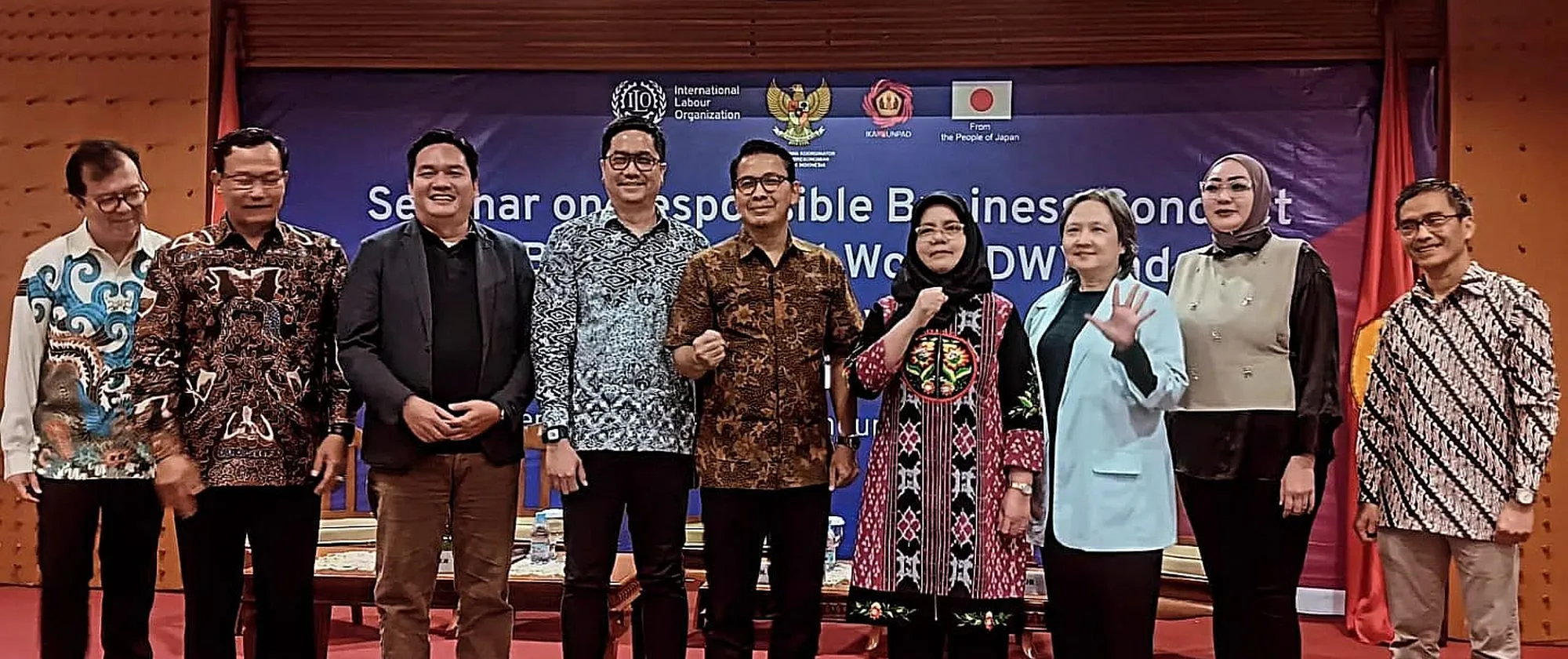
BANDUNG, West Java (ILO News) - The ILO’s Resilient, Inclusive and Sustainable Supply Chains (RISSC) in collaboration with the Coordinating Ministry for Economic affairs and the University of Padjadjaran Bandung agreed to develop a centre of excellence as role of university network for decent work and responsible business. The agreement was developed as part of the conclusion of the seminar by the three institutions to promote decent work and responsible business conduct.
Held in Bandung, West Java on 19 December, the seminar also yielded an agreement to formulate a curriculum on subject of business and human rights for decent work, establish a forum involving a wider participation of multi-stakeholders and other universities and strengthen advocacy and capacity building on the issue of responsible business conduct.
As an OECD’s Accession Member, Indonesia is required to protecting and respecting human rights in its business operations.
Chairul Saleh, Coordinating Ministry of Economic Affairs’ Assistant Deputy for Improving Productivity and Manpower Ecosystem Development
The Coordinating Ministry of Economic Affairs’ Assistant Deputy for Improving Productivity and Manpower Ecosystem Development, Chairul Saleh, highlighted the importance of this joint seminar not only as a forum for collaboration and knowledge-sharing on issues related to responsible business and decent work, but also as a venue to promote further discussions, research and studies.
”It is important for Indonesian industry to be included in global supply chain process and to apply the principles of responsible business conduct that are in line with all international instruments. As an OECD’s Accession Member, Indonesia is required to protecting and respecting human rights in its business operations,” stated Chairul in his opening remark.
We greatly welcome future collaborations, including the development of Centre of Excellence as part of the university network that is in line with the core function of the university, research, teaching and community development.
A. Gusman Siswandi, Vice Dean of Faculty of Law for Academic, Student and Research Affairs of the University of Padjadjaran
Meanwhile, A. Gusman Siswandi, Vice Dean of Faculty of Law for Academic, Student and Research Affairs of the University of Padjadjaran, emphasized the commitment of the university to promote principles of responsible business conduct through its academic works and curricula, “We have a Centre of Human Rights Study that has undertaken number of research on responsible business conduct. Thus, we greatly welcome future collaborations, including the development of Centre of Excellence as part of the university network that is in line with the core function of the university, research, teaching and community development,” he stated.
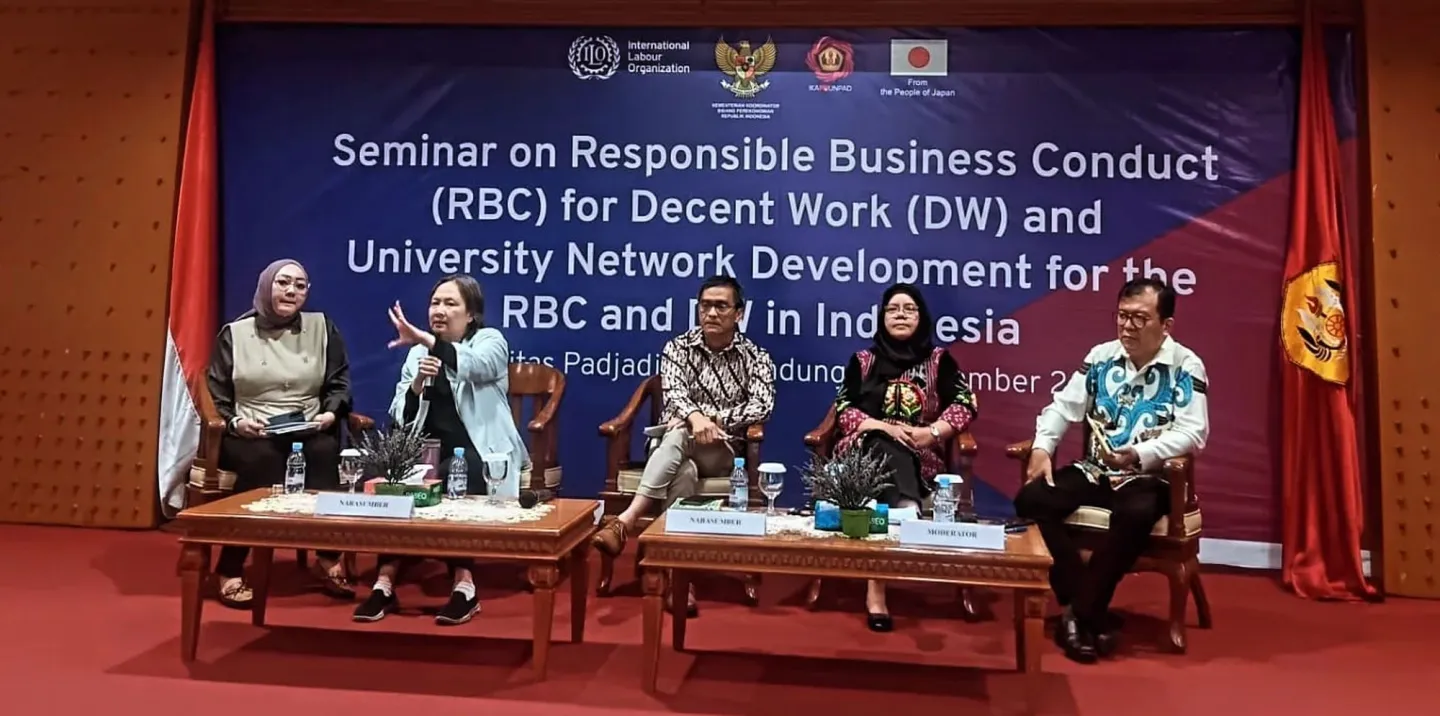
Underlying the important role of academia in sustaining the advocacy work for the younger generation and scholars on responsible business conduct and decent work, Tauvik Muhamad, ILO’s Programme Coordinator of RISSC in Indonesia said that “Universities have played an important role in advocating labour rights. This seminar, therefore, marks a kick off activity that will be expanded to other universities through the university network that will be developed.”
Attended by more than 100 participants, the seminar examined the concept of decent work and its key international frameworks, particularly the ILO’s Tripartite Declaration of Principles concerning Multinational Enterprises (MNEs), and the National Strategy on Business and Human Rights and Business from the point of view of good practices in implementing responsible business conduct. The seminar discussed the potential role of universities in advocating and promoting decent work and responsible business.
Funded by the Government of Japanese Ministry of Health, Labour and Welfare (MHLW), the RISSC project aims to build more resilient, inclusive, and sustainable supply chains by addressing decent work deficits.
Related content

Tripartism and social dialogue
Resilient, Inclusive and Sustainable Supply Chains Asia (RISSC) in Indonesia
Relevant projects

Tripartism and social dialogue
Resilient, Inclusive and Sustainable Supply Chains (RISSC) in the Philippines

ILO-Japan Partnership
Automotive Supply Chain Programme in Thailand

Tripartism and social dialogue
Resilient, Inclusive and Sustainable Supply Chains Asia (RISSC) in Thailand

Tripartism and social dialogue
Resilient, Inclusive and Sustainable Supply Chains Asia (RISSC)