

ILO draws roadmap for sustainable development of Kosovo’s HoReCa sector
The ILO conducted an assessment to map the structure, challenges and opportunities of the Hotel, Restaurant and Catering (HoReCa) sector, outlining a roadmap for inclusive development of one of Kosovo’s most dynamic and promising industries.
9 September 2025

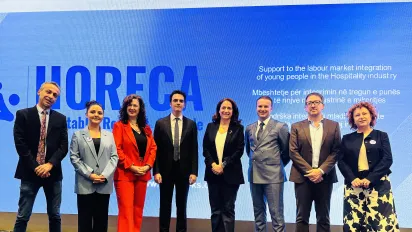
BUDAPEST, Hungary (ILO News) - The “Support to the labour market integration of young people in the Hospitality and Tourism sector” project, implemented by the ILO with funding from the Italian Agency for Development Cooperation (AICS), will contribute to generating more, better, and sustainable employment in Kosovo’s HoReCa sector.
To better understand the needs of the tourism sector and identify paths for its sustainable development, the ILO commissioned a Market Systems Analysis (MSA) that mapped the sector’s structure, challenges, and opportunities. Building on stakeholder interviews and desk research, the MSA provides a comprehensive overview of how the sector functions and where strategic interventions could deliver the greatest impact on the social inclusion of women, minorities, persons with disabilities, and young people.
What does the HoReCa sector look like in Kosovo?
The hotel, restaurant, and catering (HoReCa) sector is one of Kosovo’s most dynamic and promising industries. Powered by a rising domestic middle class, the return of the diaspora, and increasing numbers of international visitors, the sector plays a vital role in economic development and employment generation. Yet, despite its growth potential, the sector faces persistent challenges, most notably in workforce development, market coordination, and inclusion of vulnerable groups.
The sector is a key employer of both skilled and unskilled labour, and it occupies a central role in the country’s urban culture and growing tourism economy. Restaurants and cafés in particular offer year-round employment and services. These businesses, however, are heavily impacted by labour market inefficiencies. And while they provide employment opportunities, these are not always of the best quality leading to high turnover rates.
The sector also offers limited mobility into mid-skilled positions. Many young people are discouraged from entering the industry due to the lack of career progression and issues about job quality. Minority groups and women often face discrimination, reducing their access to decent work. At the same time, employers struggle to find and retain qualified workers, revealing a clear disconnect between education and industry needs.
What does the study reveal?
The MSA identifies key systemic bottlenecks that hinder sustainable development of the sector. Among the most pressing are:
- Fragmented business development services, which limit access to essential business support in areas like marketing, certification, and supply chain management.
- Poor coordination between employers and training providers, contributing to persistent skills mismatches and reducing overall workforce readiness.
- Weak enforcement of safety and hygiene standards, undermining competitiveness and credibility in the tourism market.
- Limited product and service differentiation, which reduces customer loyalty and restricts growth potential.
These constraints are further compounded by a lack of career guidance and inadequate support for entrepreneurship, both of which are critical to encourage youth and other underrepresented groups in the labour market to view the HoReCa sector as a viable and attractive career path.
A roadmap for sustainable development
The MSA outlines a strategic and prioritized set of interventions designed to shift the sector toward more sustainable and inclusive growth.
- Strengthening career guidance services: One of the most promising opportunities identified is the expansion of both public and private career guidance services to improve perceptions of the sector and help young people navigate pathways into employment and entrepreneurship. Schools, vocational institutions, the national employment agency and private actors all have a role to play in reshaping how the sector is understood by potential workers.
- Fostering stronger collaboration between training providers and employers: Improving the alignment of training curricula with labour market needs is essential for raising the quality of training. Deeper partnerships between training institutions and HoReCa businesses, including support for work-based learning and internships can ease the school-to-work transition of young people.
- Promoting destination marketing and collective branding: Strengthening Kosovo’s position as a desirable tourism destination is crucial for extending visitor stays and increasing consumer spending. Encouraging businesses to view marketing as an investment rather than a cost, and fostering collective efforts to promote the sector, will be key to differentiating Kosovo in a competitive regional landscape.
- Promoting better jobs: The promotion of inclusive hiring practices, enhanced access to business development services, and support for improved workplace practices, such as fair contracts and adherence to occupational health and safety standards will not only improve the quality of employment, but also support a more resilient and competitive HoReCa sector overall.
A Skills for Trade and Economic Diversification (STED) analysis is ongoing that focusses on the skills needs of the sector. The MSA’s market systems perspective on the HoReCa sector’s workforce and business environment is an important complement to this analysis. Together, they offer a robust, evidence-based foundation for action to achieve more and better employment in the HoReCa sector.
Related content

HO(SPITABLE) RE(SILIENT) CA(PABLE): Support to the labour market integration of young people in the hospitality and tourism sector in Kosovo
Youth employment
ILO and Italian Development Cooperation join forces to boost youth employment in Kosovo’s hospitality sector
Relevant projects
HO(SPITABLE) RE(SILIENT) CA(PABLE): Support to the labour market integration of young people in the hospitality and tourism sector in Kosovo