

Global webinar spotlights innovative approaches to addressing informality through the social and solidarity economy
The ILO–WIEGO joint webinar highlighted the role of the social and solidarity economy (SSE) in addressing informality, drawing on ILO standards and resolutions. It featured country cases from Argentina, Colombia, India and Nigeria, and explored how the SSE supports the transition to the formal economy in diverse contexts.
4 July 2025
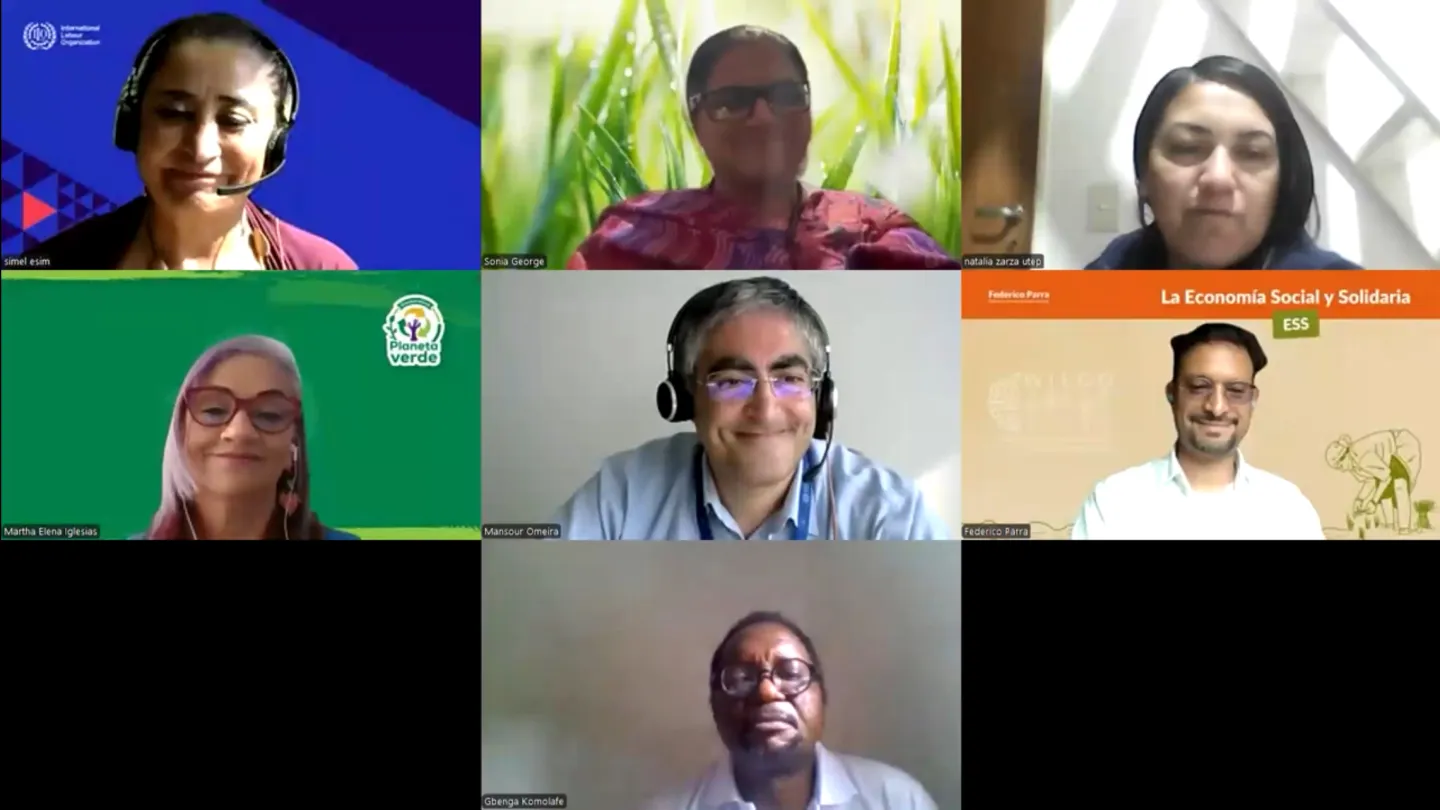
GENEVA (ILO News) – 3 July 2025 – In the lead-up to the 103rd International Day of Cooperatives on 5 July 2025 and as part of the second United Nations International Year of Cooperatives, the ILO Cooperative, Social and Solidarity Economy Unit (COOP/SSE) and Women in Informal Employment: Globalizing and Organizing (WIEGO) co-organized a global webinar on Innovative approaches to addressing informality through the social and solidarity economy. The event featured more than 150 participants, including ILO constituents, social and solidarity economy (SSE) networks, informal economy organizations and development practitioners.
The discussion was grounded in international labour standards and social dialogue. Several of the initiatives featured were supported through ILO development cooperation projects, implemented in collaboration with national stakeholders and adapted to local conditions.
Simel Esim, Head of the ILO’s Cooperative, Social and Solidarity Economy Unit (COOP/SSE) and Chair of the UN Inter-Agency Task Force on Social and Solidarity Economy (UNTFSSE), moderated the discussion. She stressed the importance of dialogue among actors working to build people-centred economies rooted in democratic governance, social inclusion and sustainable development.
Recognizing SSE pathways to the formal economy
Mansour Omeira, ILO Social Innovation Specialist, opened the discussion with insights from the 2025 International Labour Conference Resolution on addressing informality and promoting transitions to formality for decent work, situating it within the ILO’s evolving body of standards and tripartite resolutions. He highlighted its novel elements compared to the Transition from the Informal to the Formal Economy Recommendation, 2015 (No. 204).
Notably, the resolution recognizes SSE pathways to formalization and calls for creating a conducive environment. It also emphasizes the need to recognize and support SSE workers and economic entities in the design, implementation and monitoring of transition strategies and measures.
Omeira outlined three interrelated ways in which SSE entities contribute to the transition: by enabling self-organization and collective representation of workers and economic units; contributing to universal, adequate and sustainable social protection systems; and preventing informalization, including through transition to worker ownership.
Access the presentation slides: The role of the SSE in addressing informality: Insights from ILO tripartite texts
Country cases: SSE in action
The webinar featured country cases that illustrated how SSE entities are addressing the needs of workers in the informal economy, particularly in contexts where public policies and services may be limited or under development.
Colombia
Martha Elena Iglesias, Legal Representative and Manager of the Planeta Verde Waste Pickers’ Cooperative, explained how the cooperative secured formal recognition of waste picking as an occupation for recycling workers through legal advocacy, public awareness campaigns, and partnerships with municipal authorities. The cooperative supports its 60 members, more than half of whom are over the age of 60, through solidarity-based services including a food market, informal credit system, and cooperative education. This recognition has strengthened members’ rights, visibility, and income security.
Access the presentation slides: Planeta Verde: A supportive ecosystem and recycling services provided through cooperatives
Nigeria
Gbenga Komolafe, General Secretary of the Federation of Informal Workers’ Organizations of Nigeria (FIWON), highlighted how a member-led savings and credit cooperative has helped improve financial resilience. He noted that digital tools have facilitated trust and participation, enabling workers in the informal economy to access emergency loans, contribute to group health support funds, and build a culture of saving. These services have proven essential during economic downturns and health crises.
Access the presentation slides: Accessing social protection through the SSE: The FIWON story
Argentina
Natalia Zarza, representative of the Union of Workers of the Popular Economy (UTEP), presented the Children’s Recreation and Learning Centres (CIRAs), a network of cooperatives offering extended-hour childcare for women in informal sectors such as recycling and textiles. She explained how these centres – many of which operate into the late evening – enable women to reconcile work and care responsibilities, reduce the risk of child labour, and support community cohesion.
Access the presentation slides: UTEP & CIRA – Children’s Recreation and Learning Centres
India
Sonia George, General Secretary of SEWA Kerala and a Vice President of SEWA India, described how women in rural areas engaged in agriculture, fisheries, and crafts have organized into federated cooperatives to access markets, share infrastructure, and improve their bargaining power. These solidarity-based initiatives prioritize social justice, recognition, and mutual support, contributing to inclusive local economic development. The cooperatives also deliver essential social services, including nutrition programmes, education, and emergency assistance.
Access the presentation slides: Creating rural–urban linkages: SSE initiatives to support rural women in the informal economy in Kerala
While each example reflects a unique national and local context, participants agreed that SSE approaches offer valuable pathways for decent work, social justice and inclusive development. The ILO encourages adaptation of such models through participatory dialogue, social partnership, and alignment with international labour standards.
Emerging insights and challenges
Summing up the country experiences, Federico Parra, SSE Specialist at WIEGO, noted that SSE practices can support formalization by improving economic outcomes, expanding access to social protection, and strengthening representation and recognition of workers in the informal economy. He stressed that formalization is rarely a linear process, and that many SSE pathways address multiple dimensions of informality simultaneously.
At the same time, several challenges were identified. These included regulatory and implementation barriers, lack of public financing for SSE initiatives, and weak collaboration between SSE organizations and social partners. Participants also pointed to tensions between market-driven approaches and the principles of solidarity and cooperation. Participants emphasized that digital tools, while promising, must complement, not replace, public institutions and state responsibility in delivering decent work and social protection.
Access the presentation slides: How the SSE is supporting formalization in various informal economy contexts
A call for recognition and policy support
In her concluding remarks, Simel Esim called for stronger policy environments that recognize, protect, and promote the diversity of SSE models. She noted that cooperatives and other SSE entities are already shaping inclusive ecosystems that connect livelihoods with care, credit, food security, and collective advocacy. Women-led initiatives, in particular, are driving local economic transformation through community-based care services, digital finance tools, and shared infrastructure – often in settings marked by exclusion or austerity.
“These innovations are already underway,” Esim said. “What they need now is public recognition, policy support, and protection from co-optation. Let’s keep working together to ensure that the social and solidarity economy becomes a pillar for inclusive, equitable, and dignified work for all.”
Watch the webinar recording.