

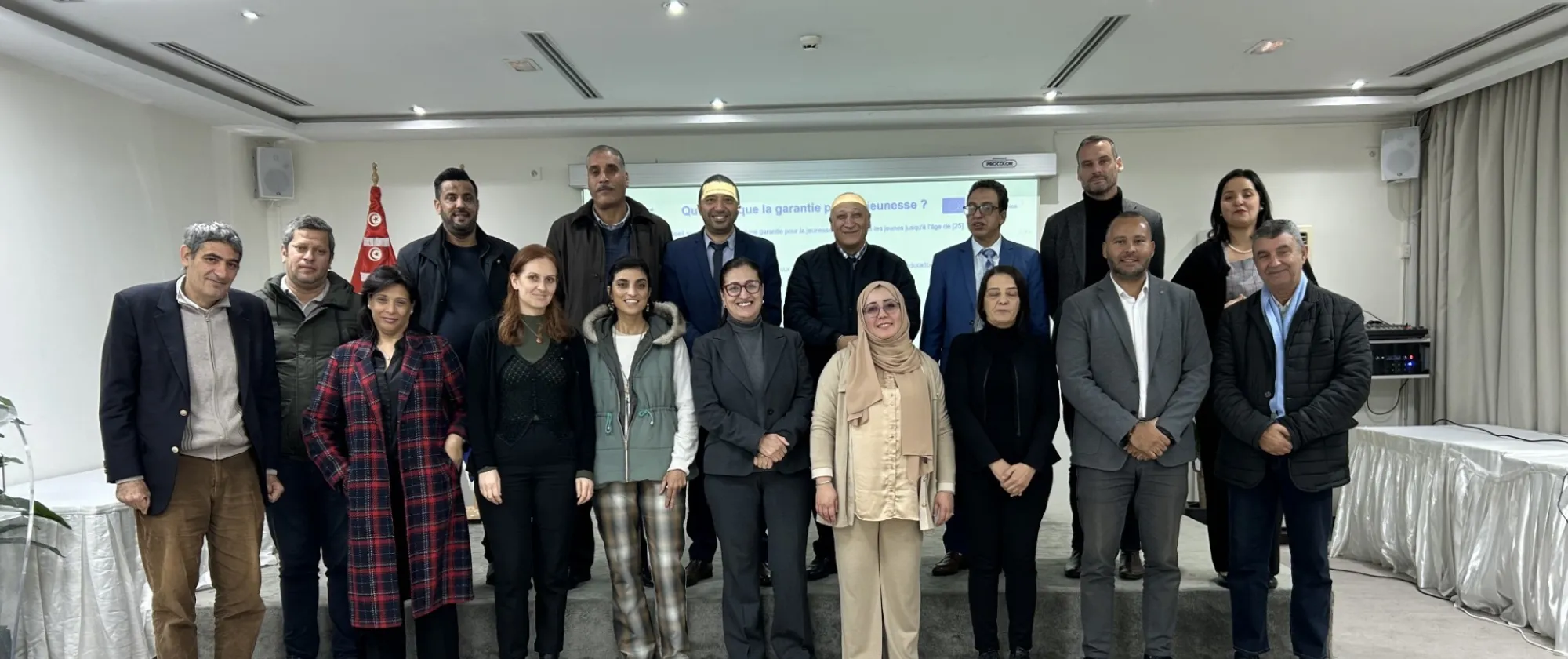
EU-funded Regional Project "Youth-NEET" Launch Steering Committee to Support Youth Employment and Inclusion in Tunisia
Key partners in Tunisia convene to tackle youth unemployment and improve opportunities for young people not in work, education, or training (NEET).
11 December 2024
TUNIS (ILO News) – A major step forward has been taken to help young people in Tunisia who are not in work, education, or training (NEET). A new Steering Committee, bringing together decision-makers from national ministries, European Union representatives, and key partners, has been launched in Tunis to review progress and guide concrete actions that will improve opportunities for these youth through 2026. The initiative is part of the Youth-NEET project, funded by the European Union and implemented by the International Labour Organization (ILO).
Why Focus on NEET Youth? NEET youth face major barriers to participating in society. They are young people who are not working, going to school, or receiving any vocational training. Addressing their needs is vital for Tunisia’s development and the region as a whole.
In his opening remarks, Jean-Yves Barba, Regional Program Lead for Youth-NEET, underscored the program’s regional scope and the critical need for inter-ministerial collaboration to address this challenge. “The NEET phenomenon transcends individual sectors,” he emphasized, “and a coordinated approach is essential to bring about meaningful change.”
Representing the European Union Delegation to Tunisia, Olivier Hack highlighted the importance of aligning interventions with Tunisia’s local context. He urged stakeholders to avoid redundancy and optimize available resources, noting that strategic planning must prioritize impactful and sustainable initiatives.
The Role of Research: Who Are Tunisia’s NEET Youth?
The meeting featured a presentation of the preliminary results of Tunisia’s NEET Youth Statistical Profiling Study conducted by SIGMA The study showed trends and challenges young people face, including a lack of jobs that match their education and fewer opportunities for young women. To address this gap, participants proposed better outreach to young women, for example, through beauty salons, youth centers, community organizations and NGOs.
Highlighting systemic challenges, representatives from Tunisia’s General Labour Union (UGTT) pointed to the mismatch between educational qualifications and labour market needs. UGTT emphasized the necessity of revising the Classification Nationale des Qualifications (CNQ) to align education and training outcomes with evolving industry demands.
Learning from Europe: Adapting the Youth Guarantee
The European Youth Guarantee initiative, which has successfully reduced youth unemployment across EU member states, emerged as a key reference point for Tunisia’s interventions. Azzouz Asma, National Coordinator, explained that while the program’s principles will guide local strategies, adaptations will reflect the specific economic and social contexts of Tunisia.
"We must tailor our approach to the realities faced by NEET youth in Tunisia, while capitalizing on proven European models,” Asma noted. Complementarity with programs like UNICEF’s UPSHIFT—focused on social entrepreneurship—was also discussed as a means to foster innovation and engagement among youth at risk.
Improving Support Services PRONVINEST, tasked with mapping labour market services and regulatory frameworks, outlined its ambitious methodology. Despite concerns regarding the feasibility of completing the study in three months, partners agreed that leveraging existing research—such as World Bank studies—would enhance efficiency and depth.
The 2025-2026 work plan emphasized supporting Tunisia’s National Employment Agency (ANETI) to better serve NEET youth. Partners emphasized the need for these services to be more proactive and responsive to young people’s needs. They proposed reforms based on insights from studies by the World Bank and Youth Guarantee principles.
A Commitment to Action
Concluding the meeting, Mounir Dakhli, Director General of International Cooperation, reaffirmed Tunisia’s commitment to tackling youth exclusion. “This committee is not just a forum for discussion—it is a governance body tasked with driving tangible results,” he said.
The meeting ended with a consensus on the need for continued collaboration, data-driven policymaking, and a renewed focus on the inclusion of marginalized youth. The Steering Committee will reconvene again in 2025, after finalizing key studies and approving a work plan that will guide actions through 2026.
About the Youth-NEET Project:
The Youth-NEET project is a regional initiative funded by the European Union and implemented by the International Labour Organization in partnership with key government ministries, international organizations, and civil society. Its mission is to reduce youth exclusion by strengthening employment services, fostering innovation, and aligning policies with local needs.
Related content

Y-NEET project
Empowering Youth NEETs in the Southern Mediterranean Region
Relevant projects
Y-NEET project
Empowering Youth NEETs in the Southern Mediterranean Region