

Rural development
Canals, roads and jobs rebuilt in Les Cayes, Haiti
ILO project advances decent jobs and rural infrastructure recovery in southern Haiti, repairing canals and rural tracks to help communities recover and build resilience.
2 June 2026
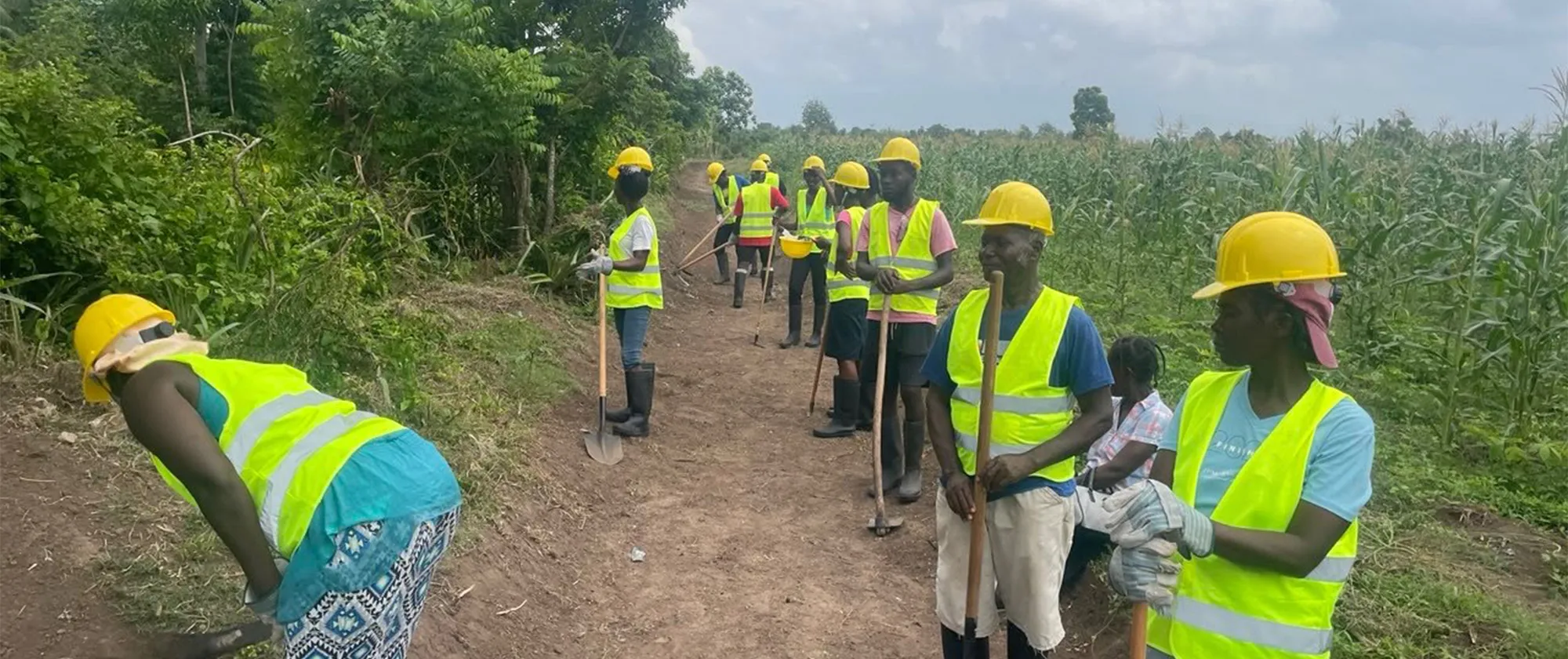
PORT-AU-PRINCE, Haiti (ILO News) – Rehabilitation works under the International Labour Organization’s “Socio-economic recovery in Haiti through decent jobs” project have advanced across four rural infrastructure sub-projects in the Les Cayes area, generating temporary employment while improving access, drainage and irrigation for local communities.
The project which commenced in August 2025 and is being implemented with UNICEF collaboration up to August 2026 is funded through the ILO’s Regular Budget Supplementary Account (RBSA). It uses a labour-intensive approach which provides multi-faceted support to communities affected by limited job opportunities, flooding, degraded rural roads and a lack of irrigation water. It gives particular attention to safer and more inclusive work practices through occupational safety and health, gender and community-based training activities, in line with the ILO’s commitment to decent work in crisis-affected settings.
Progress to date
Over the first half of 2026, the works had generated 647 person-days of employment across all four sub-projects. A total of 1,574.5 linear metres of canal cleaning and 102 linear metres of drainage excavation had been completed, contributing to improved water flow, reduced flood risks and better conditions for rural mobility. Jean Emilson Joseph, ILO National Project Coordinator spoke passionately of the tangible impact of the project saying, “In southern Haiti, where jobs are scarce and infrastructure has deteriorated for years, this project shows what labour-intensive investment can do. The people in our communities are not just benefiting from the works, they are doing the work, earning income, and rebuilding the very infrastructure that everyone depends on."
Local hands and local solutions
The project works through four local implementing partners, each responsible for a distinct sub-project in the Les Cayes area. In Gracette, Torbeck, the Groupe d’Action pour l’Habilitation Économique et Sociale de la Famille Haïtienne (GRAFHES) is cleaning irrigation canals. By June, 545 linear metres of canal cleaning had been completed, generating 155 person-days of work.
In Ti Bannànn, Cayes, Action des Cadres pour le Développement Durable (ACDED) is the lead for cleaning irrigation canals and carrying out retention basin works. Their sub-project has generated 162 person-days of work to date, with cleaning under way on a basin measuring 71.5 metres long and 0.55 metres deep.
The Groupe de Technologie Intermédiaire d’Haïti (GTIH) is rehabilitating the Ti Guinin rural track, including drainage works. By June, 810 linear metres of drainage canal cleaning had been completed, generating 180 person-days of work.
Action Communautaire pour le Développement Durable et le Progrès (ACODDEP) has been assigned to the Milor rural track. Under their management, they completed 148 linear metres of canal cleaning and 102 linear metres of drainage excavation, generating 150 person-days of work. It also includes the planned planting of 700 seedlings for forest and fruit trees to support watershed protection.
Community engagement at the centre
Community participation has been central to the project’s design. Before works began, four community meetings and four launch sessions were held across the work zones. Four steering committees – one for each sub-project – were also established to support local coordination and accountability.
Further works are planned before the project concludes in August 2026. These include masonry repairs, additional drainage excavation, backfilling and road rehabilitation, culvert construction, repairs to concrete strips, training sessions and seedling planting. Through its focus on labour-intensive infrastructure rehabilitation, the project is aligned to the ILO’s objectives of strengthening member states’ capacity to develop effective labour market programmes and services. It also reflects the ILO’s wider commitment to decent work, local recovery and resilience in communities where employment opportunities and reliable infrastructure are essential for rebuilding livelihoods.
Related content
Topic portal
Employment-intensive investment