

Azerbaijan trade unions strengthen capacity on collective bargaining and social dialogue
ILO-supported webinar enhanced trade union knowledge of collective bargaining and social dialogue in a changing world of work.
16 March 2026
BAKU (ILO News) – Trade union representatives in Azerbaijan strengthened their knowledge of collective bargaining and social dialogue during a webinar organized by the Bureau for Workers’ Activities (ACTRAV) of the International Labour Organization (ILO) and the Republican Union of Service and Industry Workers’ Trade Unions, a member organization of the Azerbaijan Trade Unions Confederation. The webinar took place on 16 March 2026.
The webinar brought together trade union representatives to strengthen their knowledge and capacity on collective bargaining and social dialogue. It focused on the role of trade unions in promoting effective social dialogue and improving workers’ representation in a rapidly changing world of work. Participants discussed practical tools, international labour standards and emerging challenges affecting labour relations, including digitalization, global supply chains and non-standard forms of employment.
Opening the event, Fuad Alekperov, Chairman of the Republican Union of the Service and Industry Workers’ Trade Unions, emphasized the growing importance of strengthening collective bargaining mechanisms in Azerbaijan. He highlighted the role of trade unions in safeguarding workers’ rights, improving working conditions and contributing to stable labour relations. He also underlined the need for continued capacity-building efforts to ensure that trade unions can effectively respond to evolving challenges in the labour market and actively engage in social dialogue processes.
Yashar Hamzayev, ILO National Coordinator in Azerbaijan (ILO Office for Eastern Europe and Central Asia), noted that the webinar was organized in the context of the new Decent Work Country Programme for Azerbaijan, which aims to promote decent work, strengthen labour market institutions and enhance social dialogue. He emphasized the importance of continued cooperation between the ILO and national partners in addressing emerging labour market challenges.
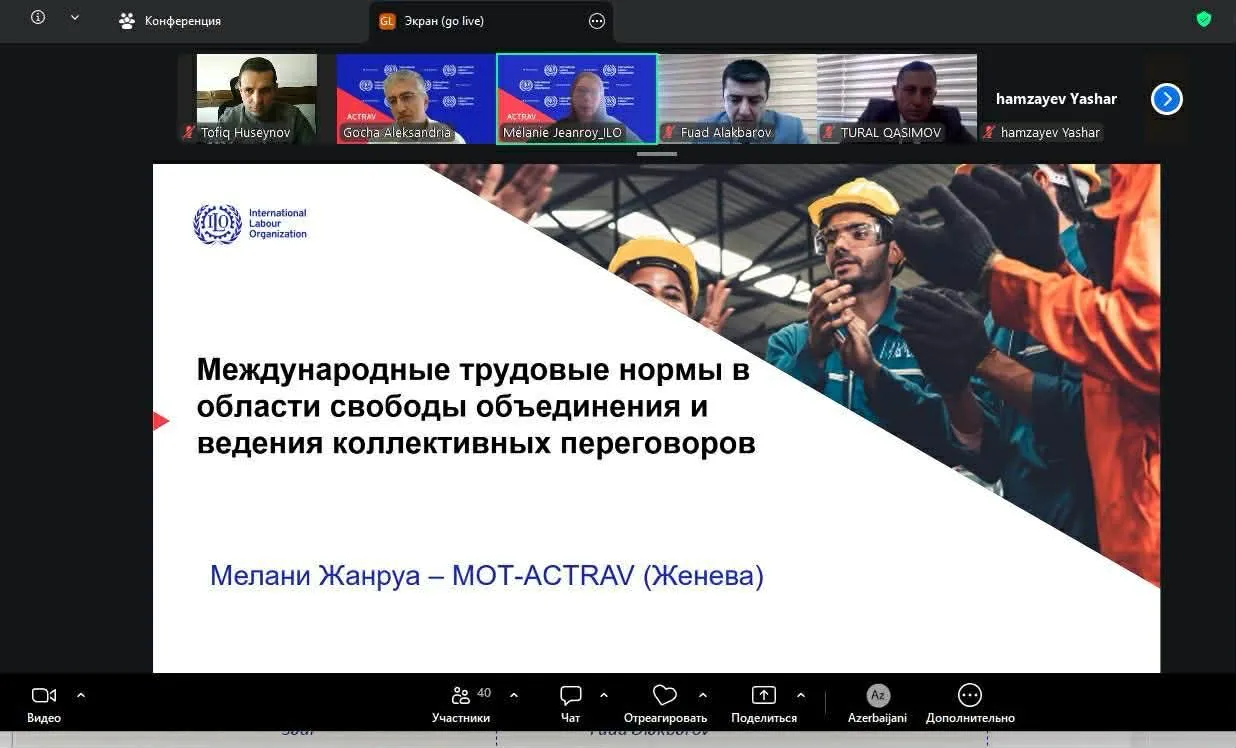
Mélanie Jeanroy, Specialist in Workers’ Activities, Legal and Labour Protection (ACTRAV), provided an overview of the international labour standards framework governing freedom of association and collective bargaining. She highlighted that ILO Freedom of Association and Protection of the Right to Organise Convention, 1948 (No. 87) and the Right to Organise and Collective Bargaining Convention, 1949 (No. 98) are fundamental rights that enable workers to organize and negotiate collectively, while the Tripartite Consultation (International Labour Standards) Convention, 1976 (No. 144) and the Collective Agreements Recommendation, 1951 (No. 91) support effective tripartite consultation and collective agreements in practice.
Gocha Aleksandria, Senior Specialist in Workers’ Activities (ILO Office for Eastern Europe and Central Asia), emphasized that strengthening social dialogue and collective bargaining is essential for ensuring effective workers’ representation and advancing the Decent Work Agenda. He stressed that in the context of rapid changes in the world of work – including digitalization, platform work and the expansion of global supply chains – strong and well-organized trade unions are essential. Social dialogue, he noted, is a key tool for influencing working conditions, protecting workers’ rights and contributing to inclusive economic development.
Victor Hugo Ricco, Senior Specialist in Workers’ Activities (ACTRAV), addressed the role of trade unions in promoting decent work in multinational enterprises and global supply chains. He highlighted the importance of international instruments such as the ILO Tripartite Declaration of Principles concerning Multinational Enterprises and Social Policy, the OECD Guidelines for Multinational Enterprises and emerging due diligence frameworks, emphasizing the role of trade unions in ensuring their effective implementation.
The webinar also featured practical presentations from trade union representatives on enterprise-level social dialogue. A representative of the Carlsberg Azerbaijan trade union shared experience on collective bargaining within a multinational company, highlighting the role of the union in negotiating collective agreements, promoting fair wage policies and addressing workplace concerns through dialogue with management. The presentation also underlined ongoing negotiations on a new collective agreement and the importance of strengthening worker representation and trust within the company.
A second presentation focused on social dialogue practices at Holcim, a multinational company in the building materials sector producing cement, aggregates and concrete. The intervention provided additional insights into how collective bargaining and cooperation between workers and employers are implemented in large industrial enterprises.
The webinar provided an opportunity for participants to exchange experiences and discuss practical challenges faced in collective bargaining processes. Discussions emphasized that effective negotiations require strong organizational capacity, access to information, coordination among trade unions and continuous training of union representatives.
Key takeaways
The webinar highlighted several priorities for strengthening trade union action in Azerbaijan:
- Enhancing the capacity of trade unions to engage effectively in collective bargaining
- Promoting social dialogue at enterprise, sectoral and national levels
- Strengthening compliance with international labour standards
- Addressing labour challenges linked to multinational enterprises and global supply chains
- Supporting trade union strategies in the context of a changing world of work
As emphasized throughout the discussions, reinforcing social dialogue and the role of trade unions will remain essential for advancing decent work, improving working conditions and ensuring inclusive economic development in Azerbaijan.
Related content
Country portal
Azerbaijan
Decent work
Azerbaijan signs Decent Work Country Programme for 2025-2029

Topic portal
Social dialogue and tripartism
Bureau for Workers' Activities (ACTRAV)