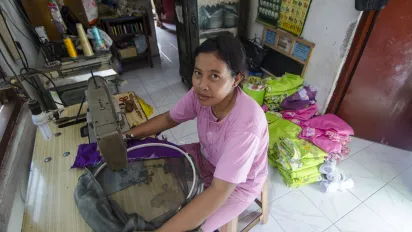
Her posture is tall and big, but she walked down the alleys in the densely populated area of Rungkut Lhor RT04/RW05 Alley No. 2, Rungkut District in East Surabaya with agility. “Mbak Irul, where are you going?” a local resident greeted her. She stopped just to say hello and walked again.
Upon arrival at a market, which is not far from her home, she immediately met cake vendors, with whom she was going to leave her cakes for sale. The woman’s full name is Choirul Mahpuduah, 43 years old. Just like other women in her kampong, she works as a cake vendor, which led her to the creation of “Cake Kampong.”
It took a long process for the area to be recognized as “Cake Kampong.” It took months, and even years, to create a “Cake Kampong” community. No one else initiated it except the woman who is popularly known as Mbak Irul.
We have seen some progress. The productivity is increasing. The living standards have changed. They once could only send a child to school, now two children
“The idea occurred when I realized that women here have been in this cake business for 30 years. I wondered, however, why their income had never increased,” she told the history behind the birth of “Cake Kampong.” “Since 2010, some women here and I have promoted the ‘Cake Kampong’.”
Irul has developed the cake kampong since 2009. At that time, the women in the kampong made cakes to be sold in the market. In the beginning, they were not coordinated. They tended to work by themselves. “There were only a few cake makers at that time, 20 people in total. When they were making ‘kue kukus’ (an Indonesian cupcake, which is steamed) and someone wanted to order ‘sosis solo’ (a traditional snack of meat dish wrapped in a soft egg roll sheet), they would reject the order,” Irul explained.
”But soon after we designed it as ‘Cake Kampong’, when someone orders ‘lemper’ (an Indonesian dish made of glutinous rice filled with chicken, meat or meat floss), the order ismet. Because of what? “We are all aware that we have joined a group. If I don’t make ‘lemper’, I can ask other women who make ‘lemper’ to meet the order,” Irul said further.
From 20 cake makers, the number now has increased to more than 60. It means that a third of the women of 200 households in the kampong are cake makers. Economic progress has been obviously seen. The local government even admitted that there has been significant economic improvements for its residents living in Rungkut Lhor Alley No. 2 RT04/RW05.
“We have seen some progress. The productivity is increasing. The living standards have changed. They once could only send a child to school, now two children,” Fadjar, subdistrict chief of the Kali Rungkut Subdistrict, explained.
Mrs. Sunarsih, 43, a cake maker who is also Irul’s neighbour, shared a similar view. “My profit used to be only Rp. 50,000 a day, but now more than Rp. 150,000,” she said. Sunarsih only makes between about 200 and 400 pieces of cakes a day.
The problem usually comes from the husbands who do not allow their wives to make cakes because they feel embarrased and still think that they can feed their families. What isthe solution? “At first, we just follow what our husbands want . We’ll see to which point that they can endure with heavier economic burdens, while their children keep growing up and need school tuition, etc.,” Irul explained.
Irul keeps empowering women in the “Cake Kampong” although she is also busy with her own cake business. Every day, she has to go here and there to deal with cakes and organization. She is also occupied with a series of other activities, because Irul is also chairwoman of PKK (Family Empowerment and Welfare) in the kampong.
Her husband Riyadi understands the situation. The couple shares the task of taking care of their two children. The eldest is in the fifth grade of elementary school, while the youngest one is still one and a half years old. “I am used to it, because I was also active in the organization along with my wife,” he explained.
This photo story is the first photo stories from a series of two stories on women home workers by Feri Latief of National Geographic Indonesia and published on 8 April 2013. The photo story is part of the ILO’s media fellowship programme on gender and employment, jointly conducted in collaboration with the Alliance of Independent Journalists (AJI) Jakarta and six selected leading, national mass media. The media fellowship programme was part of the campaign conducted by the ILO through its Access to Employment and Decent Work for Women Project, funded by the Australian Government.