Advancing social justice, promoting decent work
ILO is a specialized agency of the United Nations
English
Badminton heroes without trophies
A residential area in the corner of Malang City has highly contributed to the sustainability of badminton. However, they are paid a small amount of money for their hardwork.
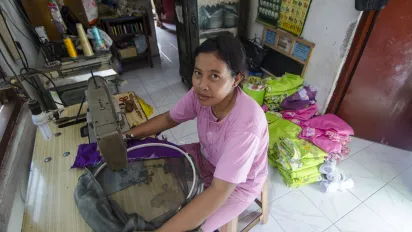
The kampong looks deserted. Not many people can be seen on the streets. Only one or two residents pass by and children are playing in front of a narrow alley. But behind the walls of some residents’ houses of Bale Arjo Sari Subdistrict, Blimbing District – Malang City, women are busy working, installing strings on badminton rackets or making shuttlecocks.
The kampong has been known for long time as the producer of shuttlecocks and badminton rackets. The women there receive orders from racket or shuttlecock business owners. The business owners receive orders from sport stores or others who need their service.
Rackets and shuttlecocks usually made by the women do not carry any brand labels. Those who submit the orders will later put certain brands on them. Solehah, 39 years old, a racket string installer, said, ”After going out of this place, the rackets will get brands with towels to be put on their handles. When they arrive at shops, the price will be expensive.”
Just like other workers, Solehah receives piece-work wage. “I deal with five dozen rackets a day. I am paid Rp. 2,500 per dozen, so I get Rp. 12,500 a day. That’s only if there is an order. Frequently, there are no orders at all for a long period,” Solehah said.
Solehah started installing strings on rackets when she was still attending elementary school. She helped her mother who worked at home to install racket strings. “Until now, my mother still works, installing strings on rackets,” she explained.
Just like other workers, Solehah receives piece-work wage. “I deal with five dozen rackets a day. I am paid Rp. 2,500 per dozen, so I get Rp. 12,500 a day. That’s only if there is an order. Frequently, there are no orders at all for a long period,” Solehah said.
She works for six to eight hours a day. When her two children get home, they help their mother to install strings on rackets. Her income is surely unable to meet the family’s needs. Therefore, she also has a side business – selling eels she collects from rice fields around her house.
The wage to install racket strings is indeed small, but just like her mother, Solehah keeps doing the job. “It’s good because I can do it at home while taking care of my children and husband” is the reason why she remains a low-paid, home-based worker.
In another kampong which is still in the same subdistrict, Bale Arjo Sari, Blimbing District – Malang City, Ida Tianingsih (32), unlike Solehah, never experiences a situation in which she does not receive orders at all. As a home-based worker, she always gets orders, because she works directly at the house of a business owner as a sorter and swan-feather cutter for shuttlecocks.
Her working hours are like formal workers, from 8 a.m. to 5 p.m. Her daily wage is Rp. 24.000. Although the wage is far below the regional minimum wage of Malang City, it is still better than the wage received by Solehah. Ida and some other women are happy to be able to work in sorting, cutting and trimming the swan feathers.
The home-based business that produces shuttlecocks in Bale Arjo Sari Subdistrict also hires men. Their tasks are punching holes on corks where the swan feathers, which have been sewn and trimmed by Ida and other women, will be put in.
They are paid higher because of their piece-work wage. Joko (40), for example, is paid Rp. 250/dozen for his work of putting feathers into shuttlecocks. “I can do 150 dozens a day, the wage totaling Rp. 37.500,” he said.
Joko explained that from the aspects of working volume and skills they need to have, what they do is not different from what Ida and other women do. The women there, however, have never questioned whether there are any differences. They prefer just being passive, “accepting” their destiny.
No exact data has ever been collected on the production number of rackets and shuttlecocks there. In comparison, however, the market demand for shuttlecocks received by one of the business owners, Suraji (47), can be used. He receives a total of 1,000 packs or 12,000 shuttlecocks monthly at Rp. 33,000/pack. It is worth Rp. 33 million.
There are other business owners in Bale Arjo Sari Subdistrict. And we still talk only about shuttlecocks, excluding rackets. And still, there is no official data. So, how much money is circulating there a month?
It is clear that women are the spearheads in the whole working process. Recently, just like the achievement of our badminton players, there has been no significant progress on the welfare of home-based workers in the rackets and shuttlecocks industry.
However, by the hands of the women, rackets and shuttlecocks have been produced to be used by the young generation, who will follow the steps of Rudi Hartono and Susi Susanti. Their products will beam from one generation to another. They deserve to be called badminton heroes without the trophies.
This photo story is the second photo stories from a series of two stories on women home workers by Feri Latief of National Geographic Indonesia and published on 29 April 2013. The photo story is part of the ILO’s media fellowship programme on gender and employment, jointly conducted in collaboration with the Alliance of Independent Journalists (AJI) Jakarta and six selected leading, national mass media. The media fellowship programme was part of the campaign conducted by the ILO through its Access to Employment and Decent Work for Women Project, funded by the Australian Government.