

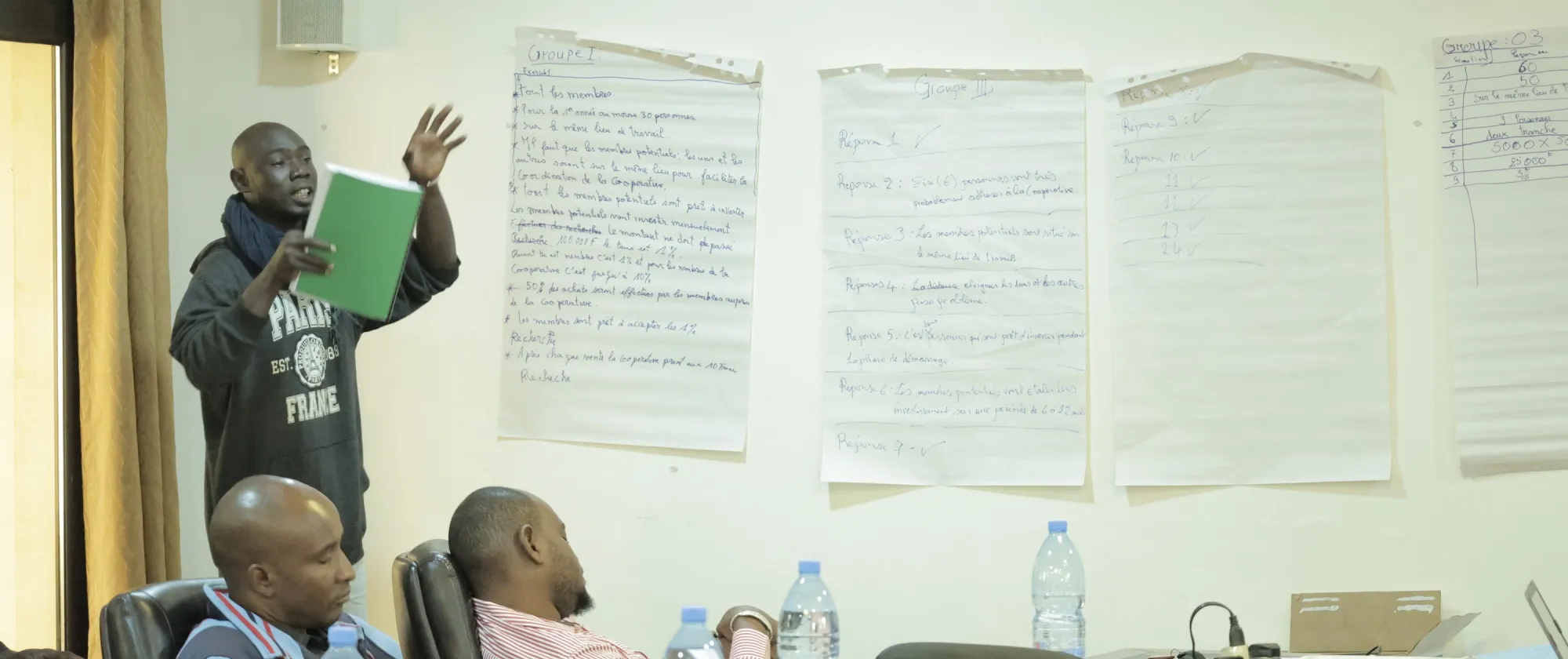
Strengthening cooperatives to combat child labor: Start.COOP adapted to the cotton and gold mining sectors in Mali
In Mali, the ILO’s ACCEL Africa project adapted the Start.COOP tool to strengthen the governance, management, and professionalization of cotton and artisanal gold mining cooperatives. This local adaptation, developed with national trainers and cooperative representatives, aims to improve internal organization, financial transparency, and the strategic planning of cooperatives.
24 October 2025
SIKASSO (ILO News) – In Mali, the ACCEL Africa project has supported local stakeholders in taking ownership of an International Labour Organization (ILO) tool designed to promote viable cooperatives and position them as a key lever for eliminating decent work deficits—particularly in the fight against child labour—through its adaptation to the cotton and artisanal gold mining sectors.
Following the Start.COOP tool adaptation workshop organized by the ILO through the ACCEL Africa project from 13 to 17 October 2025, representatives of cotton and gold-mining cooperatives, along with four newly certified national trainers (two from the gold miners’ confederation and two from the cotton confederation), expressed strong interest in integrating this tool into their governance and management practices.
Developed by the ILO, Start.COOP is a pedagogical instrument designed to support the creation and launch of a cooperative based on solid foundations rooted in sound internal organization, planning, and strategic vision. Its adaptation to the Malian context—requested by stakeholders to ensure stronger local ownership—opens new perspectives for strengthening cooperatives operating within the cotton and artisanal gold mining supply chains. This request follows directly from the Training of Trainers previously organized by the project for around twenty national institutions that support cooperatives in the gold-mining and cotton sectors.
The usefulness of Start.COOP for cooperatives
When asked about the relevance of the tool in the implementation of their activities, cooperative representatives highlighted several key benefits.
According to them, Start.COOP:
- enables better structuring of the cooperative and a shared understanding of the roles and responsibilities of each member;
- offers simple methods for planning, monitoring, and evaluating activities;
- strengthens financial transparency and improves democratic management;
- facilitates the development of sustainable cooperative services for the benefit of members.
“Before this workshop, we operated like an informal organization. The Start.COOP tool clearly shows us how to structure our cooperative, define our objectives, and ensure transparent governance. It is a practical tool that will help us better organize our work and build the trust of members and partners.”
— Amadou Sally Diallo, Training Officer, Confederation of Gold Miners of Mali
Planned use in daily management and member training
Regarding the use of the tool after the workshop, participants highlighted several intentions:
- integrating Start.COOP into annual planning meetings;
- using it as a reference when developing cooperative business plans;
- training new members using the adapted modules;
- strengthening accountability and transparency in resource management;
- guiding decision-making to improve economic performance.
The national trainers certified by the ILO also expressed their commitment to supporting cooperatives in the appropriation and effective implementation of the tool in the field.
“We will use Start.COOP when developing our next annual plan. The tools provided help us better identify our needs, define our priorities, and improve our internal organization. It is a guide that will support us for a long time.” Samuel Zonou, Technical Adviser, Federation of Cotton Producers’ Cooperative Societies of Sikasso
A concrete step toward eliminating child labour in supply chains
The application of Start.COOP by cooperatives also represents major progress in efforts to eliminate child labour.
The tool contributes to this objective by:
- strengthening governance and transparency, which reduces informal practices that enable child labour;
- improving the profitability and economic resilience of cooperative members, thereby reducing the pressure that leads to children being involved in agricultural or mining activities;
- encouraging the adoption of cooperative action plans that incorporate child protection measures;
- facilitating access to financial services, training, and alternative economic opportunities for families.
With a better-organized cooperative, communities are more likely to adopt responsible practices that align with national and international standards relating to children's rights.
The Start.COOP adaptation workshop marks a decisive step for cotton and artisanal gold-mining cooperatives in Mali. Participants committed to using the tool as a lever for professionalization, improved governance, and the prevention of child labour.
Beyond the training itself, these efforts point to lasting structural change, driven by stronger cooperatives that are fully aware of their role in building responsible, human-rights-respecting supply chains.
Relevant projects

Accelerating action for the elimination of child labour in supply chains in Africa (ACCEL Africa)