

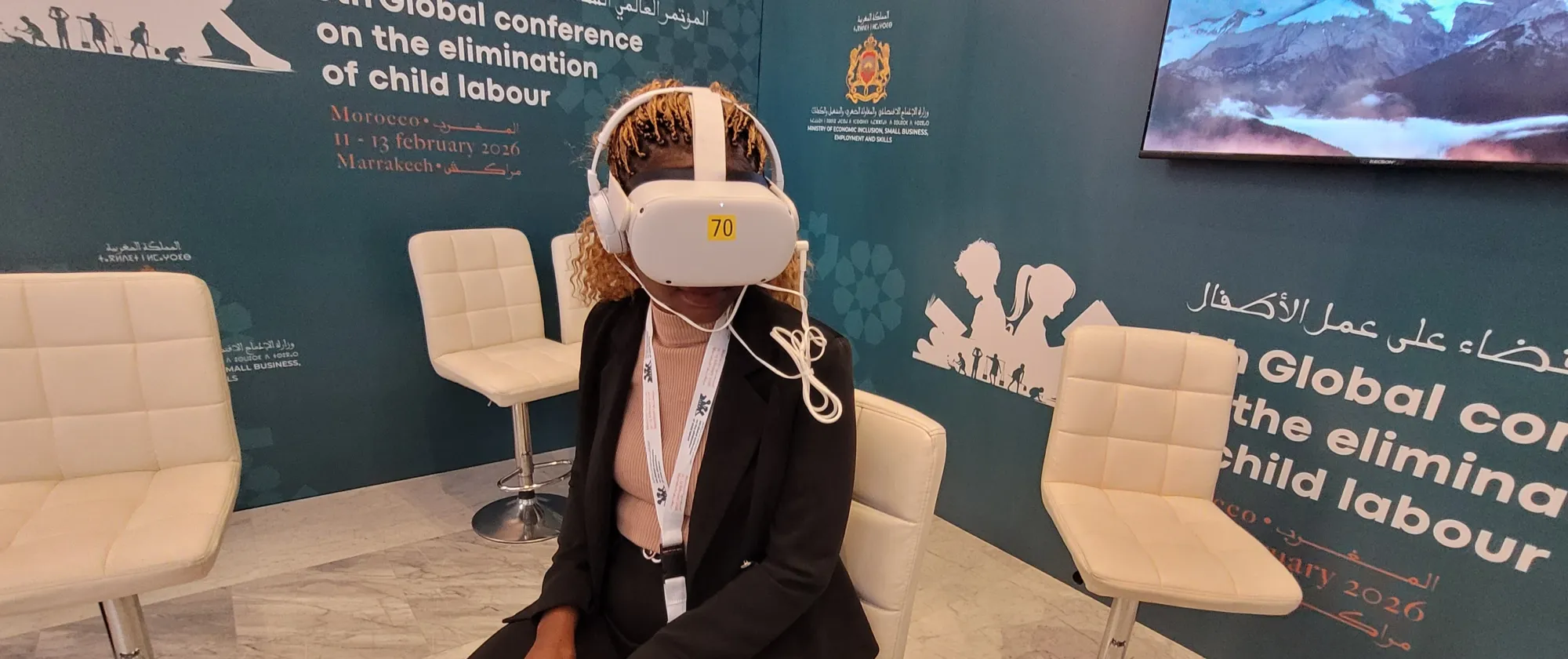
Stepping into the cocoa fields at the Global Conference on the Elimination of Child Labour
At the 6th Global Conference on the Elimination of Child Labour, delegates did not just discuss solutions, they experienced them, through an immersive Virtual Reality (VR) film produced by ACCEL Africa.
18 February 2026
Through an immersive virtual reality (VR) film produced with the support of ACCEL Africa, financed by the Ministry of Foreign Affairs of the Netherlands and the International Training Centre of the ILO (ITCILO), participants were invited to step inside a cocoa-growing community in Nigeria and witness first-hand the complex realities surrounding child labour and the pathways being built to eliminate it.
The VR experience transported viewers directly into the daily life of a cocoa farming community. It showed:
- The economic pressures families face
- The blurred lines between helping and hazardous work
- The aspirations of children
- The concrete interventions supported by ACCEL Africa to prevent and address child labour
Rather than presenting child labour as an abstract issue, the film placed delegates in the middle of the cocoa fields, allowing them to see, hear and feel the environment where decisions are made and lives are shaped.

From data to human experience
The VR film opens with sweeping aerial views of Nigeria’s cocoa-growing region: Ondo, State. Two young women guide viewers through their childhood experiences of child labour: Blessing Thomas and Obassey Divine.
Blessing remembers watching other children go to school while she worked:
“Seeing other kids going to school and me going to farm… I cried.”
After losing her father at an early age, her mother, struggling to provide for her children, sent her to live with another family at just seven years old. Instead of schooling, she was made to hawk fruit on the streets and instructed not to return home if she did not sell everything. Later, she returned to farming cocoa with her mother.
Obassey’s story mirrors similar hardship. When she lost her father at nine years old, her life changed dramatically:
“My happy life back then, now shattered. Everything just went so bad.”
She began performing physically demanding and hazardous tasks during cocoa season, including handling sharp cutlasses and working near chemical spraying operations. She recalls witnessing serious injuries in the fields, underscoring the real dangers children face in cocoa production.
The film also highlights the gendered dimension of child labour, girls bearing a double burden of farm work and domestic responsibilities, with limited access to education and opportunities.
The narrative does not end in hardship. Through six months of vocational training and the provision of equipment, both young women were able to transition away from hazardous farm work.
The VR film makes visible the full chain: from cocoa pod to global chocolate consumption and the children whose labour has historically remained unseen.
Participation and engagement at the conference
Around 100 participants had the opportunity to experience the VR film during the 6th Global Conference on the Elimination of Child Labour held in Marrakesh. The audience included:
- Government representatives
- Workers’ and employers’ organizations
- Development partners
- Technical experts
- Youth delegates
The reactions were immediate and powerful. Many participants described the experience as: “Eye-opening” and “A reminder that policies benefit real families”.
The immersive format sparked deeper conversations about supply chains, community engagement, and the need for integrated responses that address the root causes of child labour.
In a space where discussions can sometimes remain technical, the VR experience re-cantered the human dimension of child labour. It also demonstrated that innovation is about improving how we communicate evidence, how we learn, and how we inspire action. As the global community renews its commitments under the conference outcomes, the message from the VR experience was clear: Eliminating child labour requires not only strong frameworks and partnerships, but also the ability to truly see the lives behind the data.
The VR film forms part of ACCEL Africa’s broader commitment to innovation, learning and impact in supply chains.
Through its work across multiple African countries, ACCEL Africa supports:
- Strengthening legal and policy frameworks
- Empowering workers’ and employers’ organizations
- Improving livelihoods and social protection
- Promoting safe and decent working conditions
- Integrating gender-transformative approaches
- Supporting youth and adults transition to decent jobs.
Relevant projects
Accelerating action for the elimination of child labour in supply chains in Africa (ACCEL Africa)