

Occupational Safety and Health in Cocoa: The WIND approach presented to actors in the sector
In Côte d’Ivoire, the ILO brought together public actors, cocoa companies and cooperatives around the WIND approach, a participatory initiative aimed at improving working conditions, preventing child labour and promoting sustainable practices in cocoa-growing communities in Côte d’Ivoire.
26 May 2026
SOUBRÉ, CÔTE D'IVOIRE (ILO News) – The ILO, through the ACCEL Africa project funded by the Ministry of Foreign Affairs of the Netherlands, mobilized private sector actors around the WIND (Work Improvement in Neighbourhood Development) approach in the cocoa sector.
From 19 to 21 May 2026, representatives of multinationals and cocoa sourcing companies, alongside public authorities, agricultural cooperatives and technical partners, gathered in Soubré to explore partnership opportunities for the implementation and scaling up of the WIND approach in Côte d’Ivoire. The main objective of the workshop was to present the WIND approach, developed by the ILO and already implemented in the country, to the private sector, highlighting its potential to sustainably improve the working and living conditions of cocoa producers. This participatory approach is based on the identification and implementation of practical, simple and low-cost solutions in rural communities.
The workshop brought together a wide range of actors, including companies such as MARS, FERRERO, Tony’s Open Chain, CEMOI Chocolatier, CARGILL West Africa, SUCDEN, ECOM Côte d’Ivoire, MONDELEZ, BARRY CALLEBAUT (SACO), OFI and ETG Beyond Beans, as well as the Coffee-Cocoa Council, the General Confederation of Enterprises of Côte d’Ivoire (CGECI), cocoa cooperatives, and representatives of the Ministry of Employment and Social Protection and the Ministry of Agriculture.

The discussions highlighted the central role of occupational safety and health as a cross-cutting lever that contributes to addressing key challenges in the sector, including the elimination of child labour, improved productivity, environmental protection and better living conditions for producers. Beyond the prevention of occupational accidents and diseases, a proactive OSH approach contributes to the elimination of child labour, the reduction of inequalities and the fight against forced labour.
By improving adults’ working conditions, it helps limit situations in which children are called upon to compensate for labour shortages, while also promoting respect for human rights. Safer and healthier working environments also have a direct impact on producers’ productivity and well-being. Developing a culture of prevention also helps raise awareness of the risks associated with certain tasks, particularly for younger people, a crucial issue in a sector where many children remain exposed to hazardous work.
In this context, the workshop helped highlight how the ILO’s WIND approach provides a concrete response to these challenges, while presenting the tangible results achieved in Côte d’Ivoire since 2018. To date, more than 200 trainers have been trained and more than 2,000 people have been sensitized on occupational safety and health issues in cocoa-growing communities. This momentum has led to the development and adoption of solutions adapted to local realities, aimed at reducing occupational risks while improving productivity.

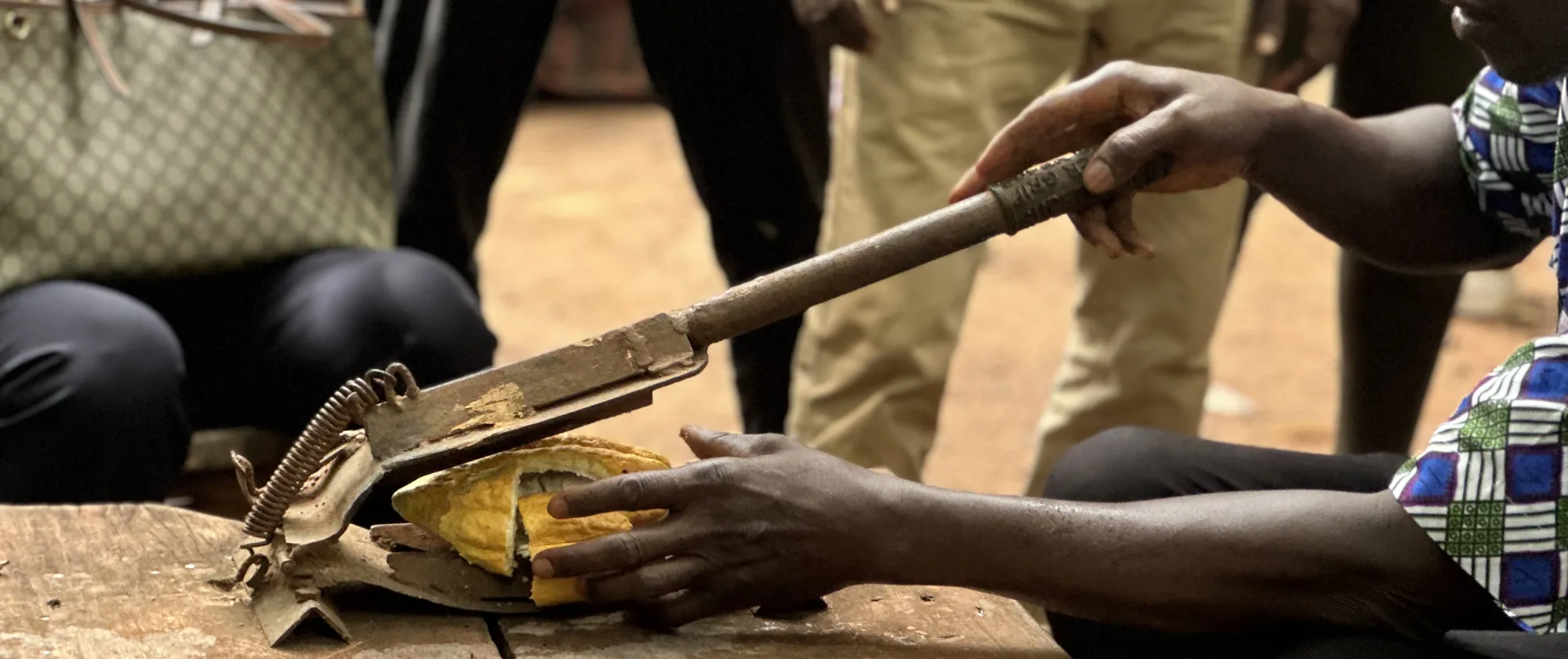
Among these innovations are the introduction of the cocoa pod breaker, a safer alternative to the machete for breaking cocoa pods, as well as the establishment of dedicated and secure storage areas for used chemical product containers.
To illustrate these advances in concrete terms, participants took part in a series of field visits organized in a progressive and comparative manner. The first visit took place on a plantation that had never benefited from the WIND approach, providing a point of reference. This was followed by a visit to a farm owned by a producer trained in WIND, where participants were able to observe significant improvements in risk management, as well as the emergence of a genuine culture of safety.
Thirdly, participants visited the living environments of beneficiaries, highlighting the extension of the WIND approach to households. Concrete improvements were observed, such as the use of improved stoves reducing exposure to smoke, the installation of multi-level shelves to support better organization and productivity, and the creation of more comfortable living spaces contributing to well-being. The approach also encourages income diversification, including through livestock activities, thereby strengthening the economic resilience of families.
“The WIND approach is also an approach towards the circular economy; everything is recreated. It is truly a very interesting approach for the environment and also for the quality of life of our producers.”
Representative of CEMOI Chocolatier
Building on these observations, the final part of the workshop was devoted to in-depth discussions on prospects for rolling out the WIND approach. Discussions focused on companies’ interest in replicating the approach within their partner cooperatives and communities in order to broaden its reach and amplify its results, as well as on opportunities to integrate WIND into their sustainability strategies.
All the companies present expressed strong interest in this approach, emphasizing its coherence with their commitments to sustainability and respect for human rights. Several highlighted its added value as a complement to their existing mechanisms, which are often more oriented towards reactive responses, particularly in relation to child labour. In this regard, the WIND approach stands out for its preventive and cross-cutting dimension, enabling action on several key issues at the same time, including occupational safety and health, productivity, community well-being and the reduction of child labour.
“WIND is clearly linked to our sustainability programme through the holistic nature of the approach in addressing productivity, well-being and child labour issues, but also through its anticipatory approach.”
Representative of Tony’s Open Chain
This alignment confirms the relevance and added value of the WIND approach in the cocoa sector as a concrete tool to support sustainable change within communities.
In this spirit, exchanges with the participating companies will continue in order to turn the identified areas for collaboration into concrete action. The ILO and its partners therefore intend to strengthen synergies with the private sector to support the wider deployment of the WIND approach within cocoa-growing communities, paving the way for concerted and sustainable action in support of better working and living conditions for producers.
Relevant projects
Accelerating action for the elimination of child labour in supply chains in Africa (ACCEL Africa)