


Netherlands Ambassador visits ACCEL Africa’s areas of implementation in Côte d’Ivoire
The Ambassador of the Kingdom of the Netherlands to Côte d’Ivoire visited cocoa-growing communities in the Nawa region to observe initiatives supported under the ILO ACCEL Africa project. The visit highlighted efforts to strengthen livelihoods, expand social protection, promote youth employment, and advance sustainable cocoa supply chains free from child labour.
10 March 2026
SOUBRÉ, Côte d'Ivoire (ILO News) – His Excellency Jeroen Kelderhuis Ambassador of the Kingdom of the Netherlands to Côte d’Ivoire visited several communities in the Nawa region to observe initiatives supported under the ACCEL Africa project, implemented by the International Labour Organization (ILO) with the support of the Ministry of Foreign Affairs of the Netherlands.
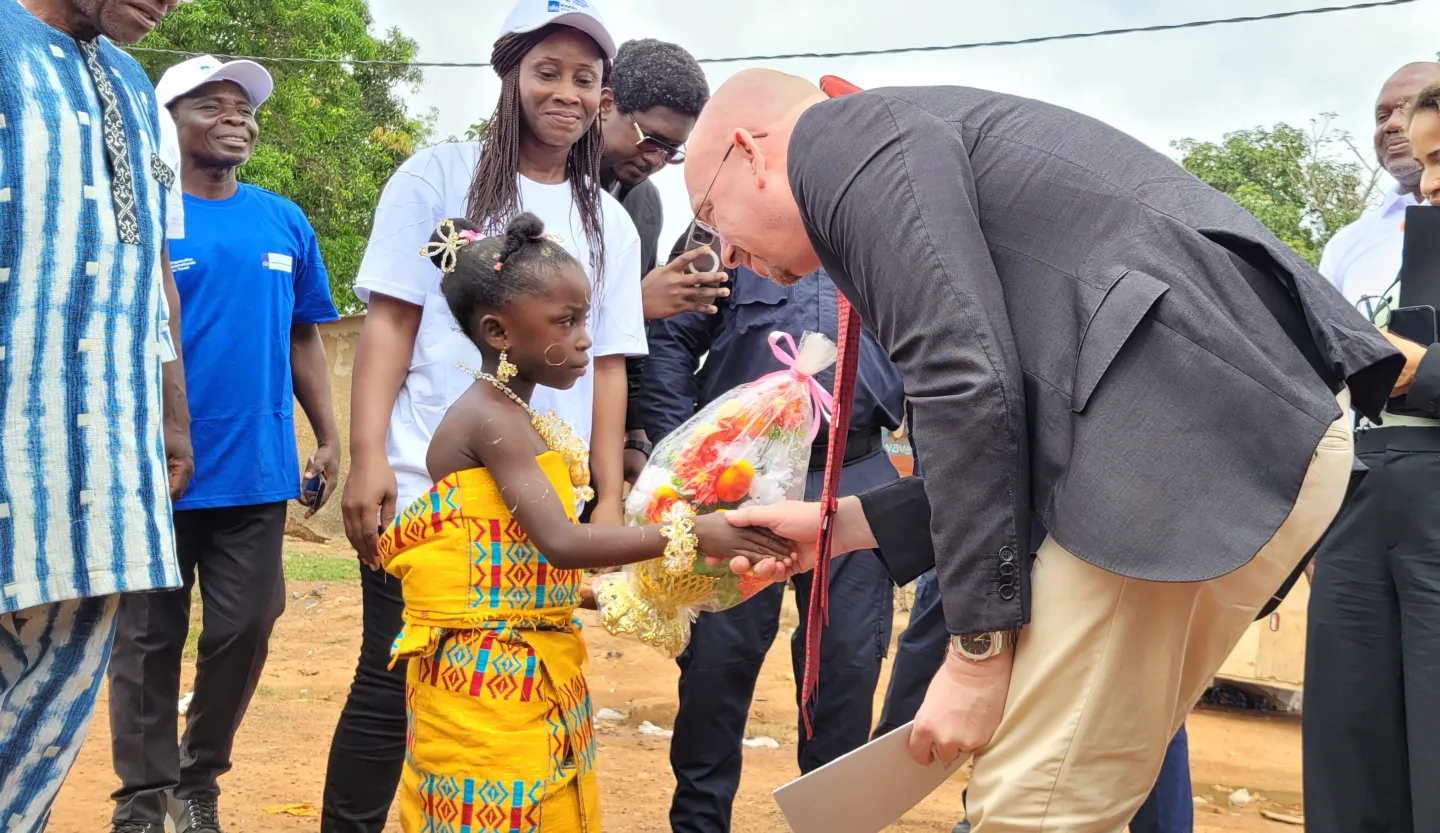
The field visit highlighted concrete actions being undertaken in cocoa-growing communities to improve livelihoods, strengthen social protection, promote youth employment, and ultimately prevent and eliminate child labour in cocoa supply chains.
Throughout the visit, the Ambassador met with farmers, women’s groups, youth apprentices, local authorities, and community members who are directly benefiting from the project’s interventions.
The first stop of the visit took place in the community of Zakéoua, where the delegation visited the local primary school and its canteen. The initiative demonstrates an innovative model linking school feeding programmes, local agricultural production and community savings groups (AVEC).

Local women’s groups supply agricultural products to the school canteen, creating a virtuous circle where improved incomes for families contribute to better nutrition for schoolchildren and help ensure that children remain in school rather than entering the workforce prematurely.
The delegation also met women members of Village Savings and Loan Associations engaged in cassava production and processing activities, supported by the project to diversify household incomes and strengthen economic resilience.
In Côte d’Ivoire, more than 21 community savings groups comprising over 630 members have been supported to diversify their income sources through activities such as cassava production and processing, livestock farming, and small-scale agricultural enterprises.

Furthermore, through the WIND (Work Improvement in Neighbourhood Development) approach promoted by the ILO, producers and community members are also introducing simple, low-cost improvements to enhance safety and working conditions in farms and households.

In the nearby community of Kotabléoua, the Ambassador visited a biochar production unit, an innovative initiative aimed at improving soil fertility and agricultural productivity while strengthening the livelihoods of cocoa farmers.
The project supports farmers in transforming cocoa pod waste into biochar, a sustainable soil amendment that improves soil quality while reducing environmental impact.
This pilot initiative aims to train 100 cocoa producers in biochar production techniques, helping them make better use of agricultural residues while creating additional economic opportunities.
The use of biochar represents a promising solution to support climate-resilient agriculture while contributing to more sustainable cocoa production systems.

Access to healthcare was another key focus of the visit. In the community of Bagoliéoua, cocoa farmers and their families received their Universal Health Coverage (CMU) cards.
Through the ACCEL Africa project, the ILO works with national institutions and partners to facilitate the enrolment of producers and rural workers in social protection schemes, particularly health insurance.
Access to healthcare plays a critical role in strengthening the resilience of rural households. When families are protected from unexpected medical costs, they are better able to maintain stable livelihoods and avoid situations that may lead children to leave school and enter work.
The visit concluded with an exchange with young apprentices and local trainers who are participating in skills development and financial inclusion initiatives supported by the project.
Through training, mentorship, and the provision of equipment for small enterprises, these young people are gaining the skills and opportunities needed to pursue decent work and contribute to the development of their communities.
In Côte d’Ivoire, the project has already supported training and apprenticeship opportunities for dozens of young people aged 15–17, particularly in sectors such as poultry farming and cassava production, helping them transition from school to productive and decent employment.
A shared commitment to sustainable cocoa
Speaking during the visit, the Ambassador underlined the strong ties between Côte d’Ivoire and the Netherlands in the cocoa sector.

He noted that the Netherlands is the largest importer of cocoa from Côte d’Ivoire, with nearly 40 percent of the cocoa imports staying in the Netherlands.
“The Netherlands is a major gateway for cocoa entering Europe,” he said. However, “Consumers increasingly want sustainable chocolate, this means chocolate whose production respects human rights and takes into account the well-being of children.”
Consumers increasingly want sustainable chocolate, this means chocolate whose production respects human rights and takes into account the well-being of children.
Jeroen Kelderhuis, Ambassador of the Netherlands in Côte d'Ivoire
He emphasized that the elimination of child labour is a shared responsibility across the entire cocoa value chain.
“Everyone wants children to go to school. No one wants children to work in harmful conditions. Through our partnership with the ILO and with Côte d’Ivoire, we want to make our contribution to ensure that cocoa production is sustainable and that children can fully enjoy their childhood and education.”
The visit reaffirmed the commitment of the Government of the Netherlands and the International Labour Organization to continue working with national authorities, farmers’ organizations, private sector actors and communities to build sustainable cocoa supply chains free from child labour.
By combining improved livelihoods, social protection, safer working conditions, education and youth employment, the ACCEL Africa project aims to address the root causes of child labour and support lasting change in cocoa-growing communities.
About ACCEL Africa
ACCEL Africa adopts adopts a systemic approach that addresses the root causes of child labour by strengthening policy frameworks, promoting decent work for adults, improving occupational safety and health, expanding social protection, and supporting the transition of young people from school to decent work.
The project is currently being implemented in several African countries, including Côte d’Ivoire, Ghana, Kenya, Mali, Nigeria and Uganda, with Côte d’Ivoire interventions focusing on cocoa and artisanal gold mining supply chains.
Relevant projects
Accelerating action for the elimination of child labour in supply chains in Africa (ACCEL Africa)