


Multi-stakeholder workshop and community engagements advance decent work and financial inclusion in Ghana
The ILO has convened a two-day multi-stakeholder workshop in Accra, Ghana, to catalyse innovative and inclusive financial solutions that address decent work deficits and promote economic inclusion for vulnerable workers, including cocoa farmers, artisanal miners, and migrants. The workshop strengthened cross-sector partnerships among trade unions, civil society, financial institutions, and government agencies, fostering a collaborative environment for co-designing impactful financial tools and advancing systemic change.
6 May 2025
Accra, Ghana (ILO News) – The ILO, under the umbrella of the ACCEL Africa, Fair Recruitment Initiative – Phase III, and Climate Cocoa projects hosted a groundbreaking two-day workshop titled “Innovating for Inclusion: Financial Solutions to Advance Decent Work.” Held from 5–6 May in Accra, the event brought together key stakeholders—trade unions, civil society organizations, financial institutions, and government representatives—to co-create financial strategies that enhance economic resilience for cocoa farmers, migrant workers, and artisanal and small-scale miners.
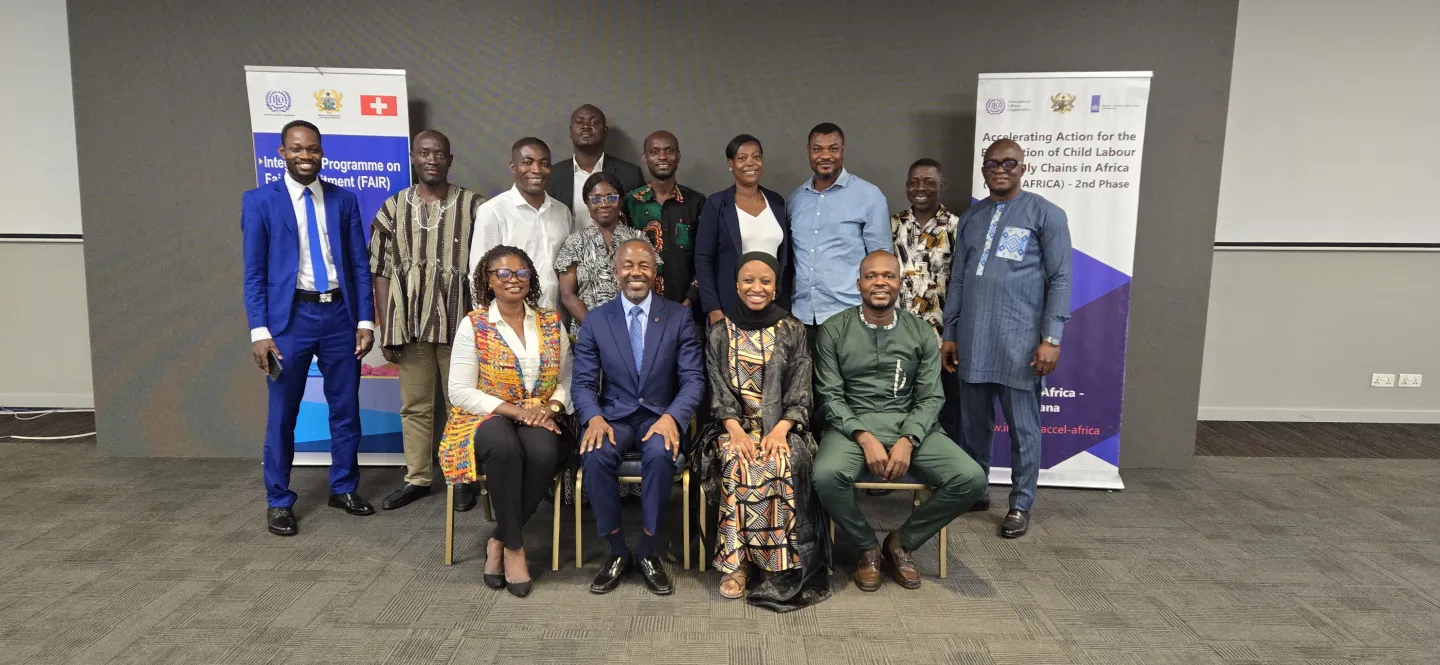
The Director of Education and Training at the Trades Union Congress (TUC), Mr. Kennedy Atong Achakoma, underscored the critical role of financial inclusion in achieving decent work outcomes. He stressed that while economic barriers are often overlooked, financial solutions are pivotal in ensuring access to social protection, productive employment, and income security.
“Limited access to social protection, fair recruitment practices, and financial services continues to challenge vulnerable workers. Through collaboration and innovation, we can develop solutions that drive meaningful change,” Abubakari Kamil, ILO National Project Coordinator in representation of the ILO Country Office Director for Nigeria, Ghana, Liberia, Sierra Leone and Liaison Office for ECOWAS.
The event demonstrated the collective commitment of ILO partners in addressing inequalities through finance. Plenary sessions featured expert discussions on reducing child labour in cocoa and artisanal gold supply chains, strengthening fair recruitment practices for migrant workers, and developing financial services tailored to informal and low-income workers.
An integral part of the workshop was the interactive co-creation process, where participants worked in multi-stakeholder groups to design innovative financial solutions tailored to vulnerable populations, including cocoa producers, artisanal miners, and migrant workers. These prototypes went beyond traditional credit and savings models, introducing features such as climate-smart input financing, savings-linked insurance for migrants, and community-based financial tools integrated with digital platforms. Each solution was grounded in the lived realities of underserved groups and aimed to address the root causes of child labour and livelihood insecurity through human-centred, adaptable, and impact-driven design.
This firsthand engagement fostered a community of practice, enabling peer learning and strengthening cross-sector partnerships. The capacity of the workshop beneficiaries was built on child/forced labour and on how to link up financial inclusion with decent work through fundamental principles at work and responsible business conduct. They also learnt about how to co-create synergy of actions for the financial sector to contribute to the elimination of child and forced labour.
By integrating inclusive finance into the Decent Work Agenda, this initiative directly supports the United Nations’ Sustainable Development Goals (SDGs), particularly SDG 1 (No Poverty), SDG 8 (Decent Work and Economic Growth), and SDG 10 (Reduced Inequalities). The outcomes of this workshop will guide future efforts to create resilient economies that work for all, ensuring decent work for vulnerable populations across Ghana and beyond.
The workshop equipped participants to actively contribute to upcoming initiatives, including the Innovation Challenge, where financial service providers will be invited to submit practical, inclusive solutions, and the Training of Trainers on Financial Education, which aims to strengthen the financial decision-making capacity of beneficiaries and their support networks. Based on participant feedback, the ILO will also continue to support the financial sector in deepening its understanding of child labour and forced labour risks, and in reinforcing social safeguards within their products and practices.
Relevant projects
Accelerating action for the elimination of child labour in supply chains in Africa (ACCEL Africa)