


Labour advisory board members trained on ILO standards and the decent work agenda
Uganda strengthens labour governance through ILO-backed training for Labour Advisory Board members. Held in Entebbe, the session deepened knowledge on ILO standards, tripartism, and decent work, reinforcing the country’s commitment to international labour standards and child labour elimination.
14 May 2025
Entebbe, Uganda (ILO News) - As part of Uganda’s continued commitment to promoting decent work and aligning labour governance with global standards, the Ministry of Gender, Labour and Social Development, together with the International Labour Organisation (ILO) under the ACCEL Africa Project, conducted a two-day capacity-building training for members of the Labour Advisory Board (LAB) from the 13-14 May 2025, in Entebbe Uganda.
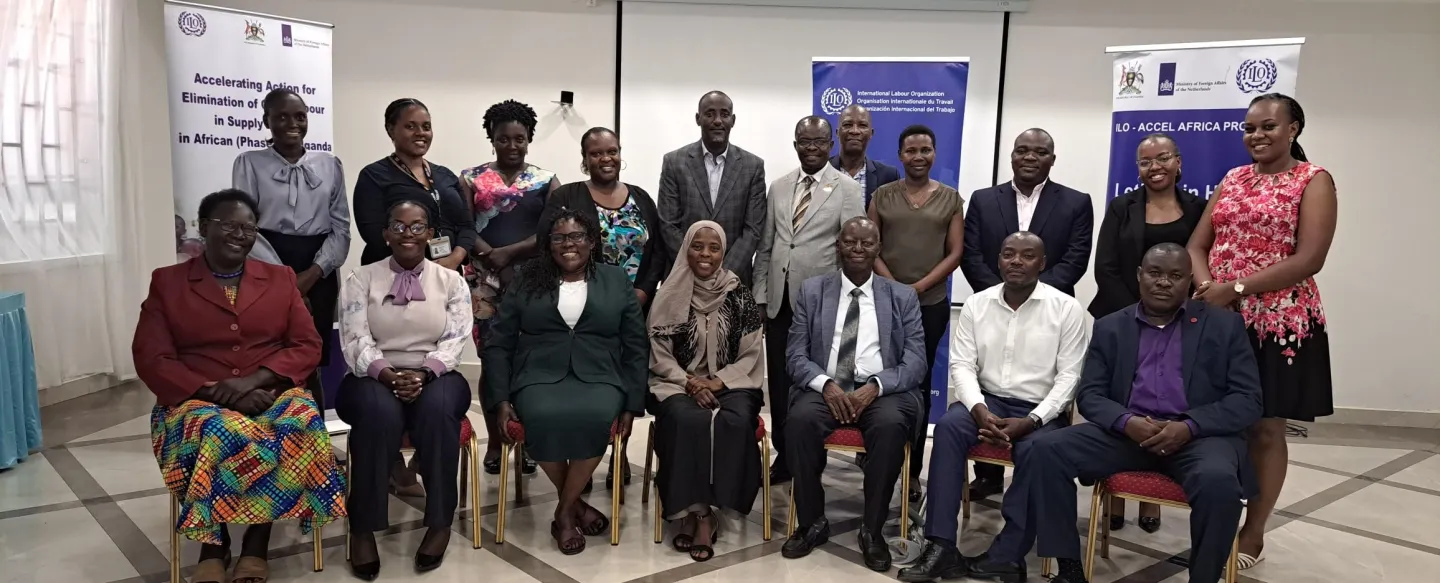
The Labour Advisory Board (LAB), composed of tripartite representatives appointed by the Minister, serves as the primary platform for social dialogue. It plays a vital role in advising the Minister of Gender, Labour and Social Development, promoting fair labour practices, resolving disputes, and enhancing the effectiveness of Uganda’s labour force.
The training was designed to strengthen participants’ understanding and application of ILO conventions, recommendations, and supervisory mechanisms; improve the alignment of national labour laws with Uganda’s international commitments; enhance the Labour Advisory Board’s (LAB) role in tripartite dialogue and evidence-based policy advisory; and equip members with the tools needed to promote decent work, social justice, and uphold international credibility.
Participants engaged in interactive sessions covering:
- ILO governance structure
- National of ILO conventions and their applicability in Uganda
- Promoting Decent Work and Tripartism
The Board gained knowledge on the reporting obligations of member states on their application of ratified conventions and on the status of the government of Uganda concerning the reporting on child labour conventions, particularly the case before the Committee of Experts on Application of Standards.
In his opening remarks, Nicholas Okwir, Chairperson of the Labour Advisory Board, expressed appreciation for the opportunity to deepen their understanding of international labour standards. He noted, “This training will greatly enhance the capacity of Labour Advisory Board members to address issues related to labour standards, especially child labour, and to advocate for the ratification of Occupational Safety and Health Conventions 155 and 184.”
The commissioner for Labour, representing the Ministry of Gender, Labour and Social Development, Bernard Amuriat said: “The training resonates strongly with our national labour priorities: promoting employment opportunities, safeguarding rights at work, extending social protection, and encouraging social dialogue.
The training significantly enhanced the technical capacity of LAB members by deepening their understanding of ILO standards, enabling them to offer informed policy advice, assess legal compliance, and support labour law reform. It also strengthened their ability to advocate for decent work and engage in effective tripartite dialogue among government, employers, and workers. Additionally, the training encouraged knowledge dissemination within their respective institutions, promoting broader alignment of labour strategies with national development goals and extending the overall impact across the sector.
The Labour Advisory Board (LAB) outlined several key actions to strengthen its role in labour governance, including advocating for the decentralization of Ministry functions to better address regional labour issues, and enhancing oversight of ILO standards implementation. LAB also committed to providing technical expertise, optimizing its broad mandate through recruitment of support staff, and fostering a culture of continuous learning and knowledge exchange across institutions and regions.
Relevant projects

Accelerating action for the elimination of child labour in supply chains in Africa (ACCEL Africa)