

KIN ELENDA project
Kin Elenda: the impact of training worksites on local communities
13 June 2024
Initiated by the Congolese government and financed by the World Bank, the KIN ELENDA project aims to improve access to infrastructure, services and socio- economic opportunities, as well as urban management in Kinshasa.
In this context, the ILO's involvement is primarily aimed at encouraging the use of local resources, the creation of temporary and sustainable jobs and the generation of income for the project's beneficiaries.
To achieve its objectives, the ILO relied on several levers:
- Training for project owners, contractors and target populations;
- Intensive techniques for the construction and maintenance of urban infrastructure;
- Setting up income-generating activities;
- Organising local people into companies or cooperatives in the various building and public works trades;
- Promoting the social value of the project's activities for both the individuals concerned and the community.
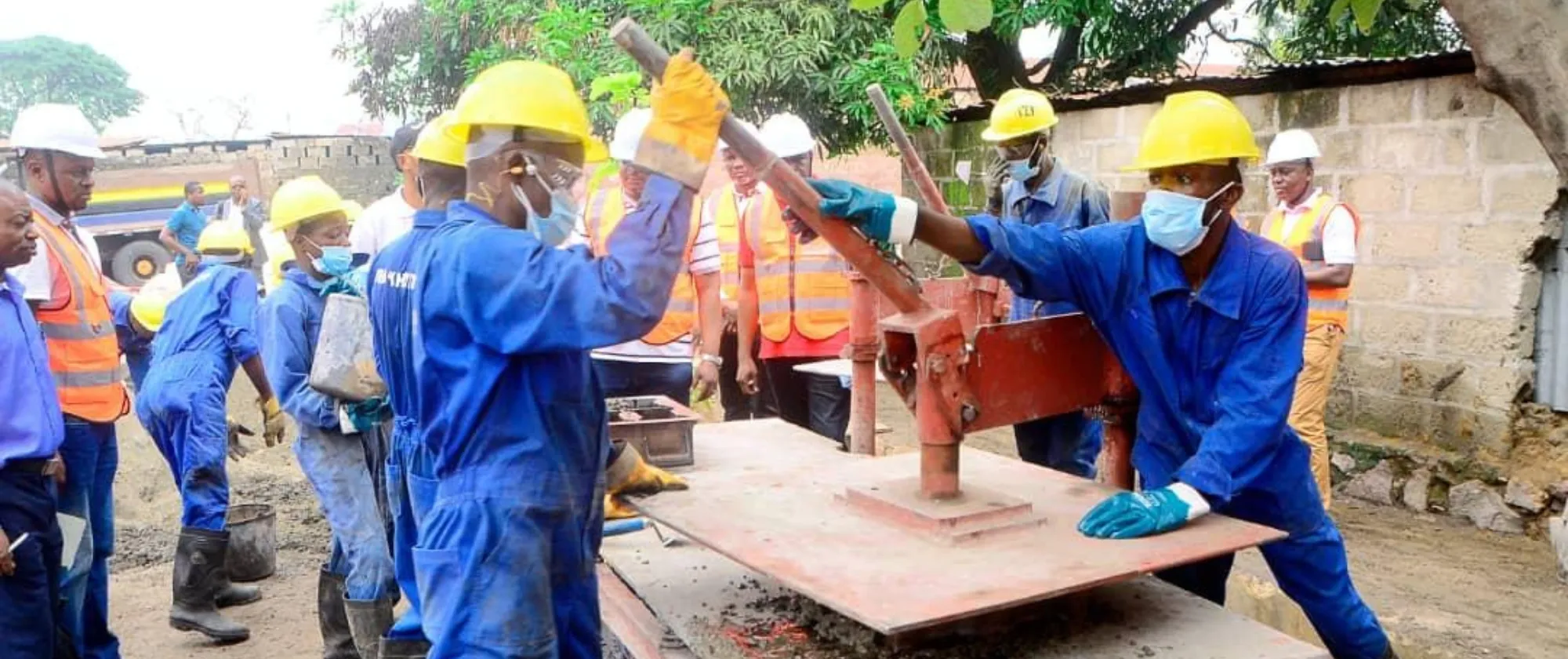
In this context, 3 training worksites have been set up to apply the theoretical lessons taught.
Spotlight on the worksites
The Lemfu project
The aim of this project was to build a paved road with drainage works in the Lemfu and Nsele lanes, in the N'Djili district of Kinshasa. To carry out this work, 45 people were mobilised, including 34 men and 11 women, and these workers were trained in the use of specific equipment.
The work involved the production and laying of 12,500 paving stones, as well as the construction of concrete gutters and a framework gutter.

The Case Communale de N'Djili project
This project involves the development of a public square in the N'Djili community centre in Kinshasa. To carry out this work, 35 people were employed, including 31 men and 4 women.
The project involved laying 8,000 TRIEFF paving stones, 100 metres of kerbs and six covered public benches, as well as 50m² of gardens.
The Kisenso commune and the Tomamba river project
This project focused on the development of 5 drinking water sources in the commune of Kinsenso and the partial development of the banks of the Tomamba river in Kisenso - Kinshasa. To carry out this work, 80 people were employed, 53 of them men and 27 women, including 1 disabled person. The workers used a concrete vibrator and a cubitainer, and the project involved the construction of a masonry canal and the planting of 110 m² of gardens.

Practical experience gained in the training worksites
The training worksites have helped to put theory into practice on a number of levels.
Recruitment
Recruitment by means of the ‘lottery’ has been successfully applied to the worksites. This method, which guarantees non-discrimination, takes place in several stages:
- The preparation of information messages by the project owner presenting the project, the number of workers to be recruited, the recruitment methodology and the place of registration;
- The preliminary meeting with the Mayor of the Commune of N'Djili, represented by the Commune's Secretary General, all the commune's social bodies, the forces of law and order, the project owners and the ILO, with the agenda being the presentation of the information messages and the presentation of the responsibilities of each of the parties present;
- Publicity: Two megaphones were acquired to disseminate this information in the neighborhoods of N'Djili and Lemfu and among the block leaders;
- Registration on the lists: Registration is on a first-come, first-served basis, with a special queue for women with children and the disabled. After registration, a registration ticket bearing a number is given to the applicant, while his or her details are entered in the registers. Four registers corresponding to the registration stations have been set up for this purpose. Applicants are informed of the date of the draw;
- On the day, a new ballot box is filled with new tickets numbered according to the number of applicants registered. If the aim is to recruit 100 people, those who draw numbers from 1 to 100 will be taken into account and issued with a recruitment certificate. It should be noted that the lottery only concerns people who have registered and have the registration ticket.
- Before the employment contract is signed, the recruiter undergoes medical examinations by approved doctors.
In terms of remuneration
The project also provided an opportunity to test digital payment, which was successfully used with two operators. In this context, the project acquired telephone chips for workers who did not have them, and wages were all paid directly into digital accounts.
Courses
One very important aspect of the project was certainly courses: numerous learning sessions were offered as part of the project, on technical subjects (manufacturing and laying paving stones, structuring employers into SMEs / cooperatives, THIMO approaches) and various other subjects, such as collective and individual protection measures, hygiene, health, safety and respect for the environment.
Workers' awareness of savings and credit was also raised.
Medical assistance
In terms of work equipment, a first-aid kit has been acquired for each training site, and the companies have signed contracts with doctors' surgeries for the provision of medical staff: a full-time nurse and a doctor in due course.
All achievements
The project's achievements include
- Preparation of tender documents with effective integration of labour-based specifications;
- Training project managers to incorporate labour-based approaches into the tender documents;
- Training companies so that they have the capacity to prepare competitive bids for works incorporating labour-based techniques;
- Carrying out training courses;
- Training contractors to carry out labour-based works effectively and efficiently;
- Generating job opportunities and corresponding income for the ultimate beneficiaries of the project;
- The training of 160 young people in pavement production and construction;
- The production of more than 25,000 paving stones;
- The construction of 600 m² of paved roads;
- The construction of 120 m of concrete gutter;
- The creation of 110 m² of gardens around the water sources;
- The protection of the banks in rubble stone masonry by the construction of a 1.20 x
channel over 220 ml; - The development of 5 drinking water springs, each comprising a catchment chamber with filter bed, an inspection chamber, a drawing area and a drainage channel.

For more information, please consult the official Kinshasa Office accounts on the social networks:
- Facebook: facebook.com/OITKinshasa
- X: x.com/oitkinshasa
Related content

KIN ELENDA
The Kinshasa Multisectoral Development and Urban Resilience Project