

An interview with Changhee LEE, Director of the ILO Country Office for China and Mongolia, by China Economic Daily
24 May 2024
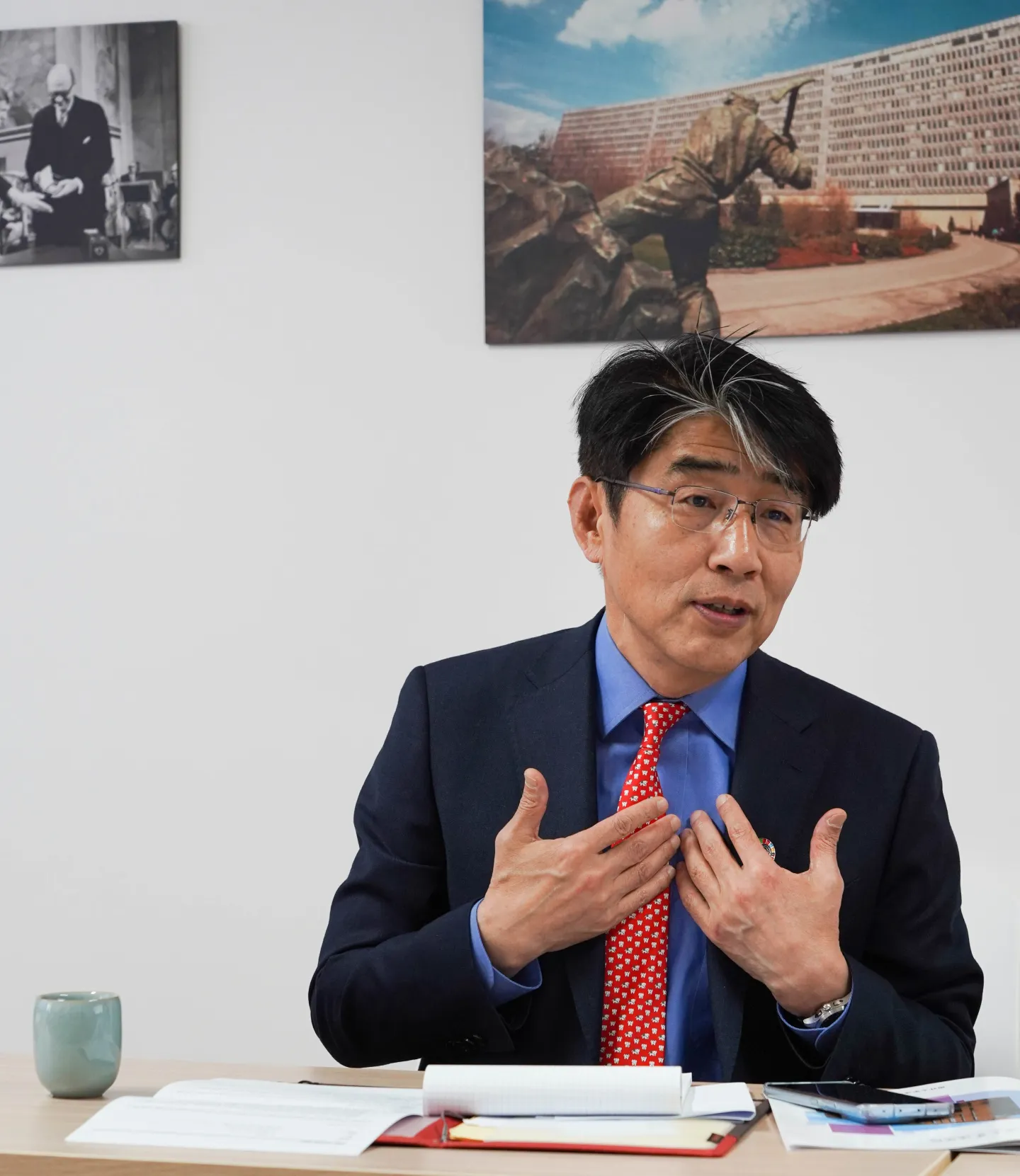
As a dedicated UN body, the International Labour Organization plays an indispensable role in promoting rights at work, creating decent employment opportunities, and enhancing social protection and social dialogue for all workers. China being one of ILO’s founding members, remains its key partner of cooperation today. In recent years, with China enjoying a rapid development in its economy and a significant rise in its international standing, its partnership with ILO has been growing and deepening.
To dig out the bond between China and the ILO, China Economic Daily conducted an exclusive interview with Mr. Changhee Lee, Director of the ILO Country Office for China and Mongolia.
I understand there is ongoing debate in the ILO how to protect workers’ rights against the backdrop of an age of digitization. With China’s economy developing rapidly and continuously giving birth to new forms of work, how could ILO guarantee its spirit of decent work have full coverage of the entire workforce?
We are living in a world of unprecedented changes and upheavals – including climate crisis, demographic changes, and other mega transformations. One of the mega transformations is rapid technological revolutions, which bring profound changes to the ways we produce, consume, and live – virtually every aspect of our lives and work.
New forms of employment include many diverse forms of work. And most prominent new forms of employment can be found in the platform economy. There are no official statistics at the global level. But it is clearly on the rise. The platform economy has great potential for driving economic growth and creating more jobs. But it comes with new challenges. How can we ensure the wealth created by platform economies is distributed in fair manner, instead of exacerbating existing inequalities? How can we balance a need for flexibility in enterprise operations with adequate protection to workers?
Virtually all countries, whether developed or developing, face these new challenges – not just China. That is also why the International Labour Organization decided to develop a new international labour standard to ensure decent work in the platform economy in 2025. Once adopted, the new international labour standard will provide a global reference for adequate protection to workers while allowing enterprises a flexibility, ensuring shared prosperity and social justice in the era of digitalization.
China has one of the most dynamic platform economies. Furthermore, China has introduced a series of new policies designed to provide proper protection to workers in the platform economy, who were not properly protected by the conventional labour laws due to their ambiguous employment contract status. I think China has many things to share with other member states of the ILO in the process of formulating new international labour standards on decent work in the platform economy.
China’s government has always attached great importance to employment and the protection of workers’ rights, thus has enjoyed a positive relationship of cooperation with the ILO. Would you please briefly introduce to us the efforts of ILO China office in promoting employment and offering safety nets, and what fruits such efforts have yielded?
Extensive collaboration between ILO and China began in the 1980s when China embarked on reform and opening. Ever since then, ILO has been working with the government, together with representatives of workers’ (ACFTU) and employers’ organizations (China Enterprise Confederation), to support China in establishing and improving labour legislation, creating more and better jobs, improving social security, strengthening occupational safety and health regulations, and enhancing social dialogue mechanisms for all workers in different forms of employment through policy advice, capacity building support and sharing international experiences, guided by ILO’s international labour standards.
Personally, I have had the privilege of working in China since early 2000s, witnessing the great transformation of the country, lifting people out of poverty, and creating more and better jobs. In particular, it was truly amazing to see how one local innovation would spread to other localities through horizontal learning facilitated by the central authority. Innovative practices of collective wage negotiation linked to skill development is one good example of such horizontal learning and replications. And today China’s vocational training system has been modernized to make it suitable for running smart factories.
Now the relationship between ILO and China is changing, as there are many things China can share with other countries.
China has entered a new phase of development. With China making more progress on its path to a full modernization, the labour governance system is bound to be further refined. ILO as a unique body with a robust working relationship with not one but three parties, namely the government, the employers’ representative and the workers’ representative respectively, what role would the ILO play in this process?
ILO is one of the oldest specialized agencies of the UN system. ILO is proud of its unique governance structure. Unlike other UN agencies, representatives of the governments sit together with representatives of employers’ and workers’ organizations in making important decisions of the ILO. It is because when decisions impacting on businesses and workers are made, the views of workers’ and employers’ representatives should be reflected. Tripartite governance of labour markets is widely practised in many countries, whether they are developed or developing. It is based on experiences of ILO member states that only when independent voices of employers and workers can be channelled through ‘social dialogue’ with the government, conflicts can be minimized, and optimal balance among stakeholders with conflicting interests can be achieved. I think this is in line with the brilliant idea expressed by the Chairman Mao’s in his ‘On Contradiction 矛盾论’, as it captures succinctly the dynamics of conflicts and harmony in modern society. In modern labour markets, there are inherent conflicts of interest, which should be recognized as a natural part of the modern economy and society.
That is why ILO works with not only the government but also ACFTU and CEC. I believe the tripartite way of managing labour market can make important contributions to China’s path towards a full modernization based on universal values expressed in the ILO’s Fundamental Principles and Rights at Work as well as China’s own institutional advantages.
With China taking up an increasingly important role in global governance, a growing number of “Chinese Solution” or” Chinese Wisdom” are expected to make their way into the international arena of labour governance as well as the formulation of related rules and regulations, paving the way for a higher standard of economic opening up. What’s your expectation on China’s role in global labour governance?
Each member state of UN and ILO has their own wisdom and solutions. Universal values and principles agreed at the multilateral institutions such as UN and ILO sum up global principles based on humankind’s historical experiences.
China is not just one of most outstanding development success stories in modern era – China has shown its wisdom from ancient times, as demonstrated by the genius Dujiangyan irrigation system and numerous examples.
I have many expectations on China’s contributions to improving global governance, as China is the G20 economy and at the same time the largest developing economy. I am eager to see China’s initiative of working with other developing countries in narrowing gaps between countries through improved global trade systems and practices for decent work and shared prosperity between and within countries, China plays leading roles, together with developed and developing countries, in achieving SDGs based on universal principles and shared values on human and labour rights and environmental sustainability, and China defends true ideal of multilateralism. In this respect, I am encouraged to see many new initiatives, including the Global Development Initiative, taken by China in recent years.
On labour policy areas, I think China can make meaningful contributions by supporting developing countries through South South and Trilateral Collaboration (SSTC) to ensure decent work and sustainable development. China has rich experiences to share with other developing countries in creating more and better jobs.
The interview was published by China Economic Daily at: 中国保障劳动者权益的经验可分享(中文)