

Employment in Focus blog series
How to make productive and full employment a reality in an uncertain and complex world?
Employment policies need to address a number of critical forces, which lead to both challenges and opportunities, including the climate change crisis; digital transformation; and demographics in terms of both the implications of the youth bulge and ageing processes.
23 October 2024
-
 Sangheon LeeDirector, ILO's Employment Policy Department (EMPLOYMENT)
The German poet Bertolt Brecht once said, “Wounds, however, leave scars”. This rather obvious statement is exactly what has happened to the global labour market since the pandemic broke out. When wounds are healed, scars are left, still haunting workers. Also, looking at countries around the world, the same wounds leave different scars, and in fact, the three year- long wounds are still with many.
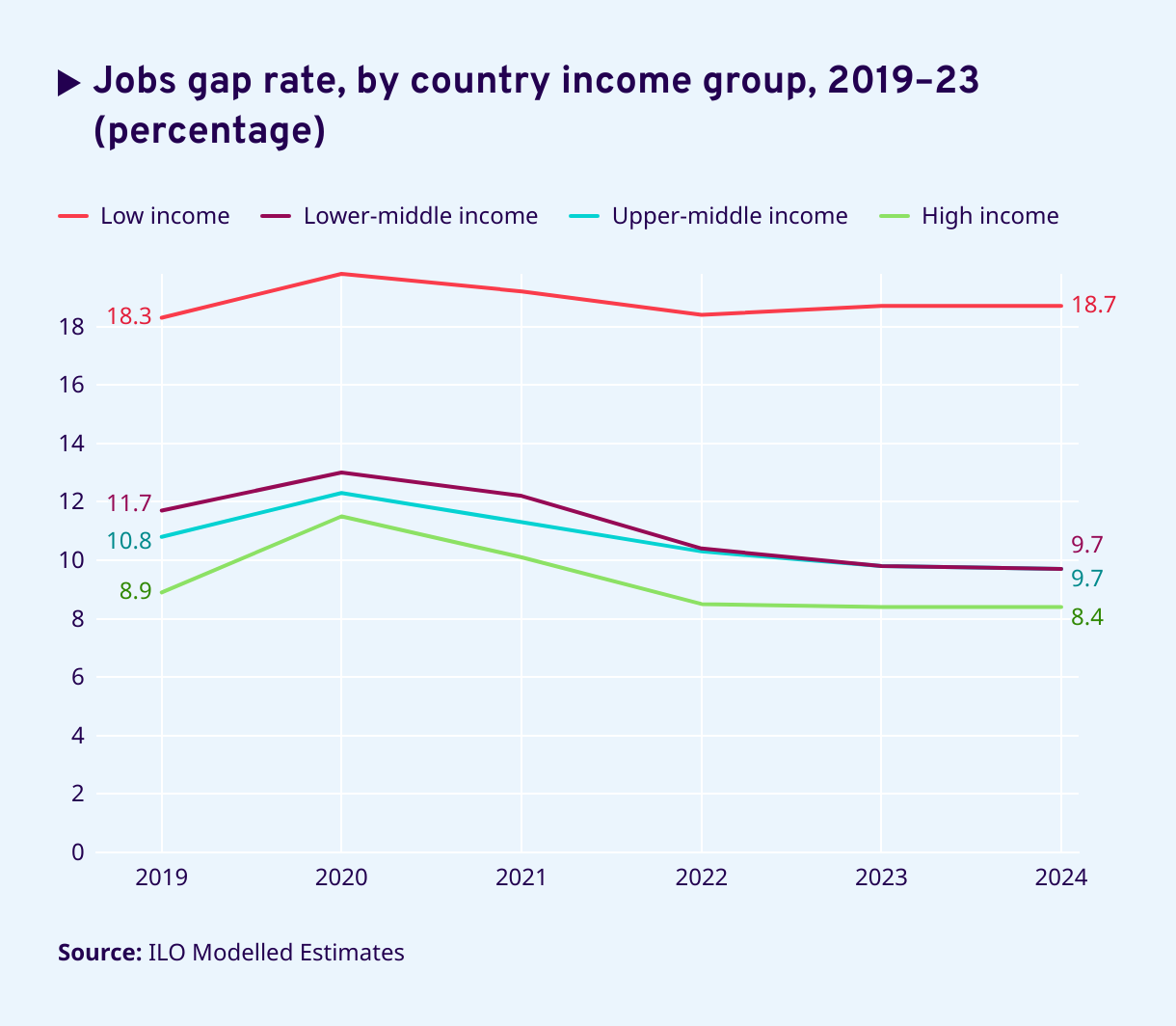
Employment recovery from the pandemic has been slow, uneven, and divided: Slow, as recovery was dashed by new economic and geopolitical developments; Uneven, as many developing countries were left behind mainly because they lacked financial resources to cushion against employment shocks; Divided, as all these developments have led to global employment divide where strong recovery is mainly confined to a group of advanced and upper-middle-income countries.
The ILO’s latest estimates of jobs gap* (which broadens the concept of unemployment to cover all workers who don’t have but want to have jobs) are very telling in this respect. In low-income countries, the jobs gap rate for women has been consistently higher than 20 per cent and is estimated at 22.8 per cent in 2024. For men, it stands at 15 per cent in 2024. The respective rates for high income countries are 4.7 per cent for women and 4.3 per cent for men and trends show that the gap is widening.
There are other parallel developments which are more structural. Technological transformation, climate changes and demographic shifts, for instance, call for unprecedented magnitude and speed of transitions for workers and enterprises. Certainly, the processes can bring the opportunities for large-scale creation of decent jobs, but they are largely “conditional”, as such opportunities will materialize only when proper and timely support in terms of time and money is provided to workers and enterprises.
These complex landscapes, both short- and long-term, pose a serious challenge for global employment. As it stands now, developing countries have little chance to achieve the SDG goals concerning full productive employment and decent work (SDG 8).
Then, what can be done? Most of all, we need new societal commitments to full and productive employment, with the clear recognition that decent jobs are not just about wages, they have positive effects on workers, families, communities and societies: in other words, decent jobs have large positive externalities. This means that decent jobs should concern all government policies, ranging from macroeconomic, industry, trade, education to labour market policies. The implications of these policies for decent jobs need to be carefully evaluated from the very beginning of policy discussion, rather than being considered as secondary or added on an ad hoc basis.
We need new societal commitments to full and productive employment, with the clear recognition that decent jobs are not just about wages, they have positive effects on workers, families, communities and societies.
This is why the ILO has been advocating comprehensive employment policy frameworks and supporting its Member States in formulating and implementing integrated actions to promote decent and productive employment. But given the nature of the challenges facing policymakers around the world, especially in developing countries, it cannot be business as usual in terms of policy solutions. Instead, much greater efforts are needed to build the necessary evidence base to ensure policy changes are in line with the realities on the ground. This means employment impact assessments of policies and diagnostics of the labour market, including focus on tackling dimensions, such as climate change and digitalization.
And processes also matter greatly. One key lesson we learned during the COVID-19 pandemic is that policymakers need to be flexible and adapt policy approaches in response to a rapidly changing context. We have also learned that effective tripartite dialogue is crucial in facilitating these agile approaches.
Going forward, it is important that employment policies address a number of critical forces, which lead to both challenges and opportunities, including the climate change crisis; digital transformation; and demographics in terms of both the implications of the youth bulge and ageing processes. Our current approach to employment policies needs to adapt to these factors while addressing the longer-term challenges – we need to find new and innovative ways to ensure that public policies can promote decent and productive employment policies effectively. It is not a one-size-fits-all approach!
The issue of decent jobs is too important to leave to some experts and government departments.
The issue of decent jobs is too important to leave to some experts and government departments. This concerns all actors in the society and requires a whole-of-society approach in which the social partners play a key role. The urgency for such an approach is even greater in today’s world marked by growing uncertainty and complexity.
* The jobs gap rate is a measure of labour underutilisation that captures the lack of access to a job. In particular, this new indicator encompasses all persons who want employment but do not have a job. It is measured as (unemployment + potential labour force + willing non-jobseekers) / (unemployment + potential labour force + willing non-jobseekers + employment). Latest data available at: https://ilostat.ilo.org/methods/
About the author
-
Sangheon LeeDirector, ILO's Employment Policy Department (EMPLOYMENT)
Sangheon LEE is the Director of the Employment, Job Creation and Livelihoods Department (EMPLOYMENT), which leads the ILO’s action for promoting full and productive employment by developing integrated employment, development and skills policies. Prior to becoming the Director of EMPLOYMENT, he was the Special Adviser to the Deputy Director-General for Policy on Economic and Social Issues (2014-18), and an acting director for Research Department (2017-18). Mr Lee has written extensively on economic, employment and labour issues, including articles in academic journals, as well as edited volumes. Mr Lee holds a PhD in Economics from Cambridge University.
Related content

Portal
Employment Policy Action Facility

Employment in Focus blog series
Blogs on employment and labour market

Topic portal
Employment promotion