

Hazardous work on the road: ILO training helps combat worst form of child labour
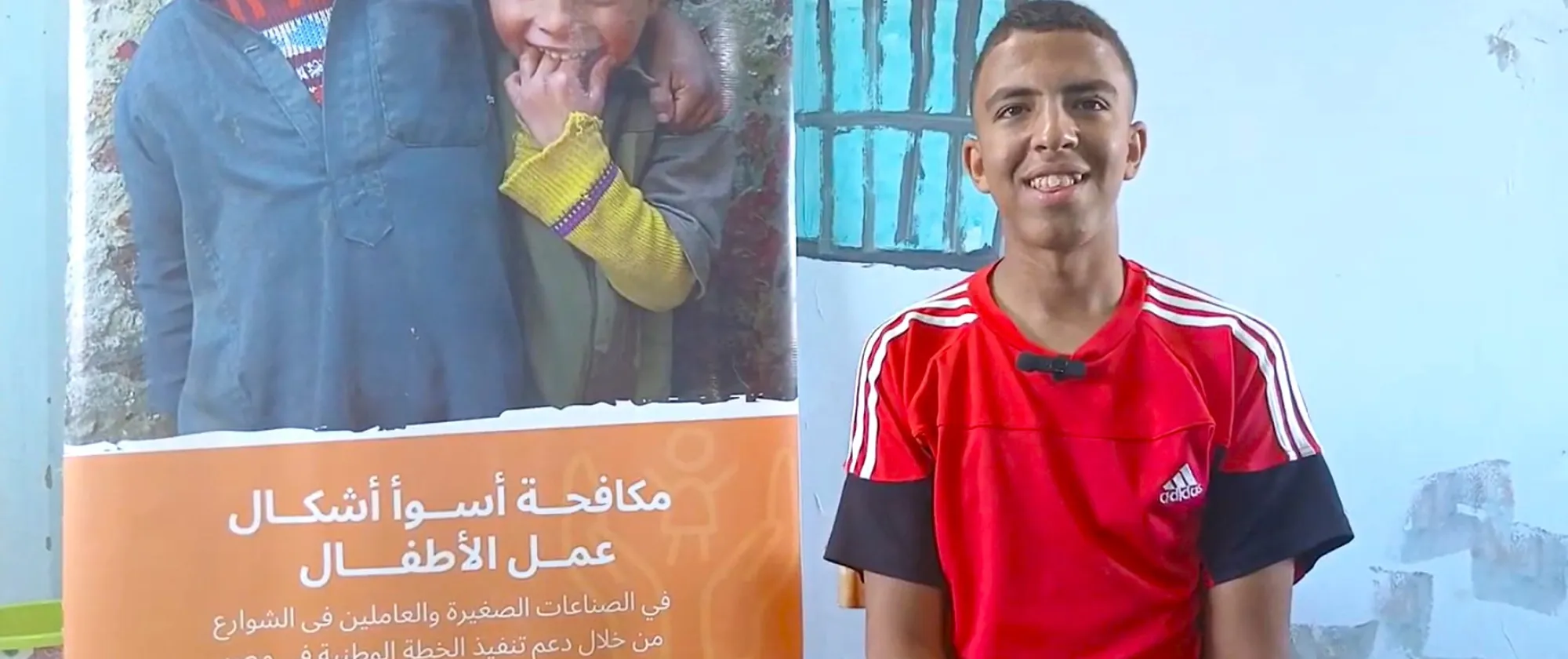
16-year-old Mohamed transported hazardous materials for work, placing him in the worst form of child labour. With support from ILO trainings, he put that reality behind him and found more suitable work. Spearheading a dual approach to combatting child labour, an ILO training also helped his mother gain financial independence.
6 January 2026
Mohamed Mostafa, 16, was living a life in Assiut Governorate that did not match his young age. He would start his day before sunrise, sometimes waking up at four in the morning to drive a tricycle to transport electrical appliances, construction debris, or fertilizer for farmers. He spent long hours under the sun and would occasionally face accidents; once, he fell inside a household goods shop and injured his arm. Yet he never saw any of this as dangerous – he assumed it was normal. He believed this is what life looked like for a child who has to work.
He did not know that what he was experiencing constituted one of the worst forms of child labour criminalized under the Egyptian Labour Law – which prohibits employing children in hazardous work before 18 and protects adolescents from any tasks that may threaten their safety – until he joined the International Labour Organization’s awareness programme SCREAM.
The programme aims to strengthen children’s and young people’s understanding of child labour and their rights, and to empower them to become active voices against exploitation. This takes place within the framework of the ILO project Eliminating the Worst Forms of Child Labour in Small Industries and on the Streets through Supporting the Implementation of the National Action Plan in Egypt, under the slogan “Empowerment through Education and Learning,” ETEL Egypt – funded by the Italian Agency for Development Cooperation (AICS).
SCREAM focuses on using different forms of art – such as theatre, drawing, and music – as tools for self-expression, identifying violations, encouraging a return to education, and building a protective environment for children’s rights within families, schools, and communities. Mohamed Mustafa was one of the children targeted by this training and, this became the first turning point in his life.
He decided to enrol in a vocational training course on mobile phone maintenance provided by the project, and there he discovered for the first time what a safe work environment truly meant. The trainer insisted on wearing gloves, constantly warned participants about the risks of the tools, and explained how they could protect themselves. For the first time, Mohamed realized the difference between a job that exposes him to danger and a job that preserves his safety and dignity.
As soon as the training ended, he went to a mobile repair shop in his village and asked for a chance to work there. He was accepted, and he began a new kind of day – one that no longer started at four in the morning or risked his safety, nor ended under the burning sun or in risky trips on the road. Smiling, Mohamed says:
Now I sleep comfortably… and no one wakes me up to work on the tricycle anymore.
Mohamed Mostafa
But the change was not limited to Mohamed alone. The ETEL Egypt project adopts a dual approach to combatting child labour by simultaneously protecting children and financially empowering parents. While Mohamed participated in trainings, his mother joined the ILO’s Get Ahead programme under the same project, which aims to economically empower families so that children are not pushed into work.
She previously sold a limited range of grocery items, but after the training she approached her business with an entrepreneurial mindset. She learned how to assess the needs of the local community and how to manage a small enterprise more efficiently. Over time, her small business expanded, and she began offering sugar, rice, ghee, soap, and cleaning products to better meet customers’ needs and improve her family’s income.
Mohamed’s story is one of dozens of stories being transformed by ETEL Egypt. They are stories that begin with hazardous, unsafe child labour, and end with children back in school or with adolescents in clean and safe professions – and with parents, specifically mothers, who have become more capable of supporting their families.
Related content
From factory work to the classroom: Mahasen’s journey out of child labour
Relevant projects

ETEL project
Combating the worst forms of child labour through the implementation of the National Action Plan