


Gender and child labour: ACCEL Africa’s Gender Lab at the 6th Global Conference on the Elimination of Child Labour
At the 6th Global Conference on the Elimination of Child Labour, ACCEL Africa contributed an interactive Gender Lab designed to highlight how gender inequalities shape child labour and access to opportunity.
18 February 2026
The Lab offered participants a short, structured experience, approximately 10 minutes, inviting them to reflect on how social norms influence household decisions, labour patterns and educational outcomes.
Why gender matters in child labour
Child labour does not affect children in the same way and gender roles and expectations often determine, amongst others:
- Who takes on unpaid care responsibilities
- Who manages the household income
- Who works or continues schooling
- Who participates in decision-making
In many communities, girls face a double burden: labour in fields or family businesses alongside domestic and care work. Boys, meanwhile, may face pressure to contribute income early, shaped by expectations around masculinity and provision.
By placing gender at the centre of discussion, the Lab aimed to show that preventing child labour requires understanding and addressing these structural dynamics.
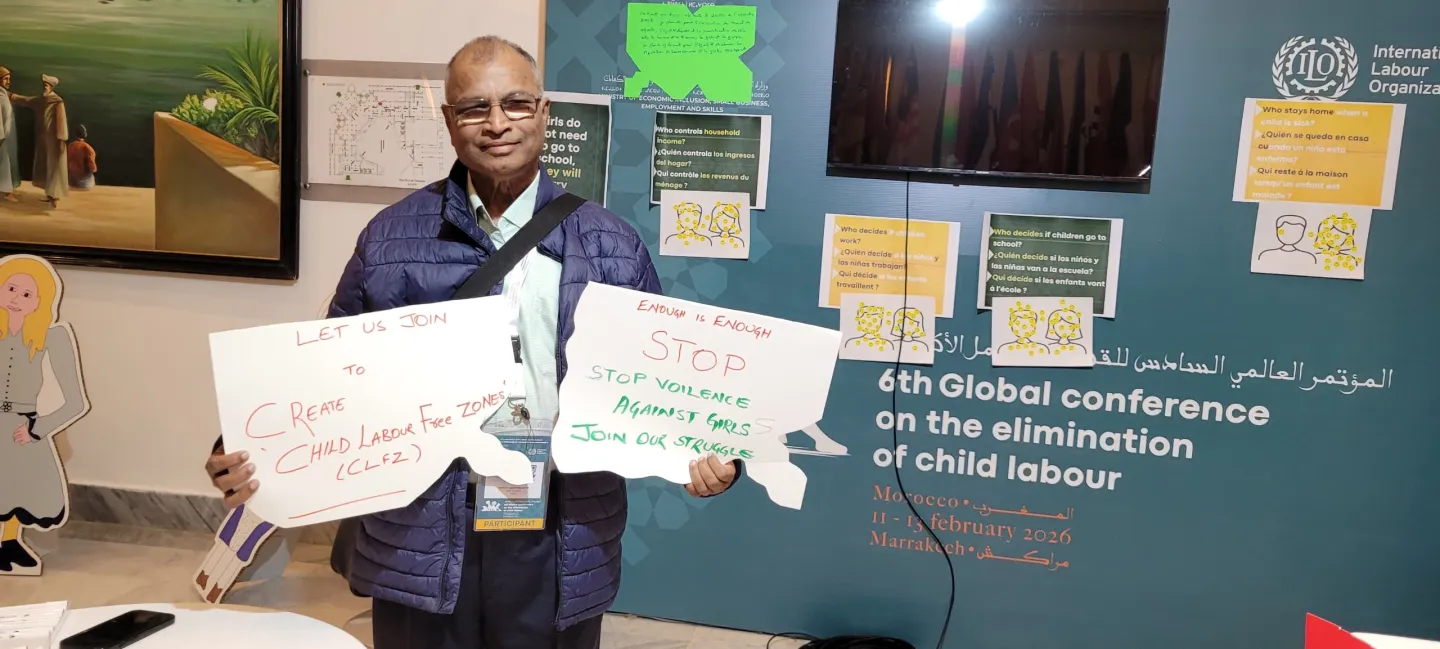
The Gender Lab was designed as a participatory space. Visitors were first introduced to a series of prompts that framed the discussion and encouraged reflection. Then, participants were then invited to respond to questions displayed on a wall, amongst others:
- Who should provide childcare?
- Who controls household income?
- Who decides if children go to school?
Using stickers, participants visually expressed their views. The resulting display provided an immediate representation of perceptions surrounding gender roles.

This simple interaction encouraged discussion among visitors and opened conversations about how norms within households and communities influence children’s engagement in labour.
Beyond identifying challenges, the Lab also invited participants to share ideas and existing practices. Contributions focused on areas such as:
- Community-based childcare solutions
- Women’s economic empowerment
- Redistribution of unpaid care work
- Engagement of men as allies
- Gender-responsive national action plans
- Youth and female leadership
Each idea responded to three questions:
- What problem are you addressing?
- What is new about your approach?
- How does it reduce child labour?
The collection of proposals created a visual map of ongoing and potential actions, demonstrating the diversity of strategies being implemented or envisioned.

Before leaving, participants were invited to share a pledge. These reflections formed a collective display of commitments, highlighting that eliminating child labour is not only about enforcement and programming, but also about transforming social expectations.
The Gender Lab reflected ACCEL Africa’s commitment to integrating gender-transformative approaches across its activities. By embedding gender considerations into prevention strategies, the project aims to address not only the symptoms of child labour but also the norms and inequalities that sustain it.
Related content

Accelerating action for the elimination of child labour in supply chains in Africa (ACCEL Africa)

ILO Live
6th Global Conference on the Elimination of Child Labour
Relevant projects
Accelerating action for the elimination of child labour in supply chains in Africa (ACCEL Africa)