

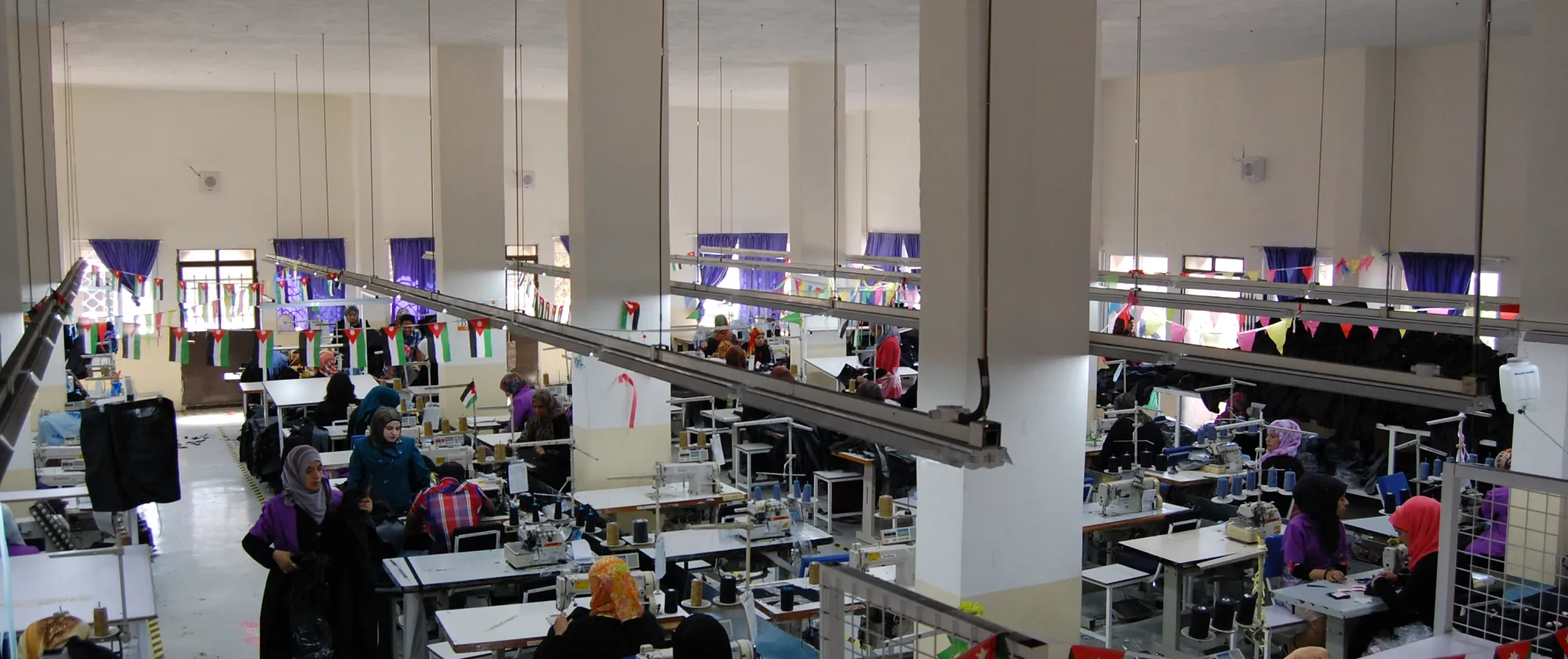
From factory floor to championing workers in Jordan garment sector
With guidance from their union and the ILO, Amal and Ahlam are helping garment workers raise concerns and resolve issues through social dialogue.
23 July 2025
AMMAN (ILO News) - In Jordan’s garment sector, where the hum of sewing machines fills long days, workers often face difficult conditions and limited opportunities to speak up. For Amal Youssef Mansi and Ahlam Younes Abu Zayed, their experience on the factory floor shaped a quiet determination to build trust and communication between workers and employers.
Amal: Speaking up for fairness
Amal, from northern Jordan, began working in garment factories in 2003, learning to sew from scratch on busy production lines. After eight years of work and a break to raise her family, she returned to the industry — only to see her new factory close down without paying workers two months’ wages.
While some colleagues hesitated, Amal refused to accept silence. She reached out to the trade union, the Ministry of Labour and the media until she and 45 co-workers, including some who had already left, recovered every dinar they were owed.
“They said I’d never find work again if I kept pushing,” she recalled. “But I couldn’t let it go.”
Her determination caught the union’s attention. Amal was invited to join a trade union training initiative supported by the International Labour Organization (ILO) and the Government of Canada. With guidance from Moroccan expert unionist Thoraya Lahrech, she learned how to negotiate with management, follow up on grievances, address harassment, and — for the first time — use a laptop to track cases and share information.
“Before, I was doing it on my own. The training gave me tools, but also the confidence to keep going.”
Ahlam: Building skills and trust
Hundreds of kilometers south, in Aqaba, Ahlam brought a strong foundation in vocational training and leadership long before she entered the garment sector: 1,400 hours of tailoring courses, life skills and leadership workshops. Her supervisors recognized her potential but kept her on the production line for her technical skills.
Still, she found ways to stand up for her co-workers. When a colleague was denied a rest break, Ahlam stepped in to cover her work and speak to management. This spirit of quiet courage motivated her to run for a union post. Though she lost her first election by three votes, her co-workers encouraged her to try again, and she won.
Like Amal, she took part in the same training collaboration with Thoraya Lahrech, the union and the ILO, learning how to mediate disputes, raise sensitive issues like harassment, and build trust across different worker groups — including migrant workers.
Structured support for worker representation
Amal and Ahlam are part of a broader, deliberate effort by the General Trade Union of Workers in Textile, Garment and Clothing Industries, with ILO support, to strengthen real worker representation from the ground up. Over the past three years, this partnership has combined in-person and online training, practical coaching, and grassroots mentoring to identify trusted workers and give them the mandate and resources they need to carry out their roles effectively.
“When workers like Amal and Ahlam find their voice, they don’t just solve individual problems — they change mindsets inside factories. Representation must be built through trust, knowledge and daily presence,” said unionist Thoraya Lahrech.
“We see change when workers have clear roles, knowledge and the confidence to speak up. Amal and Ahlam’s journeys show that trust grows, and factories benefit,” said Fathalla Al Omrani, President of the union.
“These experiences show that local leadership makes dialogue real. When workers feel heard, workplaces become fairer and more resilient,” said Muna Abdo, ILO.
Putting training into practice
For Amal in Irbid, the work happens in short breaks and quiet corners. Workers come to her when they’re denied sick leave, pushed to work through injuries, or shouted at by supervisors. One young woman wanted to resign because her husband asked her to stop working — but her manager refused to release her final pay and insulted her. Amal stepped in, mediated, and ensured the worker got her full entitlements without having to go to court.
“Before, many didn’t even know the union existed,” Amal said. “Now they come to me — and that changes everything.”
In Aqaba, Ahlam regularly visits six factories, making four visits a month to each. At first, some managers resisted her presence — preferring just one visit a month — but when they saw that her work helped prevent issues from escalating, they welcomed her in.
She listens to workers’ stories of discrimination, unsafe working conditions and everyday conflicts that, left unaddressed, could easily grow. In one case, when a dispute between two workers nearly turned violent, Ahlam helped the factory form an investigation committee, ensuring both sides were heard and the problem was resolved fairly.
“It took time to build trust,” she said. “But now they see I’m here to help — not to fight, but to make work better for everyone.”
Looking ahead
Both Amal and Ahlam say their work is about building bridges — between workers, and between workers and employers.
“When workers feel heard and respected, everyone benefits,” said Amal.
“Speaking up encourages others to do the same,” Ahlam added.
Their journeys remind us that strengthening workers’ voices doesn’t require grand gestures. It starts with knowledge, trust and a willingness to stand beside someone who needs it, every day, one conversation at a time.
Related content

Country Portal
Jordan