


Digitalization in employment policies
Digital technology is reshaping the world of work, creating both opportunities and challenges. The ILO supports the integration of digital transformation into employment policy frameworks by focusing on creating decent work while addressing exiting decent work deficits through coherent policies that harness the benefits of digitalization, support productivity and job creation, while mitigating challenges like job displacement and widening inequalities through measures such as digital inclusion and social dialogue.
30 October 2025
The COVID-19 pandemic led to a further reconceptualization of the nature of work and the workplace, while accelerating the shift of government services and people’s livelihoods on to virtual and digital platforms. Consequently, many countries have made digitalization a key policy goal, though efforts are needed to ensure that they are effectively addressed in national employment policies frameworks.
According to the ILO’s Global Employment Trends for Youth 2022 report, achieving universal broadband coverage by 2030 could lead to a net increase in employment of 24 million new jobs worldwide, of which 6.4 million would be taken by young people. Meanwhile, one important finding of the report Digital transformation in employment policies is that regardless of the level of digitalization in a country, it is possible to embrace digitalization in employment policies. As many e-government initiatives around the world started when countries still had limited internet penetration, and they made progress over time, thus demonstrating that strategic long-term planning can overcome the divide with “adaptable” policies. In addition, to mitigate negative impact and tap into the potential of digitalization, tripartite social dialogue as promoted by the ILO, is pivotal.
Policy implications
To support decent work creation and address potential job destruction effects and job quality reductions, transformations in the labour market brought on by digitalization should be addressed by comprehensive policies frameworks.
Key areas to consider include among other:
- Regulations (national and international): appropriate regulations at both national and international levels have not yet been able to catch up to an exponentially increasing levels of digitalisation. Regulations will be a key challenge over the coming years. For example, in the case of regulations of digital labour platforms. The growth in the platform economy and platform work represents an opportunity for job creation and more flexible organization of production processes, but also a challenge in terms of fair competition among enterprises and achieving levels of employment protection and social protection for workers which are consistent with decent work standards and the international labour standards. To address this, the International Labour Conference is currently discussing the issue of digital labour platforms. An international Labour Standard on platform work would significantly contribute to the guidance of employment policy formulation at national and sub-national levels.
- (Digital) transition to formality: digitalisation can strengthen the transition to formality but can also increase it if not regulated and included in policy. Formulation of employment policy frameworks must therefore take this issue into consideration. (Transitioning to the formal economy through technology, or E-formality)
- Digital skills: The digital transformation of the labour market has a high impact on the demand for digital skills. At the same time as it is becoming increasingly difficult to assess such changes in demand. (Skills for Digital transformation / Digitalisation of skills systems)
- Digital inclusion: digital access is diverging amongst and between countries/areas/ages/genders/groups in society. On the one hand, digital access in urban areas far outweighs that in rural areas and many (vulnerable) groups are potentially left behind as digital divides grow. At the same time as disadvantaged groups could have potentially better access to the labour markets through technology (such as refugees and other forcibly displaced people as well as people with disabilities). Highlighting digital inclusion in employment policy formulation and implementation can support a fair inclusion into labour markets of otherwise marginalised groups.
- Diagnostics of digital progression in the labour market: In addition to the economic, institutional and employment assessments and diagnostics, the evolution of future of work issues, including the digital and the green economies, is crucial for an evidence based and realistic employment policy formulation. (Digital Employment Diagnostic Guidelines).
- Digital entrepreneurship: In many countries, small businesses and independent workers are the primary creators of employment. Digital tools have the potential to help a business become more productive and access new markets. Various tools such as digital payments and e-commerce can reduce transaction costs and bring services to hard-to-reach areas and marginalized populations, including for youth. Given that entrepreneurship is an important component of employment policies, ILO is developing knowledge in this area of work that will support policy formulation.
- Digital infrastructure: A key roadblock to more and better digital employment is a county’s capacity to provide universal, affordable and good quality high-speed internet (or broadband), which is dependent on a reliable electricity supply. “Mobile broadband internet,”. Access and use continue to be much lower in developing regions. Although this is beyond the expertise of the ILO, it is an important aspect to consider in policy formulation.

Partnerships
United Nations Group on the Information Society for Digital Transformation

International events
WSIS+20 High-Level Event
Related content

Portal
Observatory on AI and Work in the Digital Economy

Report
Digitalization and Employment, A Review

Publication
Towards decent work for young refugees and host communities in the digital platform economy in Africa: Kenya, Uganda, Egypt

Report
Global Employment Trends for Youth 2022: Investing in transforming futures for young people
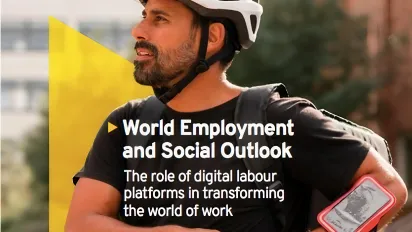
World Employment and Social Outlook 2021
The role of digital labour platforms in transforming the world of work

Promotion, inclusion and protection of refugees and host communities in the digital and gig economy