

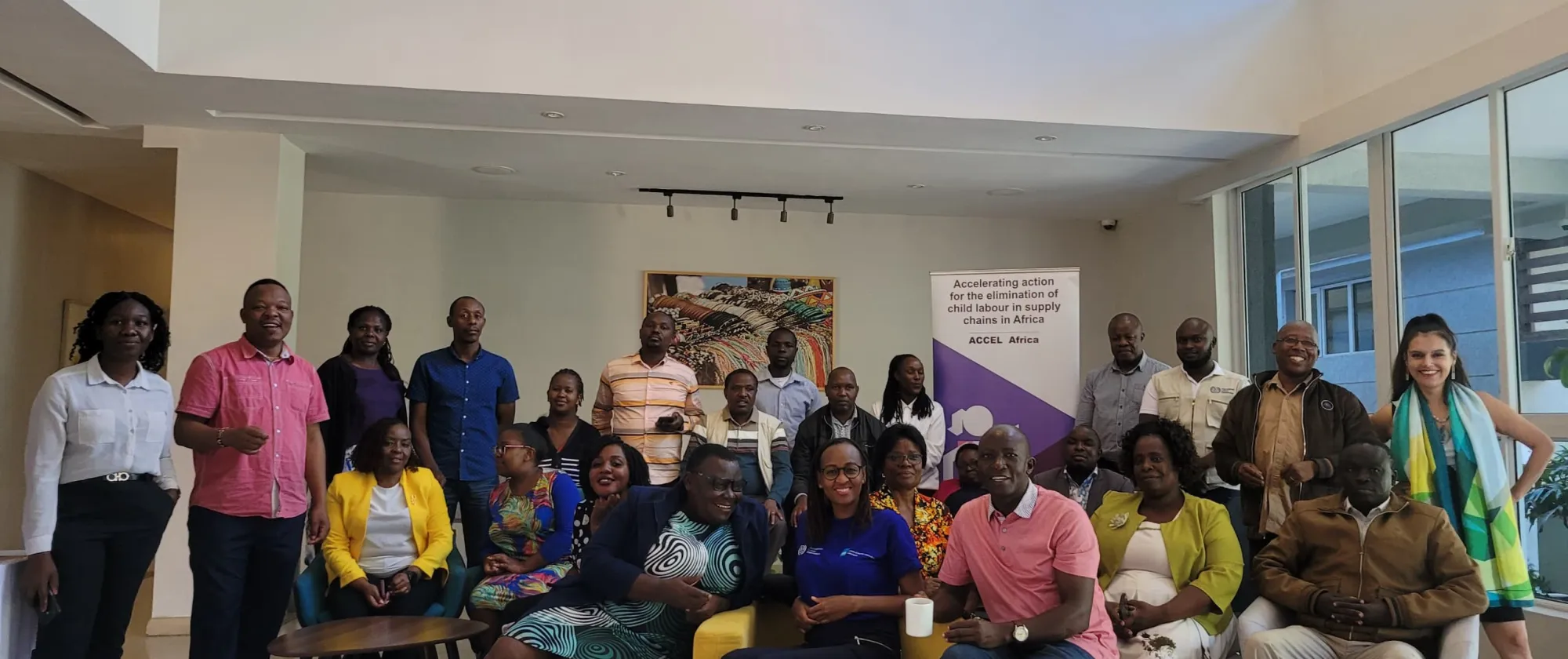
Addressing knowledge gaps and sustainable financing for the elimination of child labour
The ACCEL Africa project trained County Child Labour Monitoring Committees (CCLMCs) in Kenya on financial sustainability, equipping them with skills in fundraising, crowdfunding, and social enterprises. Four counties developed proposals and are tasked with securing financial solutions by year-end to sustain child labour prevention efforts.
7 February 2025
Naivasha, Kenya (ILO News) - The fight against child labour in Africa’s supply chains demands sustainable, community-led solutions. Recognizing the critical role that County Child Labour Monitoring Committees (CCLMCs) play in preventing and addressing child labour, the ACCEL Africa project organized a comprehensive training on "Addressing Knowledge Gaps and Sustainable Financing for the Elimination of Child Labour."
The training, which brought together CCLMCs from four counties, aimed at equipping them with the tools and knowledge to secure long-term funding for their efforts. CCLMCs play a vital role in monitoring and responding to child labour cases, but their work is often hindered by two major challenges:
- Many committees rely heavily on external, project-based funding, making them vulnerable once donor support phases out.
- A lack of training and exposure to alternative financing models prevents these structures from exploring self-sustaining funding sources.
By equipping CCLMCs with skills in project development, fundraising strategies, and social enterprise models, the training provided practical solutions to ensure financial independence and long-term impact in the fight against child labour.
The event focused on three key objectives:
- exploring innovative financing mechanisms to help CCLMCs achieve financial self-sufficiency,
- strengthening the capacity of community structures to leverage funding opportunities and reduce dependence on external donors,
- and promoting local ownership and leadership to embed child labour elimination efforts within community governance and social structures.
Through hands-on exercises, case studies, and interactive group work, participants gained practical skills to develop sustainable community-driven projects, explore crowdfunding and social enterprise models, and engage with businesses and funding sources such as Public-Private Partnerships (PPPs) and Corporate Social Responsibility (CSR) initiatives. Additionally, they enhanced their ability to monitor and evaluate projects effectively, ensuring long-term sustainability and impact.
This initiative aligns closely with ACCEL Africa’s Output 3.2, which aims to strengthen the capacity of stakeholders to identify and leverage resources to prevent and reduce child labour in supply chains. By bridging knowledge gaps and introducing sustainable financing strategies, the training complements past efforts to establish and strengthen CCLMCs, ensuring that these structures remain resilient and effective.
The training successfully laid the groundwork for a more financially independent approach to child labour elimination.
As the training concluded, discussions centered on the way forward. The emphasis was on continuous mentorship, knowledge-sharing, and practical application of learned skills. Participants were encouraged to implement their financing strategies and explore partnerships that would enable long-term sustainability.
Notably, the four participating counties successfully developed proposals for implementation, outlining concrete strategies to sustain child labour monitoring efforts. As a next step, they were tasked with identifying and securing financial solutions by the end of the year, ensuring that their initiatives transition from planning to action.
The event reaffirmed the importance of equipping community structures with both technical and financial expertise. When communities take ownership of child labour prevention efforts and have the financial means to sustain them, the impact becomes lasting and transformative.
Relevant projects

Accelerating action for the elimination of child labour in supply chains in Africa (ACCEL Africa)