

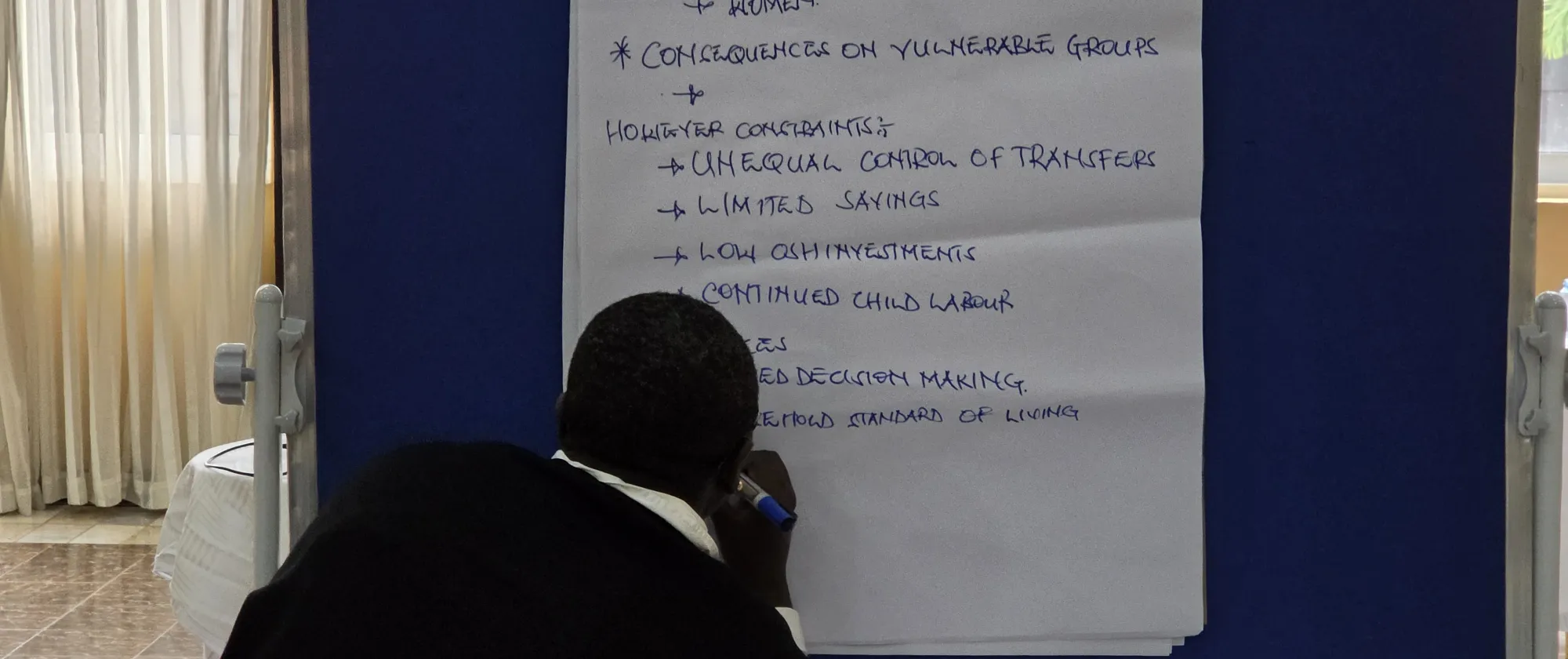
ACCEL Africa strengthens partner capacities in Uganda on financial management, M&E and gender-responsive programming
ACCEL Africa strengthened the capacities of implementing partners in Uganda through a five-day workshop on financial management, monitoring and evaluation, and gender-responsive programming. The training supported partners to improve compliance with ILO procedures, strengthen results-based reporting, use data for decision-making, and integrate gender considerations into activities to eliminate child labour in Uganda’s coffee and tea supply chains.
8 May 2026
Entebbe (ILO News) — The ACCEL Africa Project brought together implementing partners in Uganda last week for a five-day capacity-building workshop aimed at improving the planning, implementation, monitoring and reporting of interventions to eliminate child labour in the coffee and tea supply chains.
Funded by the Government of the Netherlands, ACCEL Africa works to accelerate the elimination of child labour in Africa by addressing both its root causes and its manifestations in supply chains. In Uganda, the project supports interventions that strengthen institutional capacity and promote practical solutions for communities affected by child labour.
The workshop focused on three critical areas for effective project delivery: financial management, monitoring and evaluation, and gender-responsive programming. It was designed to support partners who are implementing activities through ILO implementation agreements and who play a central role in delivering results at national, district and community levels.

Over the first two days, participants reviewed key ILO financial and administrative requirements related to implementation agreements. Sessions covered the project life cycle, financial implications of implementation, expenditure planning, eligible costs, supporting documentation, procurement, fraud prevention, ethics, compliance and risk management. Partners also worked through financial and technical reporting templates, with a focus on linking expenditures more clearly to programmatic results.
The training highlighted that sound financial management is not only an administrative requirement, but also an essential part of accountability. By strengthening partners’ understanding of ILO rules and procedures, the workshop aimed to reduce risks of non-compliance, improve transparency in the use of donor funds, and support more efficient implementation of activities on the ground.
Monitoring and evaluation formed the second major pillar of the workshop. Participants were introduced to the ACCEL Africa M&E framework, the project’s results-based management approach, the logical framework, theory of change and indicators. Practical exercises helped partners identify common reporting errors, improve the quality of data collection, and better understand how to use evidence for decision-making.
The M&E sessions also encouraged partners to move beyond activity-based reporting and focus more clearly on results. Discussions emphasized the importance of collecting reliable data, using standardized tools, documenting progress against indicators, and ensuring that reports reflect not only what was done, but what changed as a result.
Knowledge sharing, learning systems, accountability and sustainability were also addressed. Partners reflected on how evidence generated through project implementation can inform decisions, improve coordination, and support the long-term sustainability of interventions beyond the duration of project funding.
The final part of the workshop focused on gender and its connection to child labour. Sessions explored how gender norms shape household responsibilities, access to education, control over income, economic participation and exposure to child labour risks. Participants examined how women, men, female children and male children may be affected differently by poverty, informality, care responsibilities and work in agricultural supply chains.

The workshop also introduced the ACCEL Africa Gender Strategy and supported partners in applying gender analysis tools to their own activities. Practical group work helped participants identify gender-related risks, strengthen the collection and use of sex-disaggregated data, and design interventions that are more inclusive, equitable and responsive to the realities of communities in Uganda.
The event's integrated approach is expected to improve the quality of implementation, reporting and learning under ACCEL Africa in Uganda.
Relevant projects

Accelerating action for the elimination of child labour in supply chains in Africa (ACCEL Africa)