

Serbia National Child Labour Survey 2021
This report presents the results of the first Child Labour Survey conducted by the Statistical Office of the Republic of Serbia in 2021 with technical support from the International Labour Organization (ILO) through the MAP16 project. The survey is based on the latest international standard on child labour measurement and its main objectives are to estimate the prevalence of child labour and of hazardous child labour in Serbia.
The main objectives of the research are to estimate the prevalence of child labour in Serbia disaggregated by the main demographic and employment characteristics and to estimate the prevalence of hazardous child labour in Serbia. Since this is the first child labour survey in Serbia, the results in this report are the only available estimates of child labour. ILO conducted an assessment of child labour in agriculture in Serbia in 2018. However, this research goes further, since it investigates child labour in general and does not focus only on agriculture.
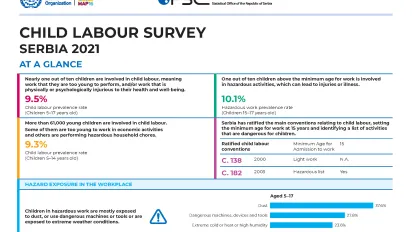
Child labour affects nearly one in ten children aged 5 to 17 in Serbia in 2021. However, research confirms previous findings that child labour is present in agriculture and non-urban areas. Work in the household is seen as the way in which children acquire work habits and contribute to production for own-use or for profit in agriculture. Children are engaged in animal production, mixed farming and growing of perennial and non-perennial crops. Child labour was not observed in industry and construction (sectors B–F NACE Rev 2.), neither for younger nor older children. It is assumed that this is due to two reasons. Parents are probably aware that it is too dangerous for children to work in those sectors (e.g. in mines or on construction site) and it is risky for employers to engage children in those sectors. On the other hand, subsistence agriculture provides opportunity for child labour in non-urban areas. Most often, children in hazardous work are exposed to dust, extreme cold, heat or high humidity; work with dangerous machines, devices or tools; and their bodies are in awkward positions. Hazardous work is mostly concentrated in the following occupations: field crop and vegetable growers, crop farm labourers and mixed crop and animal producers.
This report shows the key areas of child labor that require urgent action. There are 14,000 children aged 5–14 that are exposed to hazardous work, representing 2.2 per cent of children in this age group, and 21,000 children aged 15–17 (10.1 per cent). While the share of children aged 15–17 in hazardous work is low, it is not a negligible issue.
The results of this study are expected to guide development partners and other concerned agencies in prioritizing areas for immediate interventions to eliminate child labour, and take actions to review policies and programs on child protection. The results are especially important for the Ministry of Labour, Employment, Veterans and Social Policy (Labour Inspection and Centres for Social Work) and the Ministry of Education, Science and Technological Development. Overall, the results of the report will be important to monitor the progress in reducing child labour and in devising policies to reduce child labour in Serbia.
Read also the key results of the Child Labour Survey 2021:
Additional details
Author(s)
- ILO, SORS
References
- ISBN Web PDF: 978-92-20392-76-8
- ISBN EPUB: 978-86-6161-235-0
Related content
Fact sheet
At a glance - Serbia National Child Labour Survey 2021
Relevant projects
MAP16: Measurement, awareness-raising and policy engagement to accelerate action against child labour and forced labour

Measurement, Awareness Raising, and Policy Engagement (MAP16) Project

Towards the first generation free of child labour
Regional Initiative Latin America and the Caribbean Free of Child Labour
MAP16
MAP16 Project: Measurement, awareness-raising and policy engagement to accelerate action against child labour and forced labour