


Environmental, Social and Governance (ESG)
Leading the sustainability agenda: Global and regional insights for Employer and Business Membership Organizations
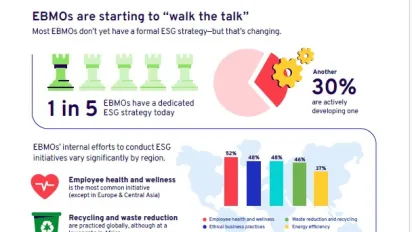
This report outlines key findings and insights of a survey on Environmental, Social, and Governance issues (ESG) conducted by the ILO among employer and business membership organizations worldwide.
Employer and Business Membership Organizations (EBMOs) are uniquely positioned to drive ESG (Environmental, Social, and Governance) initiatives, leveraging their cross-sectoral reach, technical expertise, and policy influence. By championing ESG, EBMOs can enhance their visibility and credibility, attract new members, and provide valuable services such as ESG training and advisory. This leadership not only benefits the organizations themselves but also empowers their members to improve performance, access sustainable finance, and navigate evolving regulatory landscapes. Furthermore, EBMOs play a critical role in preparing businesses for stricter ESG regulations by offering compliance support and advocating for coherent policies. Their involvement ensures that companies, especially small and medium-sized enterprises (SMEs), remain competitive and resilient in global markets.
Between November 2024 and March 2025, the ILO Bureau for Employers’ Activities (ACT/EMP) conducted a global survey among EBMOs. This survey aimed to gather insights on the services and activities that EBMOs offer in relation to Environmental, Social, and Governance (ESG) issues, identify who uses these services, and assess the benefits they bring to both EBMOs and their members. The survey was conducted online and gathered responses from 90 EBMOs in 65 countries across five regions: Africa, Arab States, Asia and the Pacific, Europe and Central Asia, and Latin America and the Caribbean. The regional distribution of respondents EBMOs was as follows: Latin America and the Caribbean (35 per
cent), Africa (32 per cent), Asia and the Pacific (14 per cent), Europe and Central Asia (12 per cent), and the Arab States (7 per cent). An equal share of women and men responded to the survey.
In this report, ESG serves as a framework for evaluating an organization’s business practices and performance regarding various sustainability and governance issues. Additionally, ESG provides a method for assessing business risks and opportunities in these areas. Furthermore, it enables companies to address and report and/or communicate on their environmental, social, and governance practices.
Additional details
References
- DOI: https://doi.org/10.54394/GZYG0175
- ISBN Web PDF: 9789220424063
See also
ESG (Environmental, Social and Governance)
Leading the ESG agenda: Global and regional insights for Employer and Business Membership Organizations