


Ethiopia
Skills
Objective
The ILO, through the PROSPECTS partnership, aims to enhance access to inclusive, quality and market-relevant skills training for forcibly displaced persons (FDPs), host communities (HCs), youth, and persons with disabilities. Through demand-driven vocational training, digital skills development, work-based learning and apprenticeship programmes, the ILO is equipping individuals with the competencies needed to access decent work, foster resilience, and promote social inclusion in displacement-affected areas.
Technical and Vocational Education and Training
The ILO is investing in inclusive, demand-driven vocational training for youth, persons with disabilities, and displaced populations, enhancing employability while fostering social inclusion and resilience in Forced displacement context. In Somali region, through the agreement with as Jigjiga Polytechnic college (JPTC), ILO PROSPECTS implemented 90 days of short-term skills training, followed by 20 days of practical training for 500 refugees and host communities in Kebrebeyah. The programs focused on in-demand skills such as building electrical installations, construction finishing, aluminium works, furniture making, metal works, tailoring, food preparation and beauty In this partnership, JPTC, though the support of ILO, has provided essential training materials, personal protective equipment (PPE), facilities, and accommodation in the college to the trainees mobilized from the Kebrebeyah refugee settlement. To remove barriers of distance from Kebrebeyah to Jigjgia, the ILO constructed a new Satellite TVET Centre in Kebribeyah, near the refugee site, JPTC is managing this center, with trainers commuting from Jigjiga. ILO PROSPECTS also provided a minivan to help with trainer transportation. The center can accommodate 250 trainees at a time. In Amhara region, ILO PROSPECT partnered with Dabat TVET college to implement a short-term skill training for refugees in Alemwach settlement and nearby host communities. 182 youth from refugee and host community enrolled in a short-term training in an occupation of carpentry, masonry, road construction, Basic computer, Agriculture, Tailoring and Food preparation.
Work- based learning (WBL)
To enhance JPTC trainers' skills in high-demand vocational areas, the ILO implemented a trainers focused Work-Based Learning (WBL) program. This initiative involved the partnership between employers Federation and private companies and placement of trainers within the enterprise to align their knowledge and skill to the up- to date technologies in the company expertise. Upon completing the WBL program, trainers returned to JPTC to lead a three-month training for selected trainees.
After the first cohort training was concluded, graduates from the short-term training at JPTC were placed in six suitable private enterprises in Jigjiga for 45 days of hands-on experience in the fields like aluminium works, construction finishing, and woodwork. The placement was facilitated by the Confederation of Ethiopian Employers Federation (CEEF) and Somali region Breau of Labour and social Affairs (BoLSA) and during this practical period, graduates received supervision from both private enterprise trainers and JPTC instructors.
Training persons with disabilities
The ILO collaborated with Ethiopian Center for Disability and Development (ECDD) to implement a project aimed at enhancing the livelihood of PWDs among IDPs, refugees, and host communities through inclusive skill development and employment opportunities (ENHANCE). As part of the project, 200 PWDs from the Kebribeyah and Qoloji were identified, oriented, and enrolled in two rounds of training at Community-Based Skills Training Centers (CBTs) in Kebribeyah and at Jigjiga Polytechnic College.
To ensure the successful implementation of facilitating the training, JPTC trainers were oriented to sign languages and Disability Inclusion Awareness Training (DIAT) by ECDD assistive devices were distributed to PWDs,
Accessibility work at JPTC
An accessible compound is essential for the training of persons with disabilities. The ILO with ECDD and JPTC modified the existing, walkways and ramps at JPTC campus and constructed disability friendly toilet and bathe room to make them disability inclusive. These modifications improved access to key areas such as workshops, classrooms, and dormitories. After the modification, JPTC has become the first disability-inclusive TVET institution in the region, with the capacity to provide technical and vocational skills training for persons with disabilities.
Key Activities
- Enrolled 682 youth from refugee and host community was enrolled in Technical and Vocational training in JPTC and Dabat TVET College
- Established a Satellite TVET Centre in Kebribeyah to improve access and quality of Education.
- Developed and implemented inclusive training programs for 200 persons with disabilities with 178 completed the training.
- Implemented work-based learning programs in collaboration with private enterprises
- Delivered capacity building for trainers, including mainstreaming of core skill in curriculum development and training delivery, sign language orientation and disability inclusion awareness.
Partners
- Jigjiga Polytechnic College (JPTC)
- Ethiopian Center for Disability and Development (ECDD)
- Dabat TVET College
- Confederation of Ethiopian Employers Federation (CEEF)
- Somali region Bureau of Labour and Social Affairs (BoLSA)
- Somali region Bureau of Skill and Job creation (SJC)
Key Achievements (Since 2019)
- 618 youths (231 R;111 IDP; 206 F) completed a training in TVT and skills development, in market demanded occupations
- 178 persons with disabilities graduated from inclusive training programs.
- JPTC became the first disability-inclusive vocational institution in the region.
Important Links
Resources on skills
Recognition of prior learning
Learning Package: Recognition of Prior Learning (RPL)
Quality apprenticeships
ILO Toolkit for Quality Apprenticeships - Vol. 1: Guide for Policy Makers
Informal apprenticeship
Upgrading informal apprenticeship - A resource guide for Africa
Factsheet
Technical and Vocational Education and Training to empower refugee and host communities in Ethiopia
Related content
Factsheet
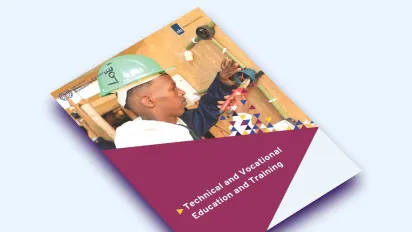
Technical and Vocational Education and Training to empower refugee and host communities in Ethiopia

PROSPECTS Impact
Vocational skills boost economic integration of Ethiopia's refugee and host youth

Skill development for refugees
Women defy gender norms, access vocational training on hard labour occupations in Ethiopia