

Supply Chains, Responsible Business Conduct
Resilient, Inclusive and Sustainable Supply Chains in Malaysia (RISSC Phase II, Malaysia)
Funded by the Government of Japan, RISSC Phase II will support a more resilient, inclusive and sustainable rubber supply chain in Malaysia. Working with tripartite constituents and key industry partners, the project will strengthen labour governance, promote practical and worker-centred approaches to responsible business conduct and human rights due diligence, and catalyse supply-chain collaboration in support of decent work and sustainable industry upgrading.
Duration
1 June 2026 - 31 May 2029
Development partner(s)
Government of Japan (Ministry of Health, Labour and Welfare, MHLW)
Reference
MYS/26/01/JPN
Location
Malaysia
Key industry facts
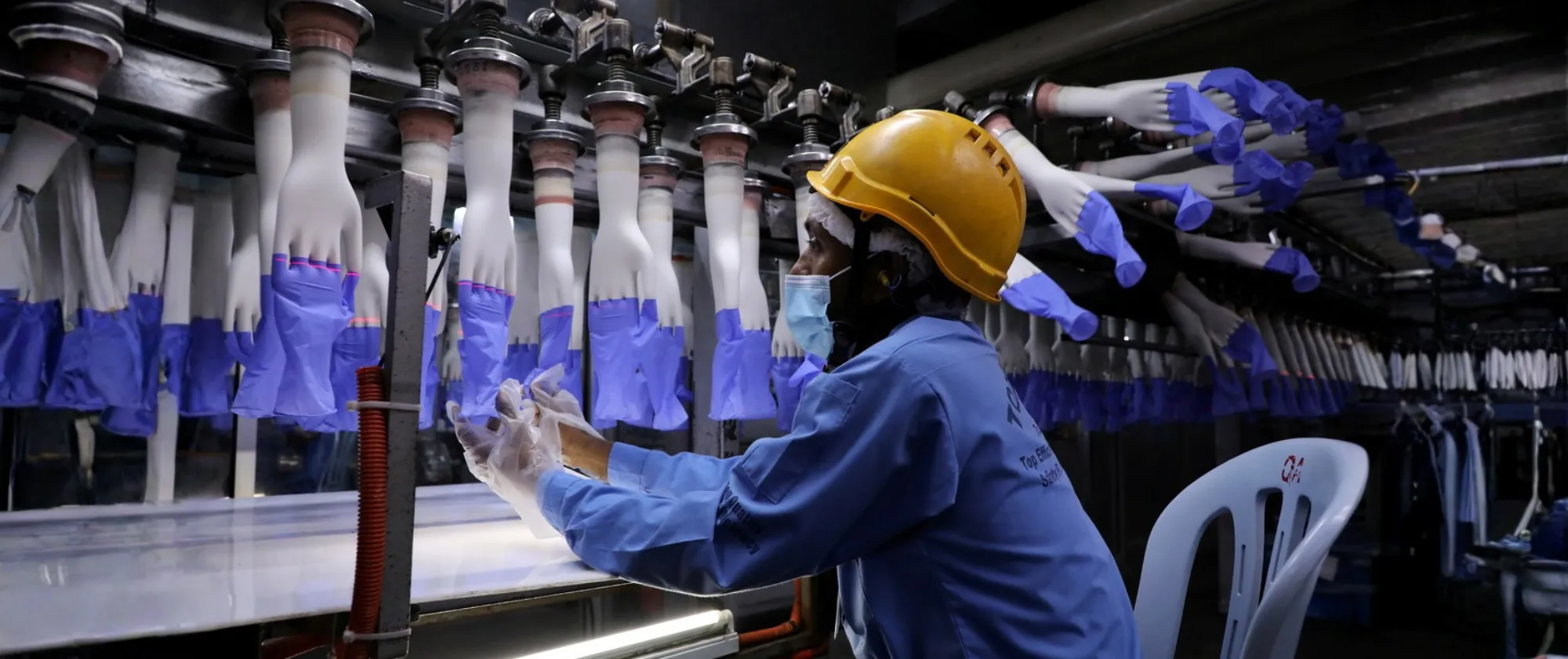
- A key export industry: Rubber generates some USD 5 billion in annual export revenues (around 2 percent of Malaysia’s total exports). Malaysia accounts for almost half of global rubber glove exports.
- A diversified supply chain: the industry spans upstream natural rubber cultivation and tapping, midstream processing, and globally significant downstream manufacturing.
- A major source of jobs: census data shows there are approximately 508,850 rubber smallholders in Malaysia, while around 85,000 workers are employed in processing and downstream glove manufacturing.
- Key decent work challenges include recruitment-related forced labour risks, occupational safety and health hazards, working-time and wage issues, and gaps in worker voice and access to remedy.
Target beneficiaries
- Employers and workers across the rubber supply chain, from smallholders and estate workers to workers in processing, compounding and rubber-products manufacturing
- Women and migrant workers, subcontracted and agency workers, and workers in high-risk employment situations
- Government, employers’ and workers’ organizations, enterprises and other key industry stakeholders
Expected results
Decent Work and Responsible Business Conduct are more consistently enabled and reinforced in nickel supply chains, supporting stronger respect for fundamental principles and rights at work and more inclusive and sustainable national development.
Change should be visible in several key areas:
- Improved sectoral labour governance and compliance frameworks
- Growing industry uptake of new RBC models and approaches
- A coherent national policy vision for industry development
- Greater stakeholder alignment and collaboration for a more responsible nickel supply chain
Key project stakeholders
- Government: Ministry of Human Resources, Ministry of Plantation and Commodities, Ministry of Investment, Trade and Industry, Malaysian Rubber Board, Malaysian Rubber Council, Rubber Industry Smallholders Development Authority (RISDA), Federal Land Development Authority (FELDA), Malaysian Investment Development Authority (MIDA), and other relevant agencies
- Employers and industry organizations: Malaysian Employers Federation (MEF), Malaysian Rubber Glove Manufacturers Association (MARGMA), Malaysian Rubber Products Manufacturers Association (MRPMA), plantation and smallholder organizations, enterprises and international buyers
- Workers: Malaysian Trades Union Congress (MTUC), relevant national, sectoral and in-house unions, rubber-sector workers and worker representatives
- Other stakeholders: rubber smallholders and cooperatives, Plastic and Rubber Institute Malaysia (PRIM), IndustriALL Global Union, civil society and technical partners, development partners, and Japanese and other international supply-chain actors
Publications and documents

Supply chains
Mapping the rubber supply chain in Malaysia
Contact
David Williams, Project Manager, [email protected]
Mohd Zharif Shafiq Badrul Hisam, National Project Coordinator, [email protected]