


Arab Social Protection Compass Webinar series: Part X
Social Protection as an Enabler of Climate Action and a Just Transition in MENA
This is the tenth episode of the Arab Social Protection Compass webinar series, titled "Towards Integrated Approaches for Universal Social Protection”. The episode will unpack the linkages between social protection and climate change adaptation and mitigation, building upon the findings and recommendations of the latest World Social Protection report 2024-26, titled “Universal Social Protection for climate action and a just transition”. The webinar will explore specific examples from the region where social protection has been used or could be used to enhance people’s adaptive and coping capacity, and to protect health, jobs and living standards from the effects of rising temperatures, dry spells and other extreme events. It will also attempt to answer a difficult question: what would a just transition look like in the MENA region and how can social protection help enable it? What social protection measures can cushion the impacts of structural economic reforms required for a green transition? What potential do fossil fuel subsidies reforms or pension fund greening hold? Lessons learnt from selected country cases and global experience will point to policy and programmatic options to ensure social protection can support human wellbeing and help the region contend with the climate crisis.
Climate change is increasingly undermining jobs and livelihoods, exacerbating poverty, and widening inequalities. Extreme weather, droughts and especially heat in the MENA region are already displacing communities and disrupting employment, particularly in sectors such as agriculture, fisheries, and informal urban work. As the ILO World Social Protection Report 2024–26 highlights, “social protection makes an important contribution to both climate change adaptation and mitigation” by providing a foundation for resilience, helping individuals and communities absorb shocks, recover faster, and invest in long-term adaptation. Yet, doing so requires closing the large coverage gaps that weaken societies’ ability to respond to the direct impacts of climate change and contain the socioeconomic costs of green transitions.
This webinar will explore the potential of social protection to contribute to climate action and a just transition in the Arab region, focusing on two complementary dimensions: a) how social protection schemes and programmes can protect individuals and households from the direct effects of climate change; and b) how social protection measures can be strategically used by governments to cushion the impact of policies required for a green transitions—such as the removal of fossil fuel subsidies—ensuring that no one is left behind.
It will highlight how key components of social protection systems, ranging from tax-financed benefits, to universal health coverage, to adapted social insurance schemes, can help households maintain consumption, avoid harmful coping strategies in the aftermath of climate shocks and protect the health of climate-exposed workers. At the same time, re-direction of fossil fuel subsidies toward social protection systems can help compensate for increased costs of transport or energy, while also ensuring the political sustainability of reforms. Social protection also has a role to play in supporting mitigation efforts to stop the drivers of the climate crisis by keeping fossil fuels in the ground — an important challenge in the MENA region— through the choices made in the way social security funds are invested and social security administrations conduct their business operations and procurement choices.
By bringing together policy-makers, social protection practitioners and specialists on the climate and social protection nexus, the panel discussion will aim to identify practical entry points for integrating climate considerations into national social protection systems and vice-versa, and being part of the solution to the challenges posed by the climate crisis.
Agenda
13:00 – 13:10 | Introduction and welcome
13:10- 13:15 I Interaction Moment
13:15 – 13:30 | Presenting key findings and recommendations from the ILO WSPR 2024-26 to frame the panel discussion.
13:30 – 13:40| Panel discussion
13:40 – 14:05| Panel Discussion
14:05 – 14:10| Interaction Moment
14:10 – 14:25| Q&A with the public
14:10 – 14:25| Wrap up by moderator
Speakers
-
 Jana BischlerSocial Protection and Climate Change Officer – ILO SOCPRO
 -
 Monia BenyounesDirector of Operations, Control and Litigation of CACOBATPH, Algeria
 -
 Dr Mohammadali MokthariDevelopment Economics Researcher (PhD), Università della Svizzera italiana (USI), Lugano, Switzerland
 -
 Shadwa Mahmoud ZaherEconomic Advisor at the Economic Justice Unit (EJU), Ministry of Finance
 -
 Ian OrtonRegional Social Protection Specialist for ILO Regional Office for the Arab States
Moderator
Session recording
Resources
ISSA Report | Climate change and natural resource scarcity
This episode is part of the webinar series

Arab Social Protection Compass “Towards Integrated Approaches for Universal Social Protection”
This episode is part of the webinar series "Arab Social Protection Compass: Towards Integrated Approaches for Universal Social Protection", organised by the International Labour Organization (ILO) in collaboration with the International Social Security Association (ISSA) and technical support of socialprotection.org. The initiative intends to put a spotlight on reforms and programmes geared towards fostering integration within social protection across the region and beyond, while contributing to stir discussion at the national level. Throughout the series, speakers will delve into both the theoretical underpinnings and practical implementations of specific reforms, aiming to inspire a broad audience of practitioners to replicate or scale up similar interventions.


Relevant projects
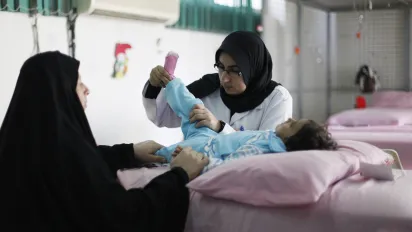
Social Protection Programme for Iraq: Leveraging Effective Response and Accelerating Reform

Estidama++ Fund – Extension of Coverage and Formalization in Jordan