

Sector portal
Education and training
Education, skills and lifelong learning are the paths to social and economic development and employability. Teachers and education workers are at the heart of education and training systems. Secure employment and decent working conditions for teachers are essential strategies to ensure quality education personnel and to address global teacher shortages. The ILO promotes quality teaching through two related Recommendations concerning teaching personnel, as well as the Joint ILO/UNESCO Committee of Experts on the Application of the Recommendations concerning Teaching Personnel . It also promotes follow-up to the Recommendations of the United Nations Secretary-General’s High-Level Panel on the Teaching Profession.
Highlights

Revision of the 1966 ILO/UNESCO Recommendation concerning the Status of Teachers

United Nations Secretary-General’s High-Level Panel on the Teaching Profession

Joint ILO/UNESCO Committee of Experts on the Application of the Recommendations concerning Teaching Personnel (CEART)
Key resources
- ILO-UNESCO Recommendation concerning the Status of Teachers, 1966
- UNESCO Recommendation concerning the Status of Higher-Education Teaching Personnel, 1997
- Recommendations concerning Teaching Personnel (1966 and 1997) - Understanding and Using the Recommendations
- ILO Policy Guidelines on the promotion of decent work for early childhood education personnel (2014)
- National labour legislation (NATLEX database): National legislation dealing with teachers
- Report on the technical‑administrative staff of higher education in Argentina, Brazil, Colombia, and Mexico (in Spanish) (July 2025)
- Teaching and the teaching profession in a digital world: COVID-19 and beyond (January 2021 - March 2023)
- Digitalization, the future of work and the teaching profession (November 2019 - December 2021)
- Skills and lifelong learning
- Skills for Employment Global Public-Private Knowledge Sharing Platform
- International Programme on the Elimination of Child Labour (IPEC)
- The International Task Force on Teachers for Education 2030 (TTF)
- Skills for Trade and Economic Diversification (STED)
- School-to-work transition survey
- Skills and Employability Branch
- Occupational safety and health in the education and research sector
Data and statistics
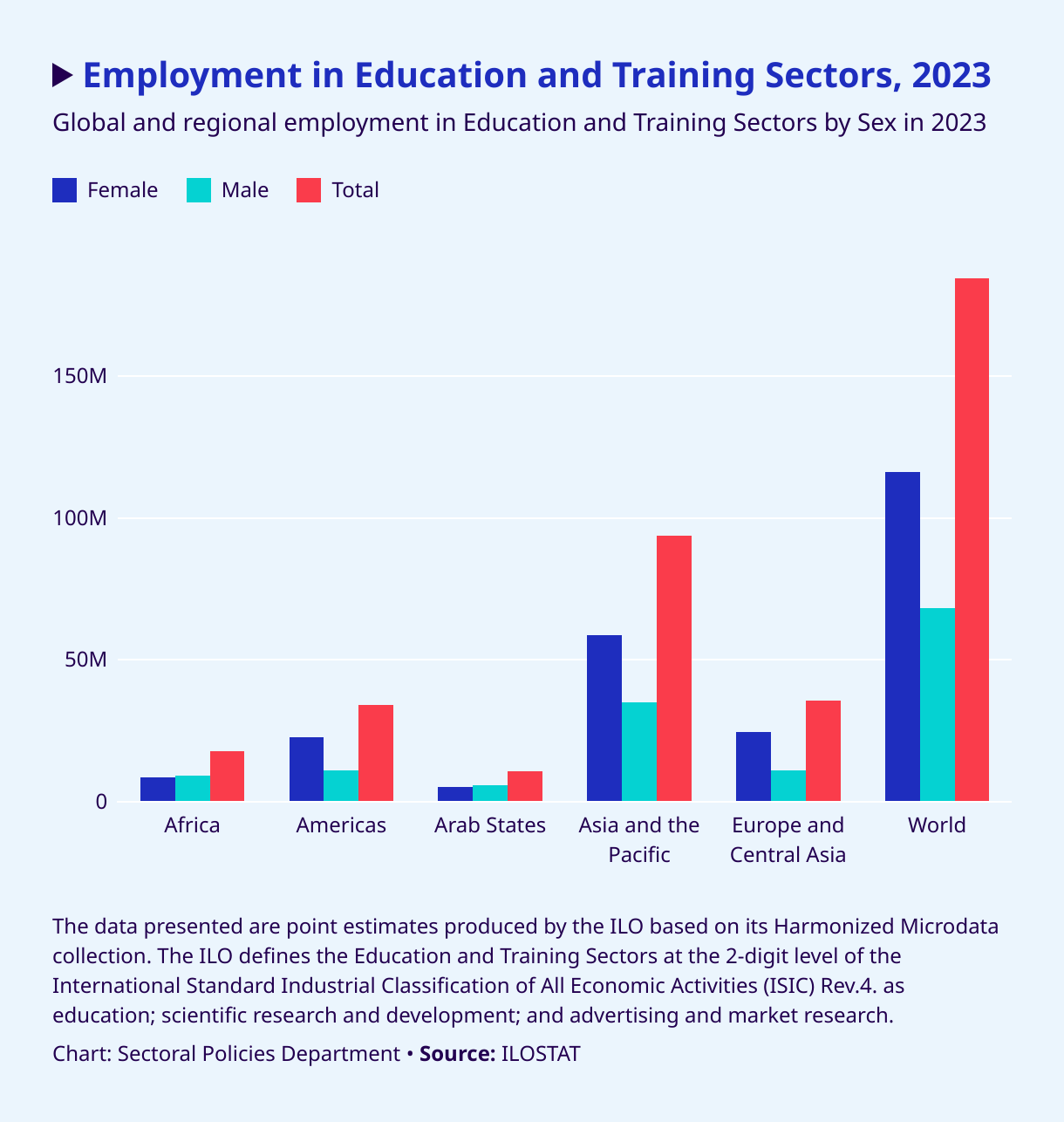
The bar charts show global and regional point estimates at the sectoral level, based on data from the ILO Harmonized Microdata collection. These estimates cannot be directly compared across different periods and may be updated as new information becomes available. The estimates provided and published by the ILO may differ from those produced and released at the national level.
For more detailed labour market indicators and country-level data, visit the Sectoral Employment Statistics page of the ILOSTAT database.
Events
Friday 16 October 2026
Africa Skills Week 2026: Work-Based Learning and Recognition of Prior Learning for inclusive skills development in Africa
2024-26 ILO/Korea Partnership Programme (I-KORP) Asia-Pacific Forum
From Results to the Next Cycle: Just Transition and Human Capacity in the AI Era
News

From Brazil to Dili: Brazil’s TVET experience offers lessons for Timor-Leste

News
Uganda launches new financial literacy strategy to support resilient livelihoods and inclusive growth

PROSPECTS Impact
In Sudan, young refugees turn community needs into business opportunities
Publications and documents
Module 18
Labour Inspection and Violence and Harassment
Policy brief
Disability inclusion in skills and employment: progress, challenges, and policy priorities
ILO brief
Employment implications of the floods in Nepal: A preliminary rapid assessment
Projects
Strategic Skills Partnership Initiative (SSPI) for Innovation and Excellence in Vocational Education and Training
Just transition through skills for employment
Just Transitions for Men, Women and Youth through Skills Training and Jobs Creation in Sustainable Construction and Eco-Tourism in Flood...
Project: Skills development and labour migration
Supporting a Talent Partnership with Bangladesh
Contact information
Sectoral Codes of Practice and Guidelines
Sectoral meetings
Conclusions and recommendations of sectoral meetings
Sign up to our newsletter!
Receive ILO news about sectoral work