

Sector portal
Commerce
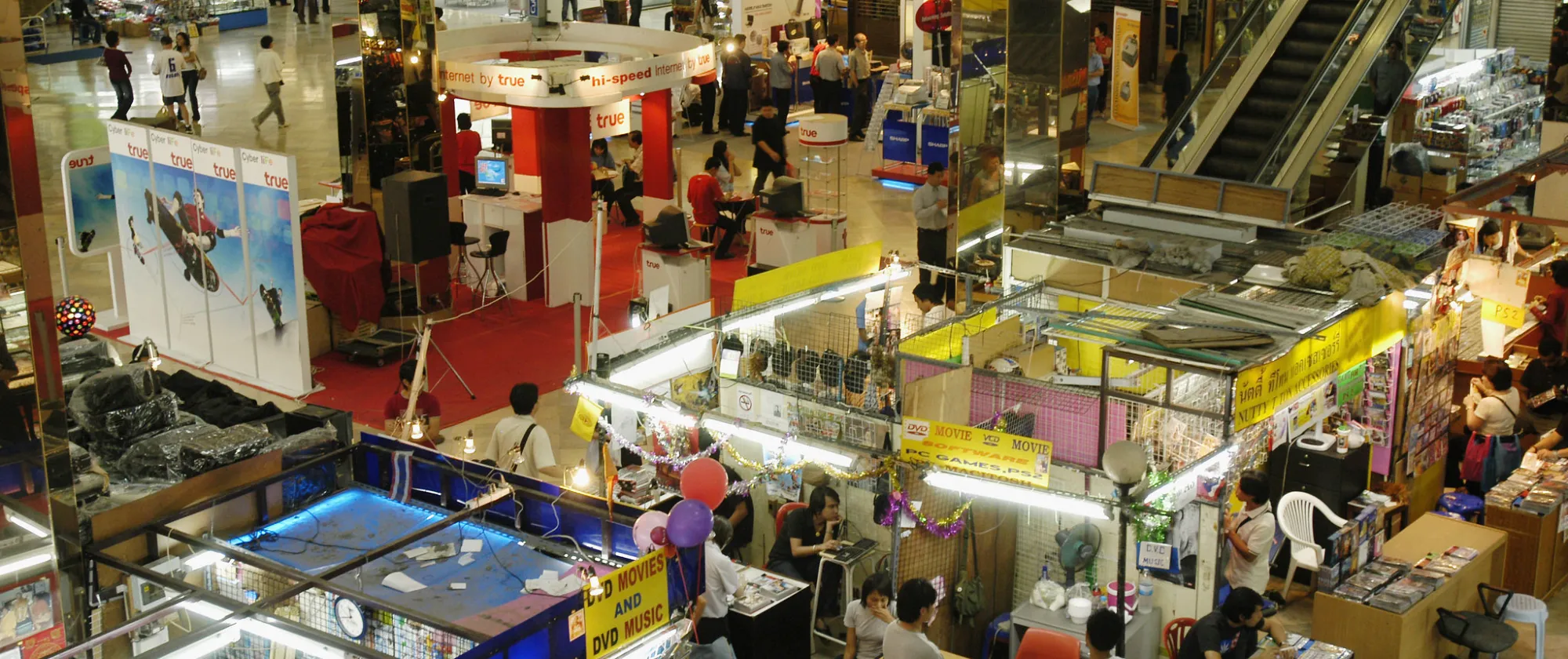
Commerce, both in wholesale and retail trades, acts as an essential bridge between goods producers and consumers worldwide, regardless of a country's development level or political system. This sector is markedly diverse, with significant differences between wholesale and retail activities and within retail categories like department, specialty, or discount stores, and between online and brick-and-mortar. Its structure varies globally, influenced by factors such as living standards, consumer habits, and legal frameworks. The sector is increasingly globalized and concentrated, with many commerce companies ranking high globally in sales and employment.
Recent trends include the impact of digitalization, revolutionizing the sector by introducing advanced retail technologies, e-commerce platforms, and online marketplaces, significantly altering consumer behaviour, business models, and employment dynamics. The International Labour Organization (ILO) has focused on the implications of globalization, just transition, digitalization, and the evolving needs of the workforce in this rapidly changing sector, particularly highlighted during the COVID-19 pandemic.
Technical meeting on occupational safety and health in the retail sector
The meeting discussed occupational safety and health in the retail sector, focusing on evolving work and increased use of technology, and examined related challenges and opportunities. It adopted conclusions with recommendations for future action.
The Digitalizing Retail Sector: Promoting sustainable business practices to advance decent work
This self-guided course examines innovation and inclusion opportunities alongside challenges like informality, new work forms, OSH risks, and skills gaps, offering ILO‑based guidance for responsible, inclusive transitions for diverse stakeholders.
Key resources
- C106 - Weekly Rest (Commerce and Offices) Convention, 1957 (No. 106)
- R103 - Weekly Rest (Commerce and Offices) Recommendation, 1957 (No. 103)
- C155 - Occupational Safety and Health Convention, 1981 (No. 155)
- R164 - Occupational Safety and Health Recommendation, 1981 (No. 164)
- C187 - Promotional Framework for Occupational Safety and Health Convention, 2006 (No. 187)
- R197 - Promotional Framework for Occupational Safety and Health Recommendation, 2006 (No. 197)
- C161 - Occupational Health Services Convention, 1985 (No. 161)
- R171 - Occupational Health Services Recommendation, 1985 (No. 171)
- C120 - Hygiene (Commerce and Offices) Convention, 1964 (No. 120)
- R120 - Hygiene (Commerce and Offices) Recommendation, 1964 (No. 120)
- HIV and AIDS: Guidelines for the retail sector (November 2015)
- Code of practice: Workplace violence in services sectors and measures to combat this phenomenon (October 2003)
Briefs
- Occupational safety and health and the future of work in retail in the post-COVID-19 context (March 2024)
- Statistical profile of the wholesale and retail trade sector (September 2023)
- Mapping practices, initiatives and policies around the circular economy and emerging services in the retail sector (May 2023)
- Technical meeting on occupational safety and health in the retail sector (September 2026)
- Technical meeting on digitalization in the retail sector as an engine for economic recovery and decent work (25-29 September 2023)
- Global dialogue forum on the needs of older workers in relation to changing work processes and the working environment in retail commerce (21-22 September 2011)
- Tripartite meeting on social and labour implications of the increased use of advanced retail technologies (18-20 September 2006)
- Advancing decent work in the culture and creative sector (Self-guided course)
- The Digitalizing Retail Sector - Promoting sustainable business practices to advance decent work (Self-guided course)
Data and statistics
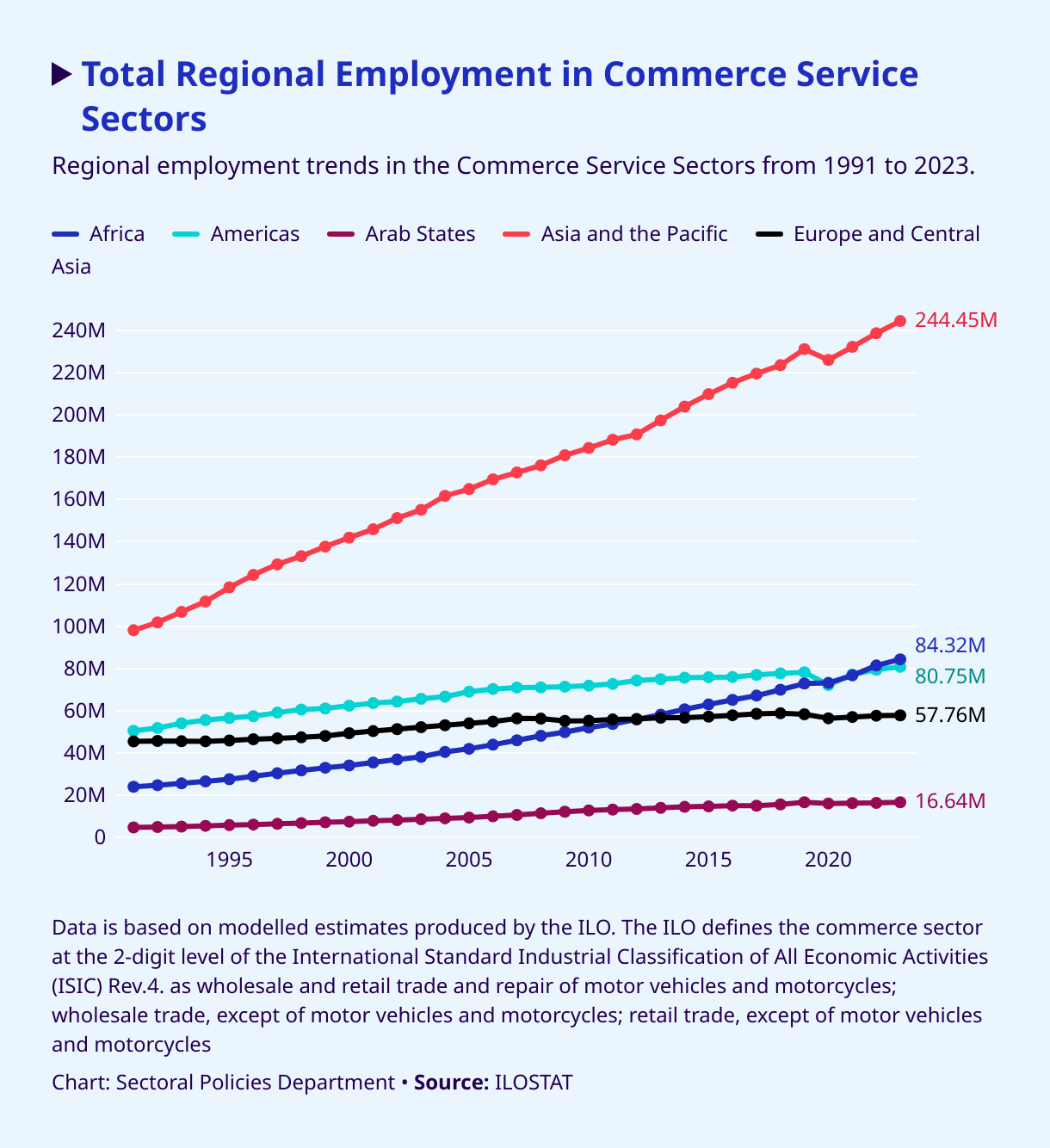
The line graphs show a time series of modelled global and regional employment estimates at the sectoral level. The ILO modelled estimates generally cover 189 countries, offering a comprehensive set of internationally comparable labour statistics. These include both reported data and imputed figures for countries with missing information. The imputations are generated using econometric models developed by the ILO.
For more detailed labour market indicators and country-level data, visit the Sectoral Employment Statistics page of the ILOSTAT database.
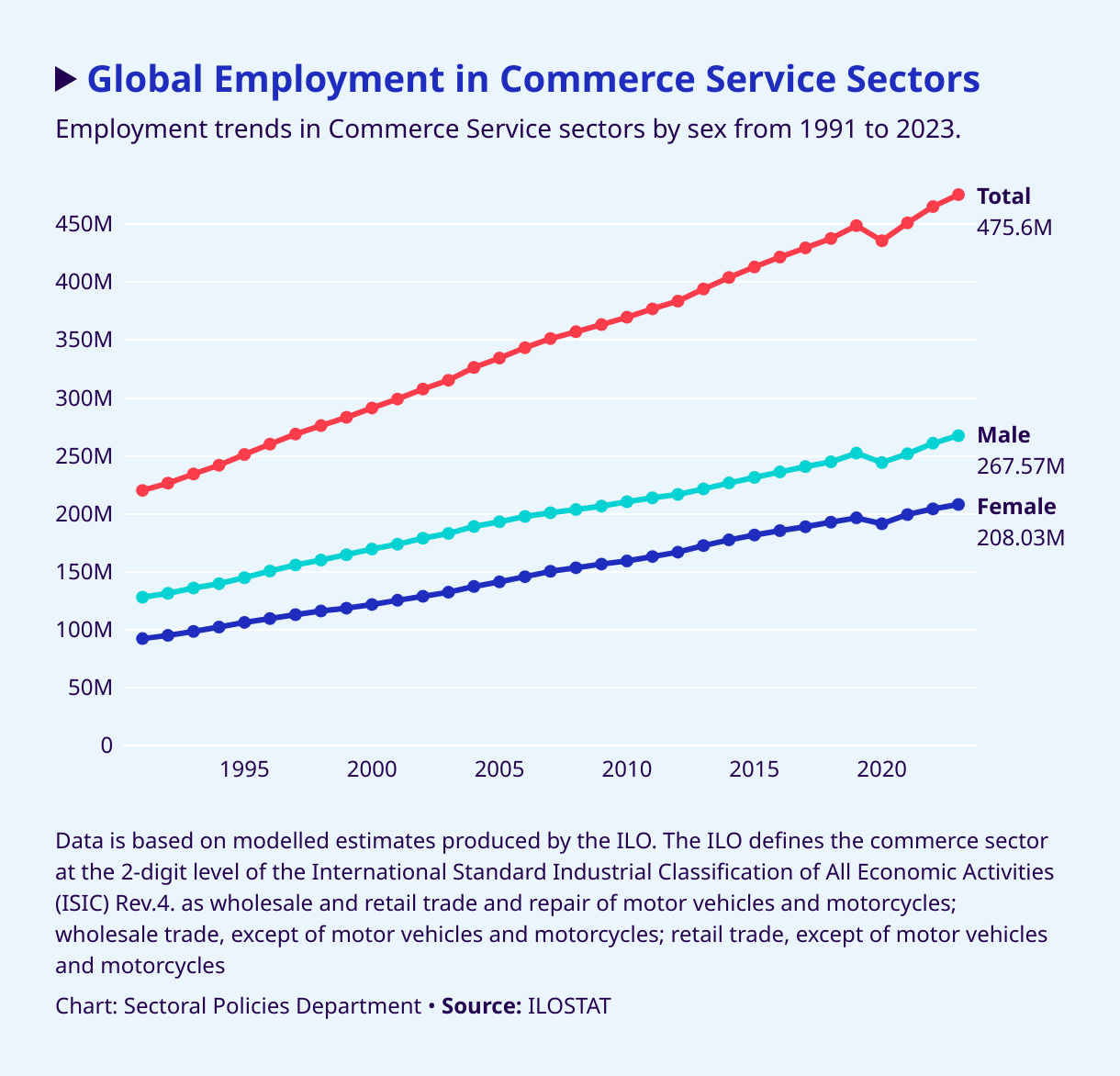
The line graphs show a time series of modelled global and regional employment estimates at the sectoral level. The ILO modelled estimates generally cover 189 countries, offering a comprehensive set of internationally comparable labour statistics. These include both reported data and imputed figures for countries with missing information. The imputations are generated using econometric models developed by the ILO.
For more detailed labour market indicators and country-level data, visit the Sectoral Employment Statistics page of the ILOSTAT database.
Events
Technical meeting
Technical meeting on occupational safety and health in the retail sector
News

ILO meeting agrees on action to strengthen safety and health in retail
ILO Voices | Women's entrepreneurship
Between Spain and Morocco, I built my independence

ILO and Canada launch project to strengthen Thailand’s rubber sector
Publications and documents
Report for the Technical meeting (Geneva, 28 September - 2 October 2026)
Occupational Safety and Health in Retail in a Changing World of Work: Risks, Prevention and the Role of Technology
Understanding rights at work
A guide to key terms related to fundamental principles and rights at work, trade and supply chains
Report
Digital labour platforms in Kenya: Exploring women’s opportunities and challenges across various sectors
Projects
Trade for jobs Uganda
Contact information
Sectoral Codes of Practice and Guidelines
Sectoral meetings
Conclusions and recommendations of sectoral meetings
Sign up to our newsletter!
Receive ILO news about sectoral work