

Occupational Safety & Health
Simple, low-cost ways to improve safety and health in agriculture - Participatory training guide for farmers and trainers
26 March 2025
Farmers, employers and workers in agricultural plantations need simple, practical methods to improve safety, health and productivity together. They are busy and often have only limited resources. The ILO’s participatory approaches meet their needs and are widely used in agricultural farms and plantations of India and other South Asian countries.
- Participatory training to improve safety and health by simple, low-cost methods
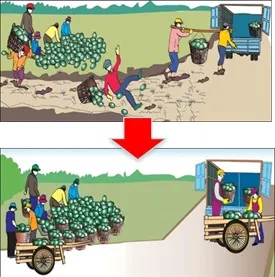
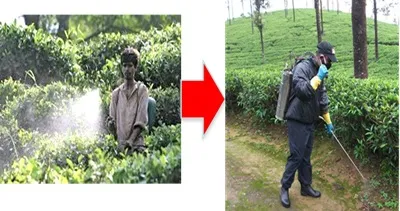
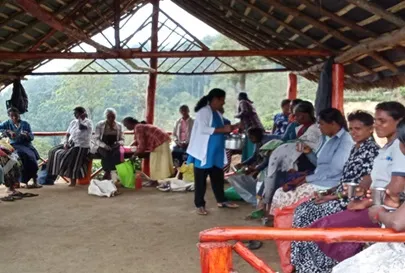
Figure 1 shows a before-and-after-improvement example of safety and health from a small fruit farm. Figure 2 shows a tea plantation worker who uses appropriate personal protective equipment (PPE) while spraying pesticide. Figure 3 shows a comfortable resting area on their farm. There are many other simple, low-cost ways to improve the safety, health and efficiency of your farms and plantations.
This guide shows how to organize and conduct participatory safety and health training activities for farmers. The ILO has conducted many training-of-trainer workshops with small farms and plantations. If nobody in your farm has been trained as a trainer yet seek the cooperation of the ILO, or the government, farmers’ associations or employers’ and workers’ organizations that have the participatory trainers in safety and health.
2. Preparing a participatory training workshop
Before the training, walk around your farm or plantation, and find and take photos of good examples in safety and health. Refer to Table 1 for a list of areas where such examples can be found. You may also wish to visit neighbouring farms to gather their good examples. These good examples should then be compiled into presentation materials for the participatory training. There are five practical areas for improvements: (1) Materials storage and handling, (2) Workstations and tools, (3) Safe use of machinery, (4) physical environment (lighting, ventilation, heat, pesticide, etc.), and (5) welfare facilities. The ILO’s Global WIND (Work Improvement in Neighbourhood Development) Training Manual provides numerous good examples.
Table 1. Five areas for practical safety and health improvements in agriculture.
| Areas for action | Improvement examples |
| Materials storage and handling | Clear transport ways, multi-level shelves for keeping materials and tools, use of carts and hand-trucks, grips and holding points for containers, mechanical devices for lifting materials |
| Workstations and work tools | Tools and materials within easy reach, working height at around elbow level, chairs of correct height with backrests, alternating standing and sitting at work, fixing devices to hold items, home for each tool, easy-to-see labels and signs |
| Machine safety | Guards to moving parts of machines, safe feeding devices, regular machine maintenance, clearly visible emergency controls, safe electrical wire connection |
| Physical environment | Full use of daylight, installation of artificial lighting, shade to protect farmers against heat, openings and windows for natural ventilation, enough fire extinguishers and escape routes, covering dust sources, lids and labels for pesticides containers, provision of masks, gloves and other personal protective equipment |
| Welfare facilities | Hygienic drinking water in the farm, clean toilets separately prepared for women and men, comfortable eating and resting places, first aid, adjustments of workplaces for pregnant women and workers with disabilities, organizing farmer safety and health committees |
The number of training participants should not be too many - generally between 20 and 30 farmers when several villages and communities participate in the training together. If your community or plantation only, the number of the participants can be smaller. A suitable location for the training is a meeting room within your community for easy participation of farmers. Tables in the training room should be arranged in a U-shape or islands. This can facilitate active discussions in small groups. A classroom-style settings should be avoided.
3. Workplace visits and the use of the WIND action checklist
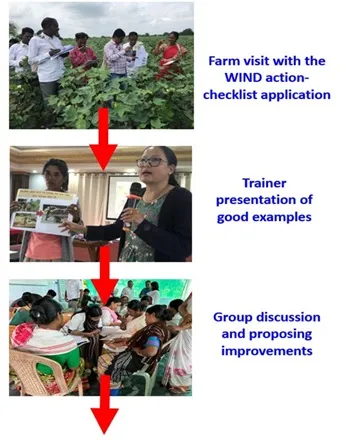
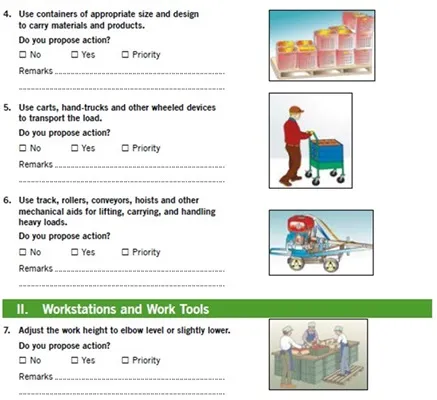
Figure 4 shows the steps of the participatory training. In the first step, all participants visit their farms and fill out the ILO’s WIND action checklist. Figure 5 shows a sample section of the WIND action checklist. The WIND action checklist consists of 33 items, covering the five improvement areas mentioned in Table 1. Each item is accompanied by a low-cost good practice picture. For example, the action-checklist item 5 of Figure 5 is: ‘‘Use carts, hand trucks and other wheeled devices to transport the load.’’ Participants are asked to decide for themselves whether this improvement action is necessary or not and fill either ‘’No’’, ‘’Yes’’ or ‘’Priority’’. In this way, each of the 33 items is checked by the participating farmers while observing their farms.
4.Learning from good practices and group discussion
After the farm visit with the action checklist application, the trainer presents many pictures of simple, low-cost solutions and provides tips for implementing improvements. Then group discussion among participating farmers and farm owners will follow to discuss and identify three good points and three points to be improved in their workplace. Participants look at the results of their action-checklists, which they just filled, exchange ideas with other participants and summarise their proposals for improvement. Farmers and farm owners, including women and men from all groups, should actively discuss and propose improvements together.
In the participatory training, trainers do not lead but rather facilitate and support the discussion of improvement proposals by participating farmers. The trainers may include ice-breaking games related to the safety and health improvements. It is also a good idea to display local good example photos in the training room and encourage the participants to select the simplest, most inexpensive and cleverest improvement examples. In conjunction with the participatory training activities, it is highly recommended to establish a farmer safety and health committee in your communities or plantations and hold a meeting every month for discussing safety and health improvements.
5. Follow-up activities for continuous improvements
Follow-up meetings among training participants or follow-up visits to their farms and plantations should be held a few months after the training. This will allow for sharing insights on the improvements made by the participating farmers and the discussion of subsequent plans. WhatsApp groups of the training participants can be set up to share improvement photos and experiences. The participatory safety and health training can be carried out repeatedly at the initiative of the farmer safety and health committee of your community or plantation.
The participatory safety and health training starts with improvements that can be done at low-cost by learning from local good examples. The training has helped many farms and agricultural plantations. It is hoped that the participatory training methods focusing on simple, low-cost improvements will be widely applied in many agricultural workplaces in South Asia.
Training developed by:
Tsuyoshi Kawakami
Senior Specialist on Occupational Safety and Health and Labour Inspection
ILO South Asia Decent Work Technical Assistance Team, New Delhi