

Honourable Minister Juan Castillo, President of the International Labour Conference,
Her Excellency Ambassador Nahida Sobhan, Government Vice President,
Ms Kristen Kaufman, Employer Vice-President,
Mr Gerardo Martínez, Worker Vice-President,
Honourable Ministers,
Delegates,
Ladies and Gentlemen,
Let me start by welcoming you to the 114th Session of the International Labour Conference and by congratulating the President and Vice-Presidents on their election.
We meet at a time of profound uncertainty. The global economy remains fragile and the crisis in the Middle East has emerged as a major source of risk for workers, enterprises and communities. Seafarers in the Strait of Hormuz, migrant workers in Gulf countries, agricultural workers in southern Lebanon, and workers and enterprises across several sectors in Iran are among those most directly affected.
The ILO moved quickly to assess the implications of this crisis for the world of work. Our latest Employment and Social Trends Update shows that its effects are already spreading beyond the region through higher energy prices, supply-chain disruptions, weaker investment and pressures on migration and remittances.
In an already slow-growing global economy marked by persistent decent work deficits, the consequences could be significant. Under a prolonged oil shock scenario, global hours worked could fall by the equivalent of 14 million full-time jobs this year and 38 million next year, with labour income losses reaching up to US$3 trillion by 2027. The impact could be particularly severe in the Arab States, with spillovers across Asia and the Pacific.
Many governments have acted swiftly. Yet coordinated and sustained measures remain essential. Strengthening social protection, supporting micro, small and medium-sized enterprises, and preserving jobs will be key to preventing this shock from becoming a lasting setback for decent work.
This crisis is unfolding in labour markets already under strain. Progress in job quality has stalled, informality affects more than 2.1 billion workers and the transition to better-quality employment has slowed. And if the Middle East crisis continues to weaken jobs, incomes and livelihoods, more workers and enterprises could be pushed into informality, with greater risks of child and forced labour.
Alongside these challenges, we are facing a transformation of a different order: artificial intelligence. AI is reshaping how work is organized, how value is created and how decisions are made, at an unprecedented speed and scale.
It is in this context that I present my report, A moment of choice: Harnessing artificial intelligence for decent work. The central message is quite clear: the future of work will not be determined by technology alone, but by the policies, institutions and social dialogue that guide it.
The choices we make today will determine whether AI broadens opportunity and shared prosperity or deepens inequality and insecurity. Such choices include: investing in skills, strengthening labour and social protection, supporting micro, small and medium enterprises and upholding fundamental principles and rights at work. This is ultimately a social and political choice about the future we want.
Workers everywhere must be able to share the productivity gains generated by AI. Those gains must be distributed fairly through better wages, stronger labour protections and more inclusive growth. Collective bargaining will remain essential, alongside AI governance grounded in transparency, accountability and human oversight.
This transformation also has a critical development dimension. Countries at different levels of development must not be left behind. They should be able to benefit from AI as a driver of convergence, job creation, structural transformation and decent work.
This is why my report proposes a strategic agenda built around four pillars: rights, employment, skills, social protection and social dialogue. I really hope this Conference will provide an opportunity for constituents to share their experiences, exchange ideas and learn from one another as we navigate this transformation together. Through our discussions, we can help chart a common path forward that harnesses the potential of AI while ensuring that innovation advances decent work, inclusion and social justice.
Excellencies,
Today’s crises and transformations remind us of the enduring relevance of our founding principles. As stated in the Preamble of the ILO Constitution, lasting peace can be established only if it is based on social justice.
I don’t see this as a mere principle – it is a call to action. Economic instability, inequality and exclusion are not only social challenges; they are threats to peace.
The Declaration of Philadelphia gave this vision its full meaning: labour is not a commodity; freedom of expression and association are essential for social progress; poverty anywhere constitutes a danger to prosperity everywhere; and all human beings have the right to pursue their well-being and development in conditions of freedom, dignity, economic security and equal opportunity.
International labour standards give expression to that vision. They remain essential to realize social justice, providing stability in times of uncertainty and direction in times of change.
This is why we must focus not only on the number of jobs, but on their quality - on rights, representation, security, equality and inclusion. I welcome the growing engagement of international financial institutions and multilateral development banks with the jobs agenda and their cooperation with the ILO on the quality dimension of employment.
Mesdames et Messieurs,
Cette année, l’ordre du jour de la Conférence offre l’occasion d’aborder des défis majeurs grâce au dialogue tripartite.
La Conférence poursuivra sa discussion normative sur le travail décent dans l’économie des plateformes – une étape importante pour répondre aux nouvelles formes de travail et combler les lacunes en matière de protection et d’innovation.
Elle tiendra également une discussion récurrente sur le dialogue social, en mettant l’accent sur les moyens de le rendre plus inclusif et plus efficace, dans le respect de la liberté syndicale et de la négociation collective.
La discussion sur l’égalité entre les femmes et les hommes portera sur les obstacles structurels qui continuent de freiner le progrès, tout en réaffirmant notre engagement commun à bâtir des sociétés où l’égalité, la dignité et les opportunités sont accessibles à toutes et à tous.
La Conférence examinera également mon rapport sur la situation des travailleurs dans les territoires arabes occupés, soulignant l’importance d’une relance fondée sur l’emploi et les droits.
La Journée mondiale contre le travail des enfants nous offrira l’occasion d’accélérer les progrès faisant suite aux engagements pris à Marrakech.
Enfin, la justice sociale demeure au cœur de notre mission. La Coalition mondiale pour la justice sociale continue de gagner en ampleur, témoignant d’un engagement commun en faveur de marchés du travail plus inclusifs.
Ladies and Gentlemen,
The same sense of purpose guides the ILO itself. In a rapidly changing world, we must ensure that our Organization remains agile, effective and responsive while continuing to advance social justice and decent work. Our reform agenda is strengthening delivery while preserving our unique normative mandate, supervisory system and tripartite structure.
Reform is not about changing who we are. It is about strengthening our ability to fulfil our mandate in the context of the wider UN reform. As we adapt to new realities, we remain firmly anchored in the values and principles that have guided the ILO for more than a century.
Above all, our strength lies in our people. I wish to express my deep appreciation to ILO staff for their professionalism, resilience and unwavering commitment during a period of significant change and uncertainty.
Social dialogue must also remain at the heart of our own efforts. I remain fully committed to maintaining constructive engagement with the Staff Union and to ensuring that change is guided by dialogue and our shared values.
The world of work is changing rapidly. Yet the values that unite us endure. If we remain faithful to those values while embracing change with confidence and purpose, the ILO will continue to be a beacon for social justice, a trusted partner for its constituents and a driving force for decent work for generations to come.
I wish you all fruitful deliberations and a successful Conference.
Related content

1-12 June 2026
114th Session of the International Labour Conference
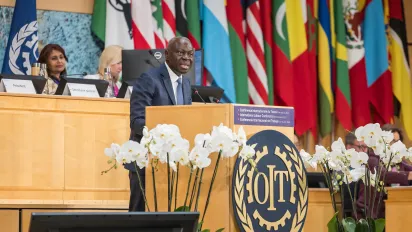
“The future of work will not be determined by technology alone,” says ILO Director-General