

Skills for Employment Policy Briefs
Policy Briefs in the series are authored by the technical specialists of the Skills and Employability Department and aim to present a short overview of particular areas related to skills development, policies and systems, and training. Each brief provides: a description of the policy challenge; policy options available; and recommendations and practical illustrations. They are offered as a resource to governments, workers and workers organizations and practitioners committed to using skills development to improve employability, productivity, and social inclusion.
9 November 2011
Related content

Skills for Employment Policy Brief
Upgrading Informal Apprenticeship Systems
Skills for Employment Policy Brief
Increasing the employability of disadvantaged youth
Skills for Employment Policy Brief
Formulating a national policy on skills development
Skills for Employment Policy Brief
Enhancing youth employability: the importance of core work skills
Skills for Employment Policy Brief
Skills for Rural Employment and Development
Skills for Employment Policy Brief
The gender divide in skills development: Progress, challenges and policy options for empowering women
Skills for Employment Policy Brief
Greening the economies of least developed countries: the role of skills and training
Skills for Employment Policy Brief
Information Note: Training for Rural Economic Empowerment (TREE)
Policy brief
Making TVET and skills systems inclusive of persons with disabilities
Skills for Employment Policy brief
Skills for Migration and Employment

Skills for Employment Policy Brief
Skills for a greener future: Challenges and enabling factors to achieve a just transition
Skills for Employment Policy Brief
Distance and Online Learning during the time of COVID-19
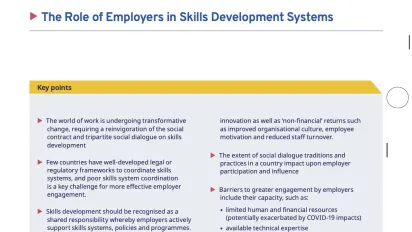
The role of employers in skills development systems
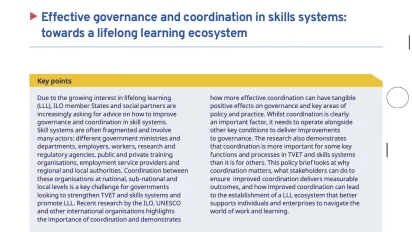
Effective governance and coordination in skills systems: towards a lifelong learning ecosystem

Financing and incentives for skills development: making lifelong learning a reality?
Policy brief
Combatting Forced Labour Through Quality Skills and Lifelong Learning