

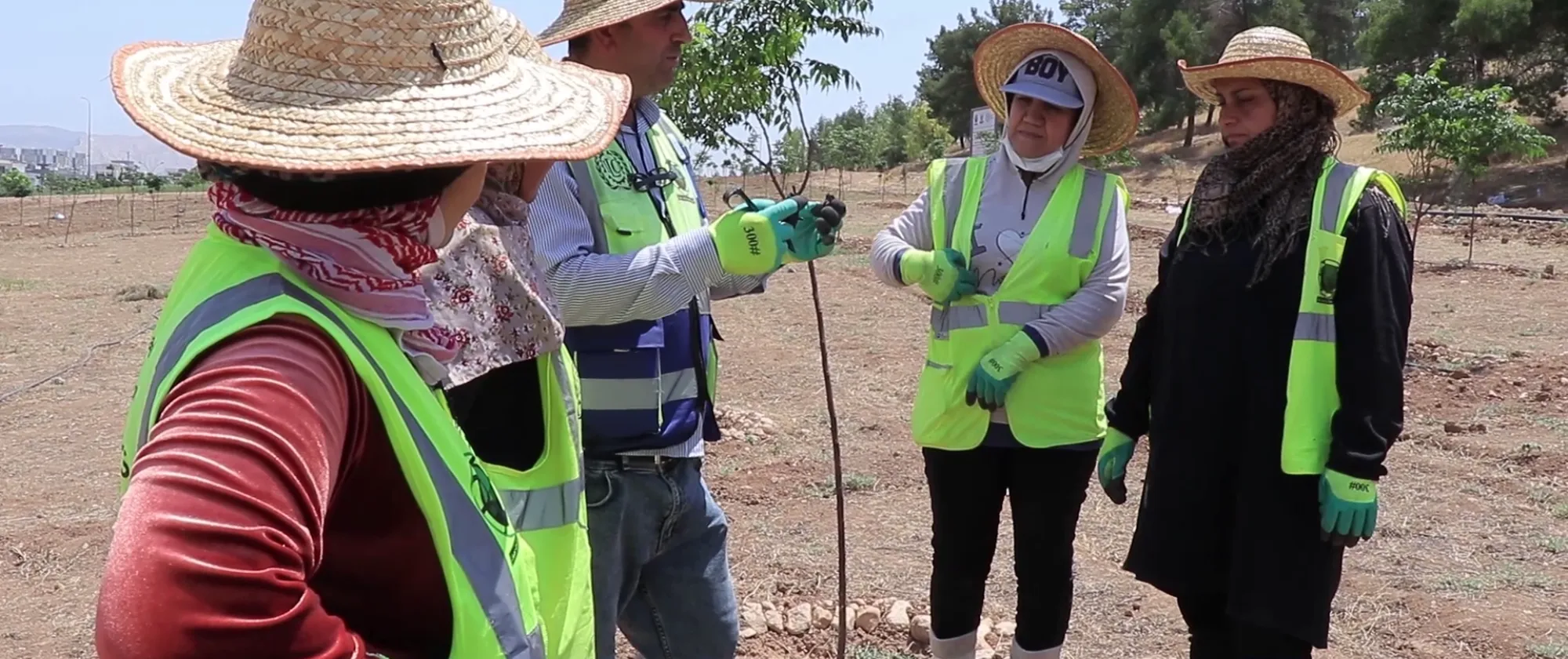
Our impact, their voices
Syrian refugee women share success and resilience in Dohuk’s afforestation project
18 June 2024
Four women recount their personal stories, challenges, and ambitions on World Refugee Day
Dohuk, Kurdistan Region of Iraq – Dalin Lagzin Hassan, Suham Ahmad Ali, Arifa Abdulrahman Khalil, and Sipani Abdulkarim Malla Hamza are four Syrian refugee women currently living in Dohuk.
They shared with us their life and work experiences amid the challenges that their displacement status brings.
They joined the largest afforestation project ever carried out in the Kurdistan Region of Iraq, at a site just outside the city of Duhok. The project is conducted by the International Labour Organization (ILO) and the Directorate of Environment in Duhok, under the PROSPECTS Partnership, funded by the Government of the Netherlands.
The area of the intervention has witnessed consistent deforestation, leading to rocky landscapes and sparse shrub cover.
Through this initiative, which aims to address climate challenges, around 700 short-term jobs have been created for local Iraqis, internally displaced persons (IDPs), and Syrian refugees.
Approximately 30 percent of the workers are women, and half of them are refugees.
The project is part of the implementation of a series of green work activities integrated into the ILO’s Employment Intensive Investment Programme (EIIP). Functioning as an entry point, it aims to improve local infrastructure through Local Resource-Based methods and to create decent jobs.
The ILO has been supporting the Directorate of Environment in Duhok to implement afforestation interventions covering an area of 100 donums (equivalent to 0.25 sq.km), planting and irrigating 12,000 trees over a period of six months.
The project is anticipated to have a positive impact on the environment, addressing the alarming rise in pollutants such as Nitrogen dioxide (NOx) and contributing to the broader goal of tackling climate change in the region.
Iraq stands as one of the most vulnerable countries to climate change shocks, facing challenges both in financial and physical terms, including rising temperatures and water scarcity. Over the last decade alone, its carbon emissions have more than doubled. The nation grapples with one of the highest levels of carbon intensity (emissions per GDP) compared to its regional and income peers. Almost three-quarters of the country’s emissions are linked to the electricity, oil and gas operations, and transport sectors.
Relevant projects
Programme
Partnership for improving prospects for forcibly displaced persons and host communities (PROSPECTS)