

A long-standing commitment to promoting the ILO MNE Declaration and strong tripartite dialogue to engage multinational enterprises in job creation in Côte d’Ivoire
For the past fifteen years, Côte d’Ivoire has taken ownership of the Tripartite Declaration of Principles concerning Multinational Enterprises and Social Policy (MNE Declaration) in order to promote its application, in particular with regard to principles related to employment. The country was among the first, in 2018, to designate national focal points responsible for promoting the MNE Declaration on a tripartite basis. Since then, tripartite dialogue has continued on a permanent basis.
8 January 2026
As Côte d’Ivoire’s economy was gradually returning to growth after a long period of crisis, it became essential to build more promising prospects for the younger generation. The growing presence of multinational enterprises operating in the country represented significant — although still largely underutilized — potential for local job creation. However, these jobs were mostly occupied by foreign workers, due to insufficient skilled labour at the national level. It was in this context that the ILO provided support to the Government as well as to employers’ and workers’ organizations in order to remedy this situation, by engaging multinational enterprises (MNEs) in the achievement of this priority national objective.
A study at the origin of a long collaboration
In 2010, the ILO conducted a survey of approximately 30 multinational enterprises to examine how they could, through their economic activities, create a greater number of better-quality jobs for local youth, both within the context of their operations and through their supply chains. The study was carried out as part of a UNIDO–ILO youth employment project funded by the Government of Japan and focused on employment creation prospects in the four economic sectors that attracted the highest levels of foreign direct investment (FDI) in Côte d’Ivoire, namely agriculture and agro-industry, banking, mining and telecommunications. The results and recommendations of this study were presented to representatives of multinational enterprises and led to the creation of a Working Group on the Promotion of Youth Employment and Responsible Investment under the auspices of the General Confederation of Enterprises of Côte d’Ivoire (CGECI), composed of all interested parties such as workers’ organizations, training and research institutes, universities and government institutions responsible for youth employment.
High-level policy consultations as well as a technical workshop then brought together representatives of more than 50 MNEs and the Government (Ministry of State, Ministry of Employment, Social Affairs and Solidarity, Ministry of Technical Education and Vocational Training, and Ministry of Higher Education and Scientific Research). The policy consultations provided a forum for key public and private sector actors to examine how to translate their willingness to promote youth employment into concrete joint actions.
The participants adopted a declaration of principles highlighting the specific roles of the Government and enterprises in the creation of jobs for young people. Action plans were developed for each of the four economic sectors (agriculture, banking, mining and telecommunications) covered by the study. The priority objectives of each action plan were: 1) Strengthening linkages between MNEs and SMEs ; 2) Assessing the impact of domestic and foreign investment on employment ; et 3) Scaling up the MNE youth employment initiative at the subregional level, building on experiences from Sierra Leone and Liberia.
The member companies of the Working Group on the Promotion of Youth Employment and Responsible Investment participated in a number of initiatives launched by the CGECI. Thus, within the framework of the recruitment support initiative, a network of human resources directors began working with the Agency for Employment Studies and Promotion (AGEPE) to explore ways of offering internships to hundreds of young women and men. The dialogue established between MNEs, training institutes and the Public Employment Services authority resulted in the conclusion of partnership agreements with a number of MNEs. Sector-specific skills development needs were identified. Fiscal incentives were also put in place to promote youth employment and youth entrepreneurship.
The ILO, in collaboration with the Ivorian Center for Economic and Social Research (CIRES), undertook a second study entitled “Strengthening linkages between local SMEs and multinational enterprises within their supply chains” in order to assess existing and potential linkages between MNEs and local SMEs with a view to strengthening supply chain dynamics. In July 2014, representatives of the Government, employers and workers participated in a workshop to examine the recommendations formulated at the conclusion of this study. They adopted an action plan covering six strategic areas: 1) Promoting subcontracting with local enterprises; 2) Establishing a permanent MNE–SME dialogue platform ; 3) Strengthening human resource management capacity in SMEs ; 4) Assessing the impact of FDI on employment; 5) Promoting an enabling environment for technology transfer between MNEs and SMEs; et 6) Stimulating SME development.
Strong commitment and national mobilization
The project “Enterprises and Decent Work”, funded by France, supported Côte d’Ivoire’s efforts to promote the Declaration from 2017 to 2020. The project aimed to strengthen the capacity of ILO constituents to mobilise national and multinational enterprises to achieve national decent work priorities. Seven awareness-raising workshops presented the 2017 revised MNE Declaration to 172 representatives from various ministries and employers’ and workers’ organizations. Five awareness sessions were also organised for 100 enterprises. Following the awareness-raising workshops, the country designated three national focal points for the promotion of the MNE Declaration (in accordance with Annex II of the MNE Declaration). Côte d’Ivoire was the third country to officially designate focal points for the promotion of the MNE Declaration.
A national forum was organised in December 2018, during which the national focal points representing the Government, employers and workers presented their national action plan. Since then, the Government, employers and workers have actively collaborated to implement the activities agreed upon in the action plan and to translate the principles of the Declaration into practice.
In this regard, within the framework of the ILO project, several tools were developed for the work of the focal points.
Two case studies were documented:
- CFAO and Carrefour: Enterprises committed to promoting local SMEs and enhancing national workforce development;
- SIFCA Group: A company committed to inclusive and sustainable development and local communities.
And policy briefs were also published:
- Delivering Decent Work for All in the Trade and Distribution Sector: Guidance from the ILO MNE Declaration ;
- Effective Abolition of Child Labour in Côte d’Ivoire: Guidance from the ILO Tripartite Declaration on Multinational Enterprises and Social Policy.
Development cooperation projects supporting focal point activities
The French Government continued to support the national focal points for the promotion of the MNE Declaration through the Entr’Alliance project (2020–2025). The project aims to support the achievement of the objectives of Alliance 8.7 for the eradication of child labour, notably by promoting a holistic approach to sustainable and responsible business practices in favour of decent work, in line with the approach of the MNE Declaration. The project supported the organisation of awareness-raising workshops for enterprises on the MNE Declaration and other international instruments on responsible business conduct in August 2024. These workshops, organised by the CGECI in collaboration with the International Organisation of Employers (IOE), reached 50 enterprises, particularly in the agricultural sector. The project also supported the national focal points in organising a national dialogue held in 2024, the recommendations of which enabled the updating of the national action plan of the focal points. French support has also been renewed for the period 2026–2029.
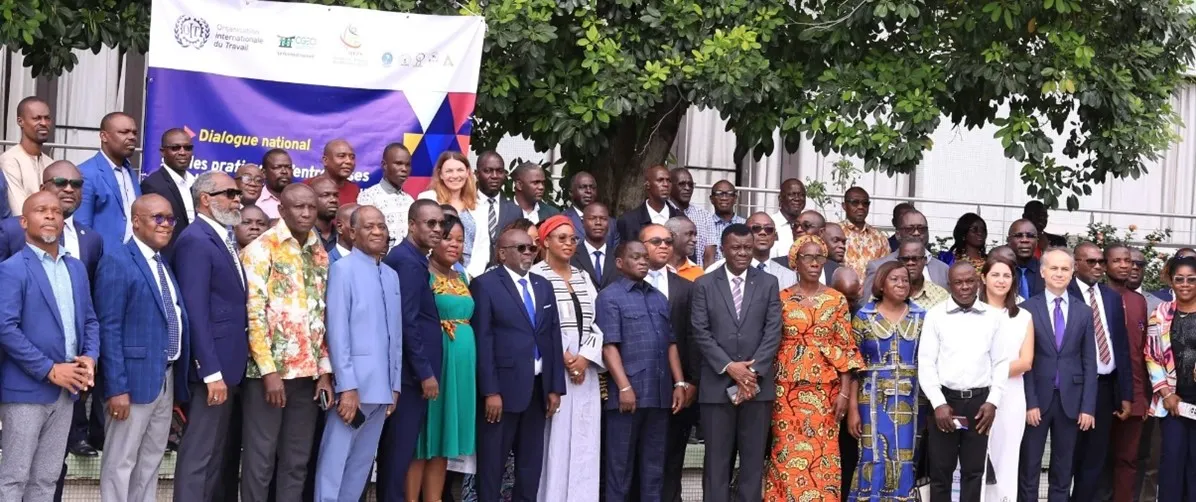
The “Trade for Decent Work” project, funded by the European Union and Finland, also formed part of the projects that supported the efforts of the national focal points from 2020 to 2025. At the request of the focal points, the project supported the conduct of a study on industrial relations and working conditions in the forestry and timber sector. The preliminary results of this study were presented during a sectoral dialogue on forestry organised in 2022. This dialogue brought together around forty sector actors, including representatives of various ministries (including the Ministry of Employment and Social Protection; Ministry of Water and Forests; Office of the Prime Minister; Ministry of Agriculture and Rural Development; Ministry of Environment and Sustainable Development), the CGECI, leaders of the five Ivorian trade union confederations, and the European Union. The dialogue made it possible to identify priorities shared by the participants and areas of collaboration in order to unlock the full potential of the sector to contribute to sustainable and inclusive growth in Côte d’Ivoire. The priority actions identified were integrated into the national action plan for the promotion of the MNE Declaration in the country. The project also supported the implementation of several follow-up actions incorporated into this action plan.
The “Trade for Decent Work” project also supported the creation and launch of the Workers’ Platform for the Promotion of the MNE Declaration in Côte d’Ivoire (PTPDEMCI) and organised training, at the request of the National Human Rights Council (CNDH), for civil society representatives on international labour standards and their promotion in the private sector, with the participation of the focal points.
Between 2023 and 2024, several capacity-building workshops were organised for various stakeholders in order to create synergies with the actions of the focal points. One workshop trained 30 labour inspectors to strengthen their knowledge of international instruments on responsible business conduct, including the MNE Declaration and its principles. A second workshop brought together 40 participants, including members of the Special Commission for the Just Transition of the National Council for Social Dialogue and the focal points, to address investments and sustainable and responsible business practices for a just transition towards an environmentally sustainable society in Côte d’Ivoire.
More recently, in December 2025, a workshop brought together representatives of the National Social Security Fund (CNPS), the Ministries of Water and Forests and of Agriculture, as well as the focal points, in order to promote dialogue on responsible business conduct in the forestry and timber sector. This dialogue made it possible to identify challenges related to the realisation of decent work, notably in the area of occupational safety and health, and the responses that could be provided through the promotion of responsible business conduct in the sector. Opportunities for synergies between the actions of the CNPS and the focal points were also identified.