

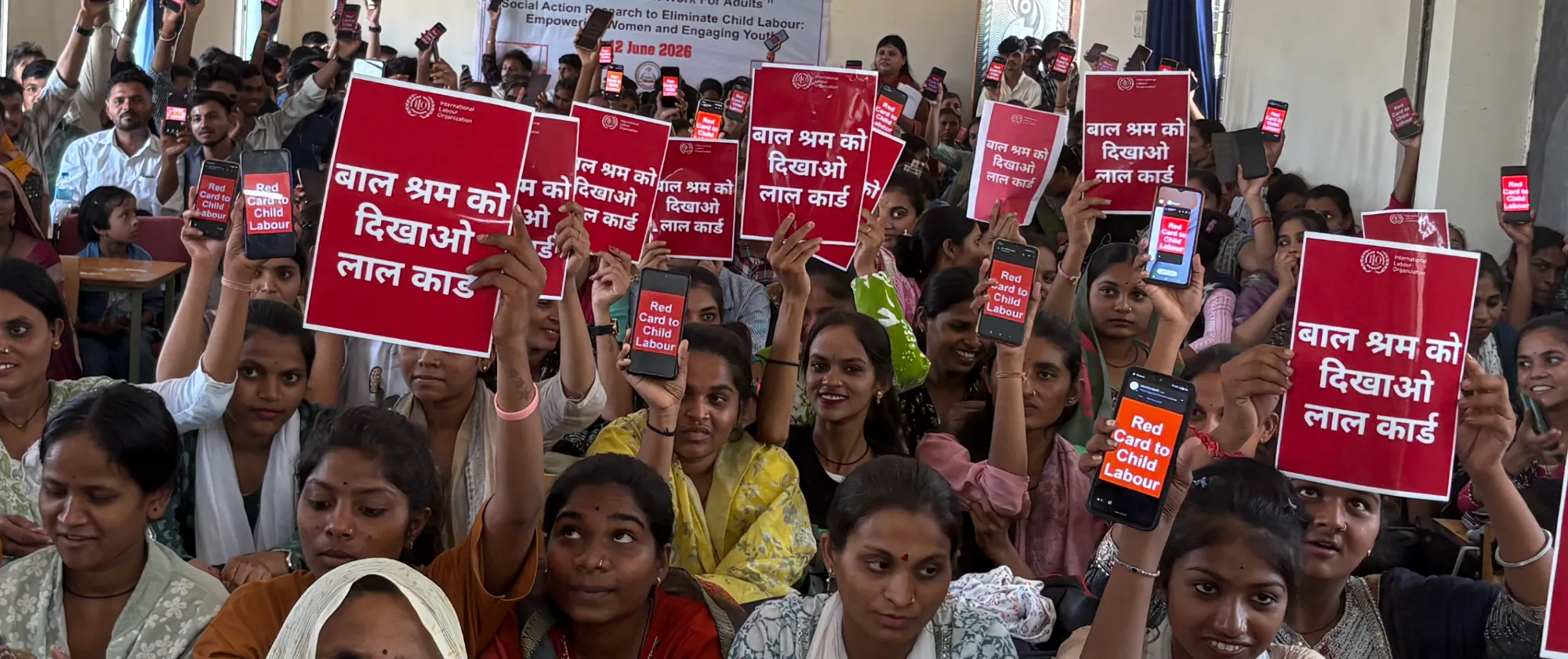
World Day Against Child Labour 2026, Madhya Pradesh, INDIA
Youth engagement takes centre stage in efforts to eliminate child labour in India
ILO-Rise for Impact project supported workshops in Madhya Pradesh mark World Day Against Child Labour 2026, highlighting the role of education, community action and youth leadership in ending child labour.
12 June 2026
The International Labour Organization (ILO), in collaboration with academic institutions, government bodies, civil society organizations and local communities, marked the World Day Against Child Labour 2026 through a series of engagements in Madhya Pradesh on 11–12 June 2026.
Bringing together students, academics, child rights advocates, women farmers and community leaders, the events promoted youth engagement, education and collective action to eliminate child labour under the global campaign theme, “Red Card to Child Labour: Fair Play for Children, Decent Work for Adults.”
The observance began with a Social Action Research (SAR) Workshop hosted by Dr B. R. Ambedkar University of Social Sciences (BRAUSS) on 11 June, followed by a community-focused dialogue at Government College, Kukshi, on 12 June. Together, the events highlighted the critical role of young people, educational institutions and local communities in advancing children's rights and addressing the root causes of child labour.
The workshop aimed to raise awareness of child labour, promote youth engagement in social action, and strengthen collaboration among stakeholders working to protect children's rights.
Addressing the event, Prof. D. K. Verma, Pro Vice-Chancellor of BRAUSS, emphasized the importance of connecting academic research with real-world social challenges.
“Research should not remain confined to academic institutions but should actively contribute to addressing social challenges,” he said, encouraging students to engage in community-based research and social action initiatives. He noted that young people have the potential to become catalysts for positive social change and community development.
The workshop was chaired by Sonam Ninaama, Member of the Madhya Pradesh Commission for Protection of Child Rights (MPCPCR), who highlighted constitutional and legal provisions related to child protection and emphasized the collective responsibility of society to safeguard the rights of every child.
Prof. Kanhaiya Ahuja, Head of the School of Economics at Devi Ahilya Vishwavidyalaya (DAVV), Indore, underscored the role of education as a powerful instrument for social transformation and called for coordinated efforts among government agencies, educational institutions and civil society organizations to address child labour.
Through interactive sessions, participants explored the challenges and consequences of child labour. The workshop highlighted the need for collective action involving governments, educational institutions, communities, and youth towards complete elimination of child labour. As a symbolic expression of solidarity, participants displayed the “Red Card to Child Labour,” reaffirming their commitment to ending child labour in all its forms.
On 12 June, a follow-up engagement took place at Government College, Kukshi, where students and faculty welcomed women members from cotton-growing communities to discuss the role of youth in promoting every child’s right to education.
Sushila Solanki, Principal of Government College, Kukshi, noted that more than 60 per cent of the college’s students are women and highlighted education as a pathway to empowerment. She called upon the students to acknowledge their role in peer group learning and help identify out-of-school children in their villages so they can be enrolled in formal education.
Rajendra Dindod, a tribal youth leader from Jhabua, emphasized the importance of community ownership and collective action in addressing child labour. He highlighted the need to strengthen smallholder farmers and producer organizations, echoing the Marrakech Global Framework for Action, which recognizes that ending child labour requires integrated responses built around quality education, decent work for adults and youth, and social dialogue.
Sharing her experience, Ramkumar Bai, a farmer and member of a farmer producer organization (FPO) in Bhimpura village, explained how participation in the producer organization, supported by the Action for Social Advancement (ASA), improved her family's income through better prices and premium payments for organic cotton.
“Before joining the FPO, I was selling cotton at a very low price,” she said. “Today, I receive a better price and an additional premium for organic cotton, and the children in my family are attending school.”
Through Social Finance initiatives and Care Cooperatives initiatives focusing on women farmers, the ILO-Rise for Impact project addresses informal care gaps like childcare, elderly care and domestic work. Supported by Industria de Diseño Textil, S.A (INDITEX), the project aims to promote Fundamental Principles and Rights at Work in Madhya Pradesh, India.
Related content

Project country page (India)
RISE for Impact: Fundamental Principles and Rights at Work in the Cotton Supply Chain – A New Phase, A New Vision (INDIA)
Relevant projects
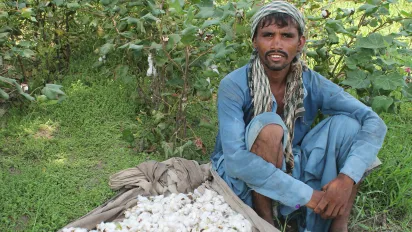
Global project page
RISE for Impact: Fundamental Principles and Rights at Work in the Cotton Supply Chain – A New Phase, A New Vision
Project country page (India)
RISE for Impact: Fundamental Principles and Rights at Work in the Cotton Supply Chain – A New Phase, A New Vision (INDIA)