Advancing social justice, promoting decent work
ILO is a specialized agency of the United Nations
English
WSIS Forum - An expanding digital economy offers opportunities for forcibly displaced youth, but challenges remain
A panel discussion organised by the ILO in the framework of the World Summit on the Information Society Forum 2023 shed light on, and convened different voices around, the multiple ways in which a digital transformation is changing how forcibly displaced youth, can access decent work in the digital economy, and the coherency and complementarity of policies and investments needed for it.
Geneva, 13 March – The spread of digital technologies is redesigning the world of work, from increasing productivity across sectors to allowing firms to tap into new labour markets through web-based or online remote work. An increasingly interconnected world of work also means that new job opportunities are made available, including in contexts of forced displacement where refugees urgently need new avenues to secure work and an income.
Yet, these digital transformations also come with closely interlinked challenges for forcibly displaced youth, where their access to the digital economy is not always incentivized, let alone facilitated by policy and regulatory frameworks and by trainings and job placement initiatives currently in place.
Today saw a panel session at the World Summit on the Information Society Forum 2023 (WSIS Forum 2023), allowing for a rich exchange around the opportunities and challenges for forcibly displaced youth in entering a growing labour market of web-based and platform work. As part of WSIS Action Line 7 on e-employment, today’s panel discussion entitled, ‘Towards decent work in the digital economy for forcibly displaced youth,’ gathered ILO and UNHCR and sector experts working on decent work issues and the digital economy. They were joined by voices of refugees and their first-hand accounts on navigating a nascent, yet rapidly growing digitally enabled world of work.
Organized by the ILO’s PROSPECTS Opportunity Fund projects -Promotion, inclusion and protection of refugees in the online gig economy and Advancing Young People’s Engagement and Meaningful Participation – both supported by the Government of the Netherlands –, and by the STRATEGIES Unit of EMPLAB Branch of the ILO, the event shed light on, and convened different voices around, the multiple ways in which a digital transformation is changing how forcibly displaced youth, can access decent work in the digital economy, and the coherency and complementarity of policies and investments needed for it.
Moderating the event was Ms Maria Prieto, ILO Employment and Future of Work Specialist, referred to recent PROSPECTS research, “While the digital economy is providing vast opportunities and transforming business models, it can also pose serious challenges and potential risks, such as decent work deficits and broader exposure to digital risks, lack of regulations, and the digital and infrastructure divide.”
The need for conducive policy, regulator and business environments
The type of technologies used and the speed at which they penetrate different sectors is changing how firms operate, including how and where they hire workers. Still, the policy and regulatory frameworks that govern web-based or platform work may not be adapting quickly or inclusively enough, amidst an otherwise rapidly expanding – and increasingly attractive – digital economy. This is despite trends that show a digital economy contributing to more than 15 per cent of global gross domestic product (GDP), with the past decade alone showing it growing at 2.5 times faster than traditional GDP (World Bank).
“Policymaking alone, even if rooted with the intention to foster employment opportunities among refugees, needs to be implemented and operationalized at different levels,” said Mr Nicholas Grisewood, Global Programme Manager of the ILO PROSPECTS. He spoke of cases where national plans, policies and strategies may be interpreted and applied in different ways at local levels, with specific regulations and norms not fully understood by local governments. “A similar situation can happen with banks and financial institutions, where refugees may have legally enshrined rights to services, but those rights are not understood across the board,” he added.
“A holistic approach is needed across the policy barriers and social barriers, not only for refugees but for everyone,” Mr Grisewood said. He added, “Governments, social partners, humanitarian organizations, communities need to work together, making the case for shared responsibility between governments workers and employers when it comes to designing, implementing and respecting policies that concern refugees.”
Adding to this was Mr Hovig Etyemezian, Head of the Innovation Service at UNHCR, who shared examples where countries may be facilitating enhanced connectivity through investments in Information and Communication Technology (ICT) infrastructure, only to have these efforts countered by regulations that, for instance, do not allow refugees to register SIM cards or access banking services in their name. ”Infrastructure access challenges are affecting both refugees and their hosting communities, even though the legal regulations that apply to each group vastly differ. Placing communities at the center and providing the means for them to solve their own problems is key,” he said.
Accessing and navigating the digital economy
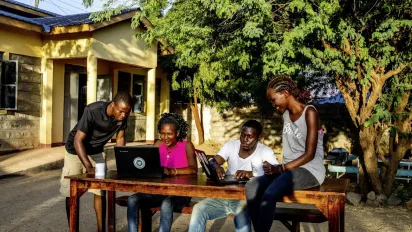
The exchange also benefited from the first-hand insights of Ms Mashimbo Rose Nafisa, a young refugee who is helping other young refugee women find their way into and navigate the income-generating opportunities afforded by the digital economy. “More skills, enhanced connectivity and improved awareness of web-based opportunities as a way to make a living are still needed,” said Ms Nafisa, a social cohesion and peacebuilding trainer with Stand for Unity and Change, a refugee-youth led organization in the Nakivale Refugee Settlement in Uganda. Ms Nafisa has benefited from a training-of-trainers scheme offered by ILO, specifically to promote social cohesion and peaceful coexistence through technical and vocational education and training, as part of work of PROSPECTS in Uganda. Similarly, she has also received training as part of the ILO/UNICEF Integrated UPSHIFT social innovation programme where young people discussed the potential of microwork in the country.
Ms Nafisa spoke of how she is helping drive change in her community, against a backdrop of recurrent challenges among young refugees in tapping the full benefits of securing work through the digital economy.
“One of the very first challenges is the lack of basic skills to navigate the virtual labour market,” she said, pointing to how keeping up with a rapidly evolving digital world of work, where specialized ICT skills are in high demand, is not only about knowing how to navigate online job applications and delivering services through web-based platforms, but it is also about a lack of availability and access to programmes and centres where these skills can be taught and acquired in the first place. According to her, these challenges are compounded by unreliable or non-existent Internet connectivity in some cases, in addition to unreliable electricity supply where many refugees live, including in camps and settlements.
What’s more, she pointed to a lack of awareness among young refugees on how the Internet can be a source of income and livelihoods, moving beyond using the Internet for entertainment or socializing purposes only.
This was echoed by Ms Iva Gumnishka, Founder and CEO, Humans in the Loop, a social enterprise providing digital remote work in the field of data annotation for artificial intelligence, who spoke on successful initiatives as those that offer comprehensive and hands-on solutions, such as coaching and intermediation to refugees and freelancers. She said, “This offers them a real opportunity to work. While these interventions are more expensive, they can ensure more effective results too.”
Moving the needle on decent digital jobs: stepping away from a piecemeal approach
While efforts to improving the inclusion of young refugees have typically focused on improving access to internet connectivity, it is important to complement these efforts with digital skills training and addressing legal impediments and administrative barriers to work in digital platforms. A piecemeal approach, however, has generated gaps, including in securing effective and sustained career pathways for refugees.
Looking ahead:
Governments, workers, digital platform operators and the international community, as well as young people themselves, need to come together and share the responsibility to create new mechanisms for the inclusion of traditionally underserved groups, all while improving protection in the digital platform economy.
It is also important that the interventions designed to support young people and communities affected by forced displacement are truly inclusive. They shall meaningfully involve displaced youth and their hosting communities together, as part of a shared effort to access jobs and develop skills for, and as part of, the digital economy.