


Workers in Malaysia enhance their understanding of responsible business conduct
Training introduces workers’ representatives to responsible business conduct and the labour pillar of Malaysia’s National Action Plan on Business and Human Rights.
20 January 2026
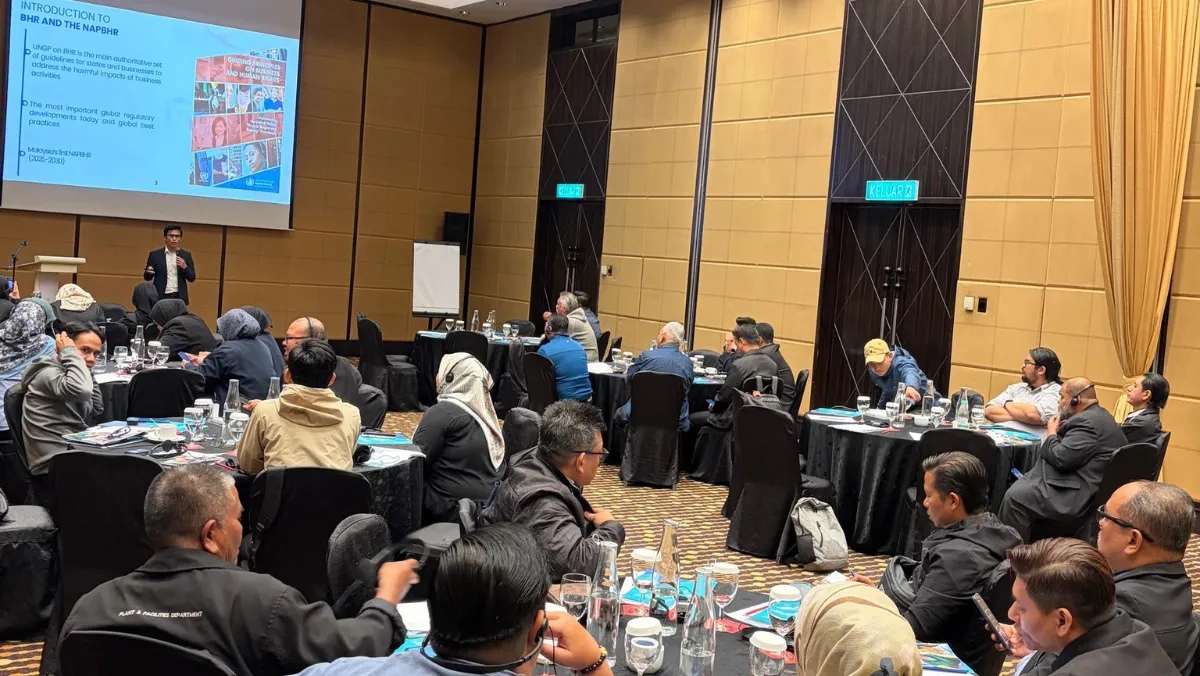
Kuala Lumpur, (LO News) - Workers’ representatives across Malaysia are better equipped to promote labour rights within business operations and supply chains following a capacity-building initiative supported by the International Labour Organization (ILO) in partnership with the Malaysian Trades Union Congress.
The workshop, held on 20 January 2026, saw forty-two trade union representatives across Malaysia gain practical knowledge of responsible business conduct and the labour dimension of Malaysia’s National Action Plan on Business and Human Rights (NAPBHR) 2025–2030. The workshop was designed to strengthening their ability to promote decent work, engage employers on labour standards and contribute to human rights due diligence processes within their sectors. Participants developed clearer strategies to integrate workers’ perspectives into company policies and supply-chain practices, helping ensure that labour rights are considered in business decision-making.
“I received a lot of new information and the explanation regarding the ILO and relevant local labour laws was clearly delivered,” said one participant.
A session led by the Ministry of Human Resources clarified national priorities under the NAPBHR’s labour pillar, including improving access to grievance mechanisms, strengthening occupational safety and health, advancing freedom of association and promoting responsible business practices. This strengthened participants’ understanding of how national policy frameworks can be used as advocacy tools at workplace and sector levels.
Through group exchanges, participants identified concrete actions to address workplace challenges and expand worker engagement in responsible business conduct. These discussions fostered peer learning and built a network of union representatives prepared to champion labour standards and social dialogue across industries.
This initiative contributes to the efforts to reinforce workers’ organizations as active partners in shaping responsible and sustainable business conduct in Malaysia. It forms part of the ILO project “Building Responsible Value Chains in Asia through the Promotion of Decent Work in Business Operations (Phase II),” funded by the Ministry of Economy, Trade and Industry (METI) of Japan, which aims to strengthen enterprise compliance with international labour standards and foster an enabling environment for responsible and sustainable business practices in Malaysia.
Relevant projects

Project
Building Responsible Value Chains in Asia through the Promotion of Decent Work in Business Operations (Phase II)