

Unlocking the Full Potential of the Social and Solidarity Economy
The United Nations Inter-Agency Task Force on Social and Solidarity Economy (UNTFSSE), presented the Secretary-General’s Report with Reflections from Member States and the SSE Stakeholders during an event at the French Permanent Mission to the United Nations attended by over 120 participants online.
15 October 2024
New York (ILO News) - This event followed the Second Committee presentation of the Secretary-General’s Report on the Social and Solidarity Economy (SSE) and provided a platform for elevating voices from Member States and the SSE stakeholders. The event emphasized the critical role of the SSE in advancing the 2030 Agenda for Sustainable Development and showcased diverse perspectives on how the SSE can drive inclusive and sustainable growth globally.
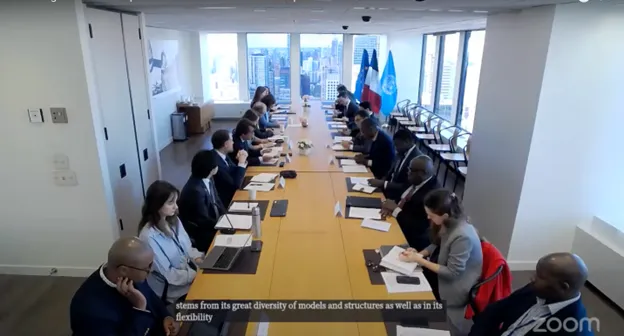
The event opened with remarks from Ms. Chantal Line Carpentier, Co-Chair of the UNTFSSE and Head of the Trade, Environment, Climate Change, and Sustainable Development Branch at UNCTAD. She set the stage by emphasizing how the SSE fosters resilience and social inclusion and formally presented the UNTFSSE, as key institutional setting to cooperate on advancing SSE, and the Secretary-General’s report, “Promoting the Social and Solidarity Economy for Sustainable Development” (A/79/351).
Following this introduction, representatives of the Resolution’s co-sponsor countries provided brief interventions regarding their commitment to the SSE. Mr. Nicolas de Rivière, Ambassador Permanent Representative of France to the UN, highlighted France’s commitment to promoting SSE at both national and international levels including by hosting this event and providing support to the UNTFSSE Secretariat. Mr. Cheikh Niang, Ambassador Permanent Representative of Senegal, stressed the SSE’s role in combating poverty and fostering inclusive economic growth in the Global South. Ms. Ana Jiménez de la Hoz, Deputy Permanent Representative of Spain to the UN, spoke about Spain’s efforts to advance the SSE through national development strategies. Mr. Claudio Garrido, Deputy Permanent Representative of Chile to the UN, shared insights on Chile’s initiatives to strengthen SSE practices for sustainable development.
This segment of the event concluded with remarks from Ms. Simel Esim, Co-Chair of the UNTFSSE and Head of the Cooperative and Social and Solidarity Economy Unit at the ILO. Ms Esim highlighted that this first UN SG report on the SSE was one of the action points of the UN GA Resolution A/RES/77/281 on advancing the social and solidarity economy for sustainable development adopted in 2023. She noted that the UN SG report highlights how the SSE contributes to the 2030 Agenda for Sustainable Development and global recovery efforts. She emphasized that the UN SG report reflects how SSE entities create jobs and provide critical services that support livelihoods, including in the rural and informal economies. She added that around the world SSE entities support food sovereignty among indigenous peoples, improve access to affordable care services, and lead green initiatives in renewable energy and waste management. She further underlined that with their bottom-up innovations, SSE entities serve as valuable partners to local and national governments.
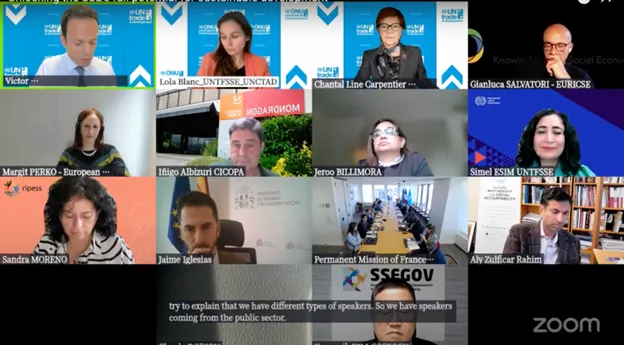
The discussion transitioned to a panel moderated by Mr. Víctor Meseguer, International Consultant on SSE at UNCTAD, which highlighted various developments on the SSE since the adoption of the Resolution in 2022. The diverse array of speakers reflected the nuanced perspectives of policy makers, researchers and activists and included:
Ms. Margit Perko, Policy Officer at the European Commission, presented the Council of the European Union recommendation on developing social economy framework conditions, a text adopted in November 2023, after the adoption of the United Nations Resolution on ‘Promoting the social and solidarity economy for sustainable development’. The Council Recommendation invites the EU’s 27 Member States to “(...) either adopt or update their social economy strategies, or integrate the social economy into relevant strategies or other policy initiatives, within 24 months of the adoption of this Recommendation”. The Council Recommendation defines the social economy and social innovation in the European Union, in line with the United Nations/ILO definition, and proposes concrete actions to promote the social and solidarity economy in key areas as: access to the labor market, social inclusion, skills, social innovation, access to public and private funding, access to markets and public procurement, state aid, taxation, social impact measurement and management, and visibility and recognition. Beyond the Council Recommendation on Social Economy, Ms. Perko also highlighted the wider European Social Economy Action Plan agenda, including the EU Social Economy Gateway, the trainings for public officials, the Youth Entrepreneurship Policy Academy, or the EU’s Industrial Strategy that identifies “proximity and social economy” as one of the fourteen industrial ecosystems to strengthen the resilience and sustainability of the EU’s economy. In fact, a transition pathways was launched to accompany the just transition of the ecosystem.
Although Mr. Sabelo Mbokazi, Head of Labour, Employment & Migration Division at the African Union, was unable to attend due to a last-minute conflict, the importance of Africa’s 10-year strategy for SSE was emphasized during the session.
Mr. Aly Z. Rahim, Global Lead on Citizen Engagement at the World Bank, discussed financial inclusion as a vital aspect of the SSE’s contribution to sustainable development, and announced the launch of CIVIC: the Civil Society and Social Innovation Alliance, which is a World Bank Group new finance and support facility for civil society organizations (CSOs), and social and solidarity economy entities.
- Mr. Young-Sik Kim, Executive Director of SSEGOV, spoke on the role of local governments in promoting the SSE across Asia, and particularly in Korea. Mr. Kim pointed out the importance of replicating and adapting to the local context existing best practices in terms of local and regional SSE public policies, and he pointed to Paris, Quebec and the Basque Country as a reference in terms of impactful policies on SSE.
- Mr. Iñigo Albizuri, President of CICOPA and Global Public Affairs at Mondragon Corporation, provided insights into the contributions of cooperatives towards development and reconstruction policies after conflicts, recalling the origins of the Mondragon Corporation Cooperative Group, that was created 16 years after the Spanish Civil War.
- Ms. Sandra Moreno, Executive Secretary of RIPESS, spoke about the SSE as a catalyst for alliances to achieve the SDGs and ensure fair transitions.
- Mr. Claude Dorion, Director General of MCE Conseils, emphasized the need for access to innovative financing mechanisms to maximize the SSE’s social and environmental impact.
- Ms. Jeroo Billimoria, One Family Foundation, stressed the potential of the SSE as a driver of social innovation.
- Mr. Gianluca Salvatori, Secretary General of EURICSE, discussed the importance of data and research in measuring the SSE’s contributions to sustainable development.
- A pre-recorded message from Ms. Ana Aguirre, President of the ICA Youth Network, emphasized the importance of youth engagement in the SSE through entrepreneurship and education.
The inspiring presentations reflected many of the key points noted in the report, including showcasing the steady progress in mainstreaming the SSE into policy processes and programmes, education and research, financial and non-financial support systems, and statistical frameworks. Both this event and the report itself, serve as a testament to the progress made but also as also a call to action for governments, UN agencies, and financial institutions to support the scaling up SSE promotion worldwide.
The event concluded with remarks from Mr. Jaime Iglesias, Spain’s Special Commissioner for Social Economy, Ms. Simel Esim, and Ms. Chantal Line Carpentier, who called for continued collaboration in promoting the SSE and implementing the report’s recommendations. This event underscored the growing momentum behind the SSE as a critical mechanism for achieving sustainable development, bringing together Member States, UN agencies, and SSE advocates to build stronger partnerships and scale the impact of the SSE globally.
Please view the full recording of the event.