

Two union federations empower their grievance personnels to effectively handle sexual harassment cases
ILO’s training programmes assist two union federations improving the services of their grievance application with the new knowledge and skills on sexual harassment related issues.
5 September 2024
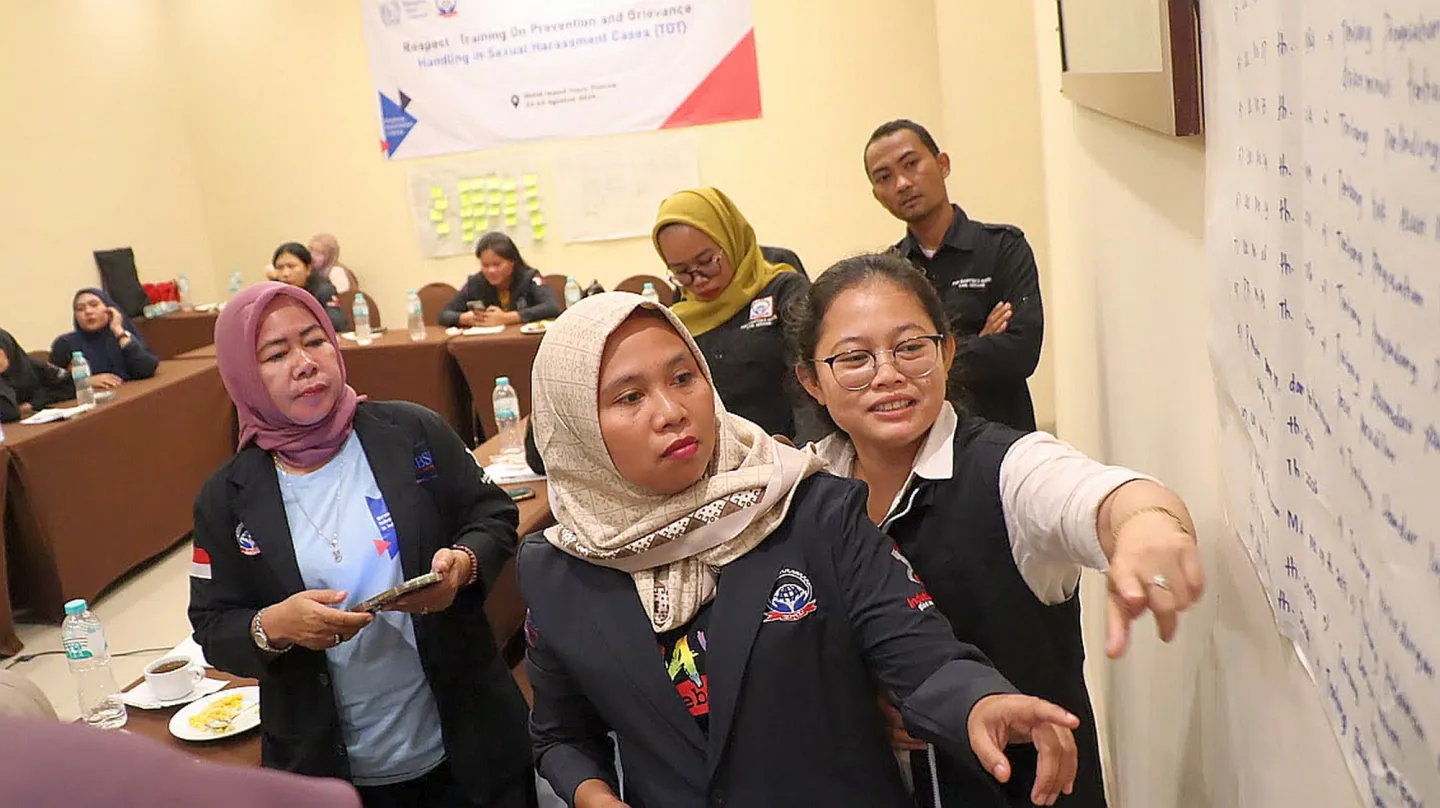
BOGOR, West Java (ILO News) - Fifty trade unionists from the National Trade Union (SPN) and the Garment and Textile Trade Union Federation (Garteks) joined a two-day training on effectively handling sexual harassment cases. The training programmes were conducted separately for each trade unions from 22-23 August for Garteks and 30-31 August for SPN.
The training programme has equipped me with knowledge and skills about types and violences and how effectively assist victims of violence by understanding their characters and how to manage their cases.
Siti Ano, a special administrator from SPN West Jakarta
The training programmes were conducted by the ILO’s Strengthening Industrial Relations in Indonesia (SIRI) project as an immediate follow-up to the implementation of the grievance application as a tool to promote harmonious industrial relations and social dialogue. Launched last May, the ILO’s SIRI project had developed an exclusive application for each federation applying and tailoring their own unique identity and specific needs named SoPaN SPN and Teman Garteks as well as one other application named Halo Siola for the Textile, Garment and Leather Trade Union Federation (FSP-TSK).
These applications are created to facilitate the flow of complaints and the submission of aspirations from the federations’ members and/or non-members. The applications are simple and easy to access and the submitted complaints or aspirations would be reviewed and verified by the union administrators who would take necessary actions including negotiation and mediation actions with the management for win-win solutions.
“The training programmes aimed to equip union administrators with knowledge and skills on how to effectively handle sexual harassment cases. These new knowledge and skills serve as a foundation for the administrators as the frontline personnel handling sexual violence complaints to follow the subsequent sessions,” said Nurus Mufidah, ILO’s Coordinator for SIRI Project.

On the first day of the training, the participants were guided to develop a shared perspective on why sexual violence occurs through materials related to gender issues, gender inequality, and the impacts of gender-based violence. They also learnt how to handle sexual violence, provide initial psychological support to victims at the early stage of receiving complaints and have a good understanding of the legal system and regulations that protect women from sexual violence.
The second day of the training focused on the rights of sexual violence victims and skills in managing sexual violence cases in the workplace. Participants learnt about effective case management and the sexual violence case handling system. Using gender perspective, knowledge and skills they gained from the training, the participants practically practiced their new skills in case handling and procedures.
These new knowledge and skills serve as a foundation for the administrators as the frontline personnel handling sexual violence complaints to follow the subsequent sessions.
Nurus Mufidah, ILO’s Coordinator for SIRI Project
The training programmes concluded with the commitment of the participants to complete the case handling procedures for sexual violence with both litigation and non-litigation steps, as well as identifying the referral services needed by victims that are available around their workplace.
“As a special administrator of SoPan application, I now know how to handle victims of violence. The training programme has equipped me with knowledge and skills about types and violences and how effectively assist victims of violence by understanding their characters and how to manage their cases,” shared Siti Ano, a special administrator from SPN West Jakarta.
Meanwhile, Ahmad Andri Wiguna, another participant from SPN, stated that the training program had opened a new window of knowledge about gender issues, the impact of gender inequality, and the legal process and regulation related to sexual harassment cases. “I am now more aware of gender-related issues and could provide better responses and feedback to the sexual harassment cases at the enterprise level.”
To date, the three applications have collectively achieved an impressive 2,608 downloads and active users, with union members submitting 189 grievances and 144 aspirations.
Related content

Strengthening Industrial Relations in Indonesia Project
Relevant projects
Strengthening Industrial Relations in Indonesia Project