

Global Accelerator
Tripartite constituents address informality in Uzbekistan’s construction sector
Government, employers and workers met to tackle informality in Uzbekistan’s construction sector and promote formal employment, occupational safety and health and social protection.
23 July 2025
TASHKENT (ILO News) — Representatives of the Government, employers and workers organizations convened on 23 July 2025 for a tripartite meeting on informality in the construction sector, organized under the United Nations’ initiative Global Accelerator on Jobs and Social Protection for Just Transitions in Uzbekistan. The meeting, hosted by the Ministry of Employment and Poverty Reduction (MEPR), provided a platform to discuss concrete measures to promote formalization, enhance occupational safety and health (OSH) and extend accident insurance coverage for construction workers.
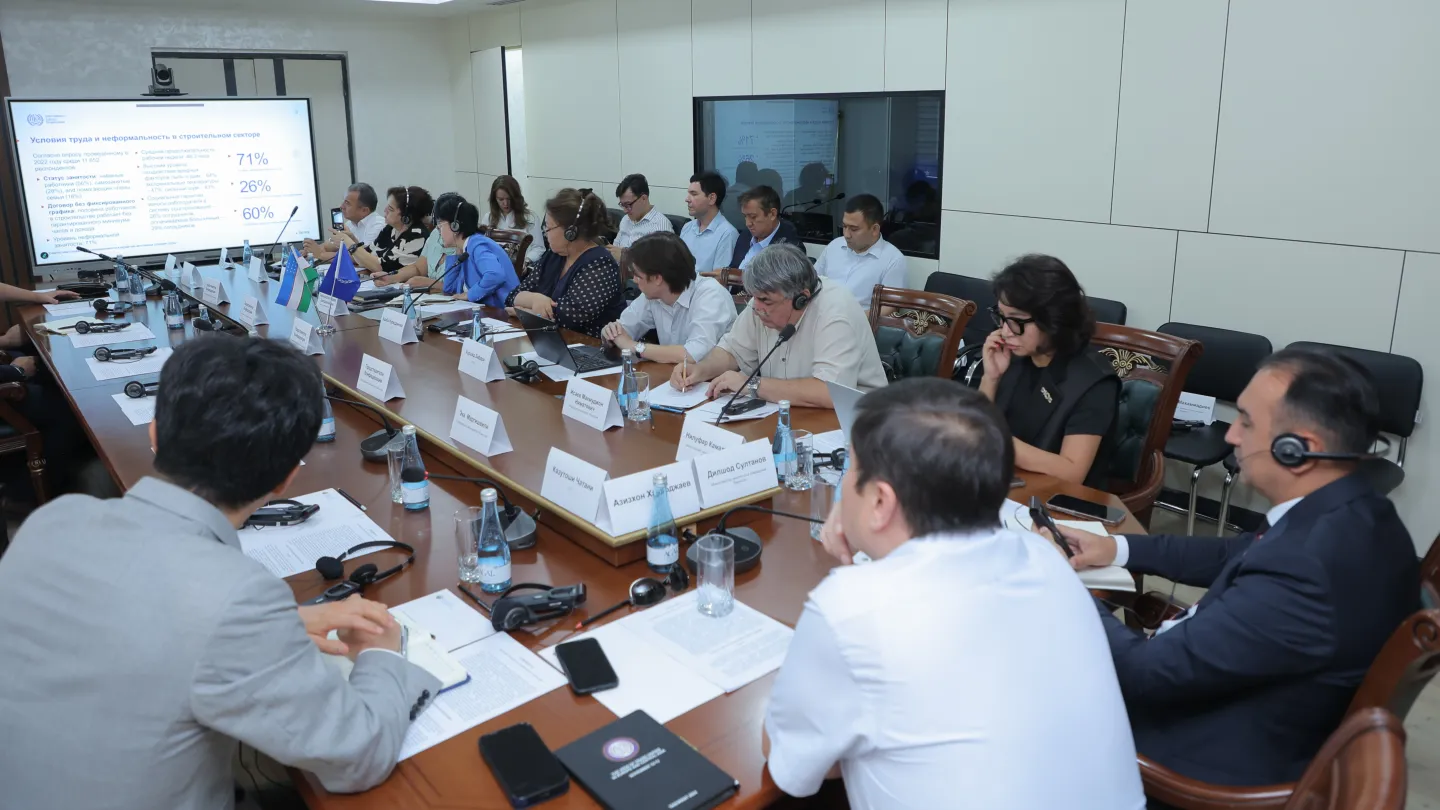
Opening the session, Dilshod Sultanov, the Head of Finance and Economics Department of the Ministry, emphasized that addressing informality in the construction sector is central to Uzbekistan’s efforts to promote decent work and inclusive economic growth. Azizkhon Khankhodjaev, International Labour Organization (ILO) National Coordinator for Uzbekistan, highlighted the persistently high levels of informality in the sector and stressed the importance of collaborative action among all partners to address this challenge effectively.
Representatives of the Federation of Trade Unions of Uzbekistan (FTUU), the Confederation of Employers of Uzbekistan (CEU) shared insights and recommendations. Nodira Gaibnazarova, the Head of the FTUU Occupational Safety Department, called for strengthening the State Inspectorate for Labour Protection and introducing anonymous feedback mechanisms to report workplace accidents. Eka Margishvili, Executive Director of the CEU, emphasized the need to better understand employers’ motivations for informality, improve coordination between contractors and subcontractors and initiate dialogue with construction companies to explore practical solutions.
ILO Senior Specialist in Workers’ Activities Gocha Aleksandria and Senior Specialist in Employers’ Activities Vlado Curovic noted that informality in construction stems from structural issues such as limited enforcement, insufficient worker awareness and administrative burdens. They emphasized the need to address both the supply and demand sides of informality and to sustain efforts over time. ILO Social Protection Specialist Pascal Annycke drew attention to the high incidence of accidents in the construction sector and underscored the need to protect both workers and employers. He noted that while insurance schemes exist, they are not comprehensive and often exclude certain worker categories. He pointed out that limited access to social protection contributes to informality and reiterated the importance of expanding coverage to promote formal employment.
Kazutoshi Chatani, ILO Senior Employment Specialist, presented the ILO’s proposal to pilot two digital solutions aimed at raising workers’ awareness on OSH and their rights, and providing accident insurance coverage. He noted that the digital tool would address the immediate issue of a large proportion of construction workers lacking accident insurance, while longer-term solutions are being developed.
The MEPR outlined forthcoming government measures to promote formalization, including strengthening the independence of labour inspectors and introducing unemployment benefits for formal workers. Sultanov also expressed interest in piloting the ILO’s proposed digital tool and accident insurance scheme at selected construction sites.
The joint programme is made possible through support from the UN Joint Sustainable Development Goals Fund, with generous contributions from the European Union and the governments of Belgium, Denmark, Germany, Ireland, Italy, Luxembourg, Monaco, the Netherlands, Norway, Poland, Portugal, the Republic of Korea, Saudi Arabia, Spain, Sweden and Switzerland. Their commitment plays a crucial role in helping countries like Uzbekistan turn ambitious SDG pledges into real, people-centred results on the ground.