

Productivity
Trinidad and Tobago’s productivity initiative gains business and wider government buy-in
Trinidad and Tobago is fostering important partnerships for the rollout of a national initiative that will support enterprises to become more productive while improving working conditions and job quality.
25 July 2026
PORT OF SPAIN, Trinidad and Tobago (ILO News) – A national initiative to help businesses improve productivity, strengthen workplace practices and create better-quality jobs is moving closer to implementation following new commitments of support from government, business and human resource organisations.
The Productivity Ecosystem for Decent Work Initiative (PEDWI) is being implemented by the Ministry of Labour, Small and Micro Enterprise Development (MLSMED) in partnership with the International Labour Organization (ILO) Decent Work Team and Office for the Caribbean.
Following a series of direct engagements between June and July 2026, the Trinidad and Tobago Chamber of Industry and Commerce, the American Chamber of Commerce of Trinidad and Tobago, the Trinidad and Tobago Manufacturers’ Association and the Human Resource Management Association of Trinidad and Tobago have confirmed their support. The Ministry of Trade, Investment and Tourism has also endorsed the initiative, strengthening cooperation around enterprise growth, local production, trade and economic diversification. The MLSMED team is scheduled to engage next with the Trade Unions and Employers Consultative Association to strengthen collaborations further.
“This initiative moves us beyond the rhetoric of talking about productivity to actioning practical improvements within our small and medium businesses. Decent work is the foundation of this collaboration, recognising that productive businesses are built on safe workplaces, respectful labour relations, skilled and engaged workers, and continuous improvements. By helping employers and workers solve challenges together, we are boosting productivity at the enterprise level while creating stronger businesses, better jobs, and a more diversified, sustainable and competitive Trinidad and Tobago.” – Sen the Hon. Leroy Baptiste, Minister of Labour, Small and Micro Enterprise Development.
Starting with priority sectors
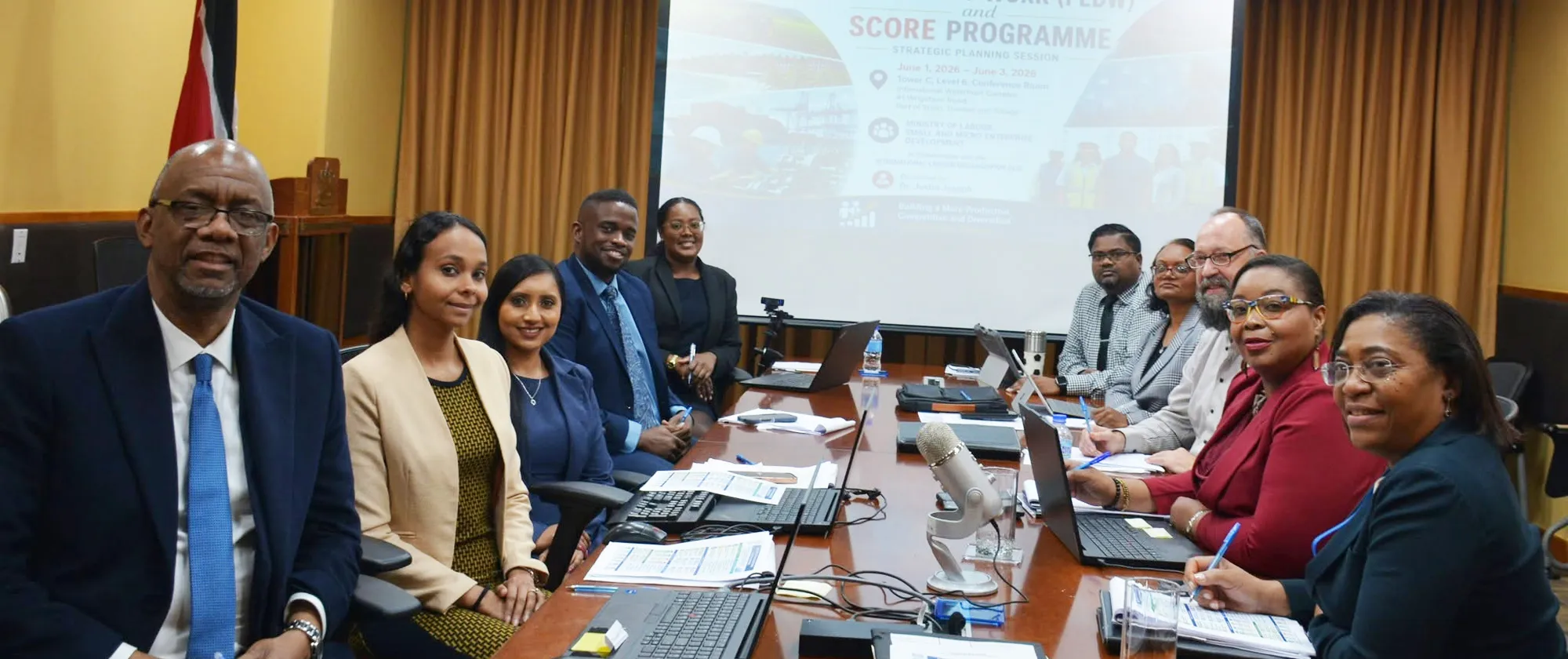
As part of decisions taken by the MLSMED during a 3-day strategic planning session supported by ILO technical specialists, the first phase of the PEDWI is expected to address productivity challenges facing small and medium-sized enterprises, with a focus on hotels and food and beverage manufacturing. These sectors were selected because of their potential to create jobs, strengthen local supply chains, increase the use of locally produced goods and contribute to wider economic growth. They also feature in the diversification plan of the Government of Trinidad and Tobago.
At the centre of the initiative is the ILO’s Sustaining Competitive and Responsible Enterprises (SCORE) programme, which is being introduced for the first time in the English-speaking Caribbean. An international SCORE expert, serving in a role equivalent to a master trainer, will help prepare and support the national trainers who will work with participating enterprises. SCORE combines practical training, workplace assessments and follow-up coaching to improve productivity and working conditions, bringing managers and workers together to identify workplace challenges and implement practical solutions.
“The SCORE approach brings managers and workers together to improve the way work is organized, strengthen workplace cooperation and address safety and productivity challenges. Experience from other countries shows that lasting improvements are more likely when workers and employers are both involved in identifying problems, introducing changes and tracking results.” John Bliek, Sustainable enterprise development and job creation Specialist, ILO.
Preparing for implementation of the Pilot
On the basis of the preparatory consultations across government and targeted discussions with business and professional organisations, the Ministry, and the ILO are now proceeding to refine the arrangements for selecting enterprises, preparing trainers, and putting in place the necessary institutional mechanisms for oversight, monitoring and evaluation of the initiative.
Businesses will be considered on criteria such as their willingness to participate, prospects for growth and job creation, links with local suppliers, export potential and commitment to decent work. The aim is to ensure that the PEDW initiative supports enterprises that are ready to make practical changes and share lessons that can benefit their respective industries and the wider economy.
The PEDW initiative is one tangible way that the ILO is partnering with Trinidad and Tobago to turn national decent work priorities into practical results. It also gives life to ILO’s global priority of placing productive employment, sustainable enterprises, social dialogue and stronger institutions at the centre of efforts to advance social justice. Through partnerships of this kind, the ILO will continue helping countries respond to changing labour markets, strengthen enterprise resilience and ensure that productivity gains contribute to better jobs and shared progress.