

Skills development
Timor-Leste takes a major step toward agroforestry advancement
The launch of the Agroforestry Sector Working Group marks a major step in uniting government institutions, development partners and stakeholders to strengthen Timor-Leste’s agroforestry sector.
1 September 2025

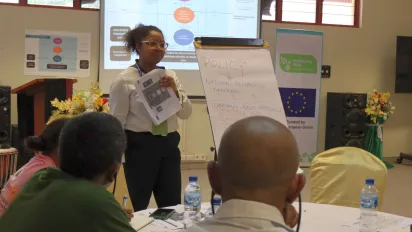
DILI, Timor-Leste (ILO News) - The Agroforestry Skills for Employment and Resilience Project, implemented by the ILO and funded by the European Union (EU), officially launched the Agroforestry Sector Working Group (ASWG) on 15 August at JL Villa Dili. Under the supervision of the National Institute for Labour Force Development (INDMO), the ASWG aims to strengthen collaboration among relevant stakeholders and guide the development of the agroforestry sector in Timor-Leste.
The ASWG serves as a dedicated platform for government institutions, development partners and key stakeholders to work collectively to identify sector priorities, design effective strategies and promote coordinated actions across the agroforestry value chain, supporting the implementation of the national Agroforestry Roadmaps.
All members of the ASWG play an important role in linking the supply and demand for skills development in the agroforestry sector.
Susana Martins, Team Leader and Communication Coordinator of the EU
In addition, the ASWG provides skills development and training opportunities for farmers, youth and local communities, equipping them with the knowledge and expertise needed to increase productivity, improve access to the labour market and contribute to sustainable national economic growth.
Arlindo da Costa, professional training curriculum specialist at INDMO expressed appreciation for the technical assistance provided by the Agroforestry Skills programme: “We are grateful to the EU and the ILO for their technical assistance, especially in our journey to accredit training centres and certificates for our graduates.”
Meanwhile, Susana Martins, Team Leader and Communication Coordinator of the EU, highlighted the significance of this initiative and emphasized the vital participation and contributions of all ASWG members in ensuring skills alignment: “All members of the ASWG play an important role in linking the supply and demand for skills development in the agroforestry sector by facilitating engagement between employers and workers, identifying specific needs for skills development and ultimately creating new employment and business opportunities.”
The ASWG must ensure that training institutions meet essential standards, including labour market intelligence, personnel qualifications, quality assurance, certification and quality control.
Lidvina Teresa Pereira Tilman, President of the the Agroforestry Sector Working Group (ASWG)
The newly elected President of the ASWG, Lidvina Teresa Pereira Tilman, expressed hope that the ASWG will support the government in addressing national challenges such as deforestation, food insecurity, climate vulnerability, the shortage of skilled workers and the lack of qualified training centers.
“As Timor-Leste faces these pressing challenges, the ASWG must ensure that training institutions meet essential standards, including labour market intelligence, personnel qualifications, quality assurance, certification and quality control,” she stated.
She added that the ASWG will work to ensure that Technical and Vocational Education and Training (TVET) in agroforestry, along with any related training programmes, are aligned with industry needs and requirements, contributing to a greener and more profitable future.
Looking ahead, the Agroforestry Skills programme aims to upgrade the ASWG into a Sector Skills Council (SSC) or Sector Advisory Committee (SAC), enabling it to take on greater responsibility for developing, delivering and assessing TVET in agroforestry.
Related content
EU Programme
Agroforestry skills for employment and resilience in Timor-Leste
Relevant projects
EU Programme
Agroforestry skills for employment and resilience in Timor-Leste