


Social protection
Timor-Leste strengthens capacity to extend social security coverage to informal economy workers
The ILO, in collaboration with its International Training Centre (ITC-Turin), supports Timor-Leste in strengthening institutional capacity to expand social security coverage and improve access to protection for informal economy workers.
13 August 2026

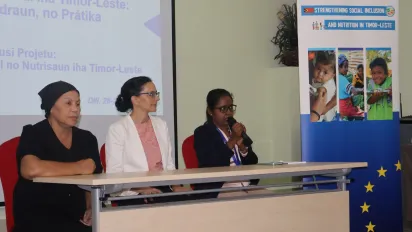
DILI, Timor-Leste – Representatives from Timor-Leste’s National Institute for Social Security (INSS), government institutions, development partners, as well as workers’ and employers’ organizations participated in the ILO’s Capacity-Building Programme on Administrative Solutions for Extending Coverage for Informal Economy Workers. Held in Dili from 3-7 August, the training programme was conducted by the ILO through the European Union-funded Strengthening Social Inclusion and Nutrition (SSIN) Project, in collaboration with the ILO’s International Training Centre (ITC-ILO) in Turin, Italy.
INSS remains committed to improving accessibility, strengthening service delivery and developing practical solutions that respond to the realities of all workers in Timor-Leste.
Zeferino da Costa Bobo, President of INSS and the Social Security Reserve Fund (FRSS)
Facilitated by experts from ITC-ILO and ILO social protection specialists, the training responded to a key national priority of ensuring that more workers can access adequate protection against social and economic risks throughout their lives. It also reflected the evolving nature of the country’s labour market, where many workers remain engaged in informal employment and face challenges in accessing contributory social security schemes.
Zeferino da Costa Bobo, President of INSS and the Social Security Reserve Fund (FRSS), highlighted the importance of ensuring that social security systems respond to the needs of all workers. “Extending social security coverage to informal economy workers is a national priority under the National Social Protection Strategy (2021-2030) and a critical step towards ensuring that no one is left behind,” he said. “INSS remains committed to improving accessibility, strengthening service delivery and developing practical solutions that respond to the realities of all workers in Timor-Leste.”
Social protection is a right, not a privilege. The European Union is committed to supporting Timor-Leste in strengthening its social protection systems.
Thorsten Bargfrede, Ambassador of the European Union to Timor-Leste
Applying the International Social Security Association (ISSA) Guidelines on Administrative Solutions for Extending Coverage, the training focused on strengthening institutional readiness and governance, as well as improving registration, contribution collection and compliance mechanisms. It also focused on enhancing citizen-centred services and outreach and developing practical solutions to reach informal economy workers and other underserved groups.
During the training, the 30 national stakeholders learned from international experiences and identified approaches that could be adapted to Timor-Leste’s context. They also strengthened their knowledge, exchanged experiences and developed practical approaches to extending coverage, contributing to stronger institutions and a more inclusive social protection system that provides greater security for workers and their families.

“Social protection is a right, not a privilege. The European Union is committed to supporting Timor-Leste in strengthening social protection systems and ensuring that vulnerable groups and informal economy workers can access the protection they deserve,” said Thorsten Bargfrede, Ambassador of the European Union to Timor-Leste.
Meanwhile, Simrin Singh, ILO Country Director for Indonesia and Timor-Leste, highlighted the need to translate policy commitments into practical action. “Most of Timor-Leste’s workforce remains in informal employment, outside the reach of adequate protection. This does not reflect the principle that social protection is a human right and a pillar of decent work. I hope that through this training programme, we can transform national priorities into concrete administrative action through coordination, knowledge-sharing and a shared commitment to ensuring that no worker is left behind,” she said.
Most of Timor-Leste’s workforce remains in informal employment, outside the reach of adequate protection. This does not reflect the principle that social protection is a human right and a pillar of decent work.
Simrin Singh, ILO Country Director for Indonesia and Timor-Leste
Related content

Project
Strengthening Social Inclusion and Nutrition in Timor-Leste
Social protection
ILO supports capacity building and social dialogue to strengthen social protection in Timor-Leste
Relevant projects
Project
Strengthening Social Inclusion and Nutrition in Timor-Leste