

Suriname tripartite partners strengthen negotiation skills in partnership with ILO Caribbean
Initiative marks substantial advancement in national commitment to green job growth.
30 October 2024
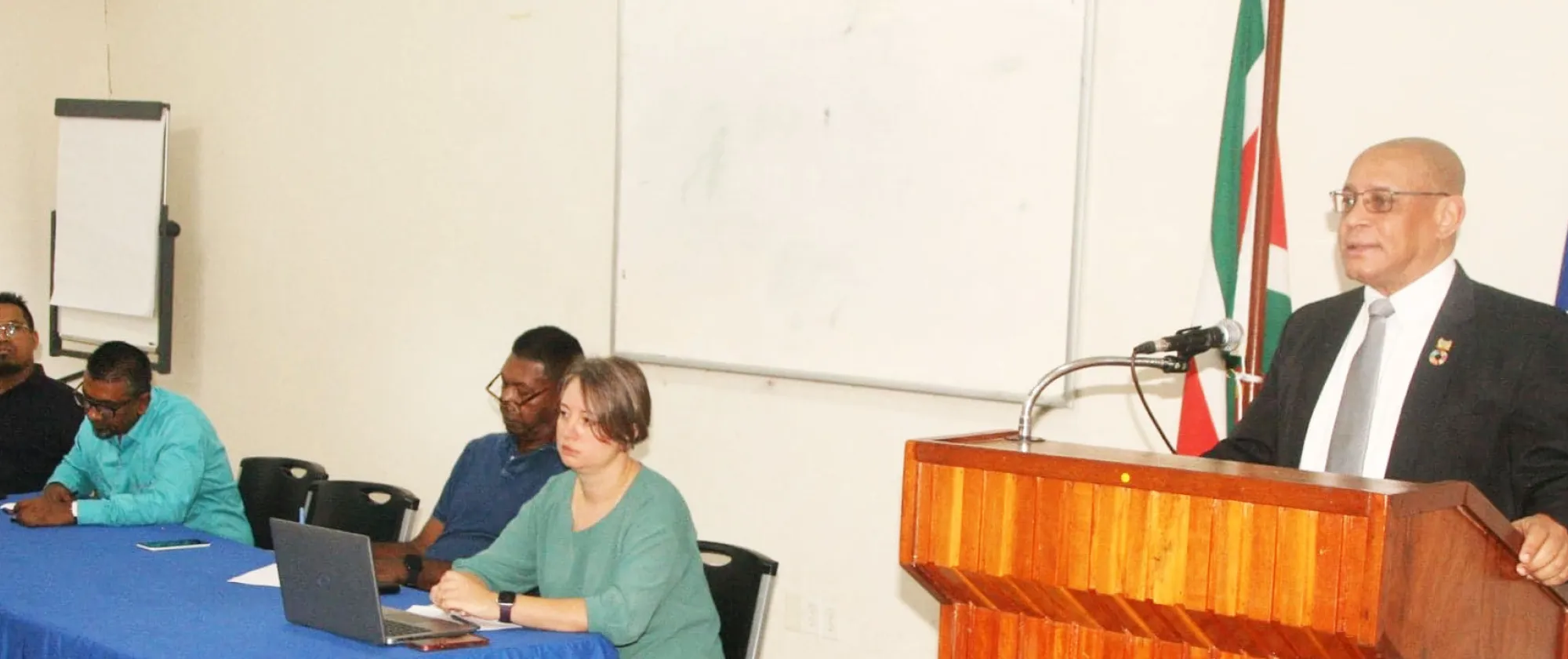
Two October 2024 workshops in Suriname, organized by the ILO Caribbean Office, provided critical platforms to strengthen social dialogue among Government, employers’ groups and trade unions so they can jointly address challenges, create inclusive labour policies, and achieve decent work.
Both events delivered as key outputs of ILO project “Environmentally focused value chain development in the economy of Suriname, fostering enterprise creation and formalization through just transition”, aligned with the current Decent Work Country Programme (DWCP) and supported the ILO’s 2024-2025 global Programme and Budget (P&B) objective to increase the effectiveness of social dialogue mechanisms.
Held from 6 to 9 October, 2024, the first workshop “Developing the Trade Union Agenda for Advancing a Just Transition Towards a Greener Future with Decent Jobs in Suriname” focused on capacity-building for trade union leaders. The session empowered union representatives to effectively participate in social dialogue, especially in contexts related to Suriname’s transition to a green economy. According to the Honourable Steven Mac Andrew, Minister of Labour, Employment and Youth Affairs, social dialogue will make it possible for all parties to get involved in the development of policy measures that are necessary for the transition to a green and formal economy. The minister indicated that there are many challenges nationwide that can only be tackled collectively. He could not emphasize enough that only through social dialogue can joint approach be developed, which must ultimately result in sustainable development.
The workshop also incorporated learning modules developed with ILO support for Suriname Labour College (SIVIS), covering social dialogue principles, negotiation skills, and strategic planning. These resources provided workers’ representatives with skills to negotiate and advocate within Suriname’s complex labour landscape, where multiple unions exist. Emphasizing coordination and strategy, the training prepared leaders to engage effectively across different sustainable development forums, increasing their capacity to influence policy decisions that promote decent employment in sectors that are transitioning to greater environmental sustainability.
"This workshop was very important and enlightening because of the just transition and formalization topics,” said Claudette Etnel, trade union representative.
The ILO Caribbean team then hosted a tripartite capacity-building workshop titled “Strengthening Social Dialogue” from 10 to 11 October 2024. The two-day session aimed to boost the ability of officials from the Government, employers’ and workers’ groups to participate in structured dialogues that support Suriname’s economic and social objectives, particularly in the context of green job growth and formalization.
The sessions included training on essential “soft skills” for social dialogue, such as trust-building and mutual-gain negotiation. Training materials, delivered in Dutch, were adapted from resources including the ITC-ILO Industrial Relations Toolkit and ILO guides on collective bargaining and tripartite dialogue. Participants also engaged in presentations, group work, and role-play exercises, enhancing their understanding of negotiation techniques.
“Through this experiential learning, Suriname’s tripartite constituents became better versed in the essential components of social dialogue and are more prepared to develop strategies for evidence-based policy formulation,” said Nancy Varela, ILO Caribbean Specialist for Social Dialogue and Labour Administration.
The workshop also supported the project’s objective to improve how ILO constituents prepare and implement just transition and formalization policies in Suriname’s value chains. Participants now have a stronger understanding of how to contribute to policy discussions with a well-rounded approach, backed by evidence-based strategies. The training reinforced Suriname’s labour administration system, promoting effective governance and expanding the social dialogue framework in line with the ILO’s measurable objectives.
Together, these workshops marked a substantial advancement in the national commitment to social dialogue and sustainable growth. They also reflect the ILO’s promotion of inclusive development through governance frameworks that prioritize social justice and economic resilience.
"There is need for more of this kind of training," said Glenn Piroe, Chair of the Suriname DWCP Monitoring Committee.
The importance to inform the public about the value and functioning of social dialogue to develop realistic expectations and participate effectively in the sustainable development of Suriname is also emphasized by Minister Mac Andrew.
SER of Curaçao shared its own experiences during the workshop, particularly the success of sound technical, substantive and administrative support. This support ensures that the social partners in an institutionalized setting are well prepared for negotiations and can participate effectively in the dialogue. The importance of closer cooperation between Dutch-speaking Caribbean countries, including Aruba, Curaçao, Sint Maarten and Suriname, and with the BES islands was stressed by SER Curacao. “By working together and sharing best practices, shared challenges in the area of labour market reforms and social inequality can be addressed more effectively”.
“By empowering trade unions and fostering collaboration across government and employer groups, the ILO is helping Suriname build a future with equitable, decent work in sectors with the potential for green growth,” said Shoblina Chotkan-Somai, ILO Caribbean Project Officer in Suriname.
More information on Suriname’s Decent Work Country Programme is available on the ILO Caribbean website.
Related content
Decent Work Country Programme, Suriname, 2023-2026